Publication
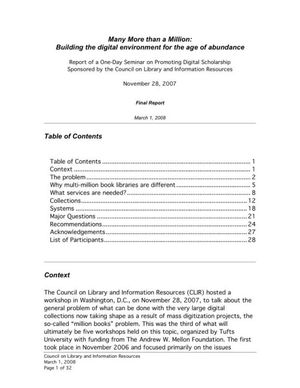
Many More than a Million: Building the digital environment for the age of abundance
About
Twenty-eight scholars in the digital humanities and representatives of the research and funding agencies met at a one-day workshop, hosted by CLIR in Washington, D.C., on November 28, 2007, to talk about the general problem of what can be done with the very large digital collections now taking shape as a result of mass digitization projects: the so-called “million books” problem. The workshop converges with CLIR’s programs in digital scholarship, cyberinfrastructure, and preservation and is part of an extended, distributed conversation on these related topics that CLIR is supporting in several venues in 2007 and 2008. The November meeting was particularly important in that it included not only humanists, librarians, and computer scientists but also representatives of the National Endowment for the Humanities (NEH), the National Science Foundation (NSF), the Institute of Museum and Library Services (IMLS), the Library of Congress, The Andrew W. Mellon Foundation, and Google, a list that illustrates the enlarged participation that digitization and computationally assisted research have created in the world of humanities scholarship.
Although the discussion focused on text collections, we considered four major questions that are largely format independent but illuminate the implications of scale:
- What is the problem? How does access to large corpora of digital materials change that problem?
- What services do scholars need?
- How do we manage digital collections when the digital material is abundant rather than selective?
- What systems or infrastructure is necessary to provide services and materials to scholars?
The rich exchanges are captured in the workshop report, which identifies five major questions to inform the next phase of our distributed conversion on the future of digital scholarship in the humanities and makes recommendations for next steps.