
pub73. Public Libraries, Communities, and Technology: Twelve Case Studies
Council on Library Resources (Nov 1996, 126 pp.)

The advisory committee overseeing the studies documented in this report looked for the following: models for emulation, examples of both large and small libraries, projects that have been implemented, programs with community impact, technologically sophisticated programs, successful or significant investments that should be highlighted, programs that encourage diversity, collaboration among libraries and community organizations, and projects that are coordinated and integrated within the overall library program. This report was supported by a grant from the W.K. Kellogg Foundation.
CLIR is interested in addressing the challenges public libraries face in an era of information revolution and the implications of these challenges for the education of the library profession. With a grant from the W.K. Kellogg Foundation, it has established a program to take a closer look at public libraries and determine the most useful avenues for developing leaders, building networks within the library and information science communities, and strengthening the dialog among the people who use and support public libraries.
Within this Kellogg program, CLIR has gathered information on public libraries that have developed particularly innovative services, that use emerging technologies to serve the local community, or that have been influential in addressing public policy for information services in their communities. In the long term, CLIR plans to use the information gathered to guide the development of programs that will enhance library leadership.
Supported by a grant from the W.K. Kellogg Foundation.
For more than 40 years the Council on Library Resources has identified library issues and developed new approaches to library operations. As a non-profit, operating foundation, the Council serves as a catalyst for programs in library leadership development, as well as the economics of information and the development of the digital library. Recently, the Council has been interested in addressing the challenges public libraries face in an era of information revolution and the implications of these challenges for the education of the library profession. At the same time, the W.K. Kellogg Foundation has taken a keen interest in the roles public libraries are playing in their communities and how public library leadership is being developed for the future. Through its Human Resources for Information Systems Management (HRISM) program, the Kellogg Foundation is developing the leaders who can build and manage the information support systems needed by society and is assisting current library leaders in transforming their institutions in response to changing societal needs. A grant to the Council on Library Resources by the Kellogg Foundation established a program to take a closer look at public libraries and determine the most useful avenues for developing leaders, building networks within the library and information science communities, and strengthening the dialogue among the people who use and support public libraries.
Within its Kellogg program, the Council is gathering information on public libraries that have developed particularly innovative services, that use emerging technologies to serve the local community, or that have been influential in addressing public policy for information services in their communities. The Council will use this information to produce publications intended to encourage and guide library directors, and to inform community leaders about the dynamic roles that public libraries and information technology can play within communities. In the longer term, the Council will use the information gathered about public libraries to guide the development of programs that will enhance library leadership.
Working with an Advisory Committee of public library directors, the Council’s staff decided that the best way to learn was through direct communication with library leaders and staff. Council President Deanna Marcum sent a letter to more than 3,000 public libraries with acquisition budgets of over $10,000 to identify innovative uses of technology, especially those applications of technology used to meet community information needs. This June 2, 1995, letter asked library directors to write a paragraph summarizing local programs. A copy of the letter follows this introduction.
The Council received 293 letters in response from public libraries in 46 states (all but Rhode Island, Tennessee, Mississippi, and Nevada). Responses came from small libraries and large libraries, state libraries and regional library networks. Rural, urban, and suburban libraries are all represented. A wide variety of community programs and means to carry them out are described. The texts of the letters are available on a World Wide Web site at the University of Michigan School of Information (http://www.si.umich.edu/CLR).
From among these letters, the Council’s Kellogg Program Advisory Committee selected 12 sites for further study and site visits. In the selection process, the Advisory Committee looked for the following: models for emulation, examples of both large and small libraries, projects that have been implemented, programs with community impact, technologically sophisticated programs, successful or significant investments that should be highlighted, programs that encourage diversity, collaboration among libraries and community organizations, and projects that are coordinated and integrated within the overall library program.
Council staff members visited the 12 libraries to gather information about library technology programs and their impact on the community. From the visits and information supplied by the libraries, Council staff have written the case studies that follow and an essay that documents commonalities among programs, challenges, and lessons learned. Through the case studies, the analysis, and subsequent publications derived from this information, the Council hopes to provide inspiration and direction to library directors and to call attention to public libraries that are serving their communities effectively.
The case studies tell only a partial story of what is taking place in public libraries. The sample is limited and by no means scientific. These 12 libraries represent a very small fraction of the thousands of public libraries in the United States that are using information technology in innovative ways. These 12 also are among the libraries that are now predicting their communities’ future information needs and planning how they might respond effectively. By eschewing a scientific sampling, the Advisory Committee paid no particular attention to the geographic distribution of sites across the country or to the particular size of libraries, even though the selected libraries represent an interesting mixture of urban and rural, large and small, city and town, individual libraries and systems.
The case studies have been prepared by the Council’s staff, and in each instance a draft narrative was sent to the library under consideration for review and comment. The opinions expressed in the case studies are those of the Council on Library Resources alone. More detailed information about the services and systems of these 12 libraries may be obtained directly from the individual library or, in most cases, from the library’s World Wide Web site. Comments or questions about this project should be directed to The Council on Library Resources, at the address noted on the inside front cover.
The Council on Library Resources is a non-profit operating foundation established in 1956 to look toward the future on behalf of libraries, address problems experienced by libraries in the aggregate, and identify innovative solutions. The Council promotes research, organizes conferences, issues publications, and manages collaborative projects to bring about significant changes in its areas of interest. It is supported by grants from other foundations, and it has recently affiliated with the Commission on Preservation and Access, an allied organization working to ensure the preservation of the published and documentary record in all formats. The Council’s current programs are in three areas important to the future of libraries: developing leadership for managing new information technologies, analyzing the economics of information services, and assisting the transition from the traditional to the digital library. The W.K. Kellogg Foundation was established in 1930 to “help people to help themselves.” As a private grantmaking organization, it provides seed money to organizations and institutions that have identified problems and designed constructive action programs aimed at solutions. Most Foundation grants are awarded in the areas of youth, leadership, philanthropy and volunteerism, community-based health services, higher education, foods systems, rural development, groundwater resources in the Great Lakes area, and economic development in Michigan. Programming priorities concentrate grants in the United States, Latin America and the Caribbean, and southern Africa.
Dramatic developments are taking place in public libraries across the country–developments that are altering how libraries deliver information and interact with communities. As the information revolution sweeps not only across the nation, but around the world, public libraries have a unique opportunity to harness new technologies to provide resources that were unimaginable a few years ago. The Internet as a communications medium and World Wide Web technology are serving as links to bring people and communities together. But technology alone is not enough. In many regions, cities, and towns, it is the public library that stands as the community’s information nexus.
With networked communications technology, libraries’ horizons have expanded, but also challenges have multiplied. The Council on Library Resources, which for more than 40 years has identified library issues and developed new approaches to library operations, is interested in addressing the challenges public libraries face in an era of information revolution. Through a grant from the W.K. Kellogg Foundation, the Council has established a program to study innovation in the use of information technology by public libraries to serve local communities. At the recommendation of the Council’s Kellogg Program Advisory Committee, the Council’s staff asked libraries to describe how they were serving their communities through technology. From the responses, the Advisory Committee selected 12 sites to study. Teams from the Council staff visited the sites; talked to directors, library staff, and users; and prepared case studies to describe how these libraries are working in and with their communities in the new era of electronic information. In this essay, Council staff present an analysis of findings in the case studies.
A case study is not a fully documented depiction of an organization. These 12 case studies represent the Council teams’ attempt to capture what they witnessed and learned on-site, supplemented by printed and Web information. The central theme in each story is the use of technology to expand and enhance the public library’s ability to serve the community’s needs. The studies illustrate how a few public libraries have articulated a vision and recruited other parts of the community to join them in providing new opportunities for the whole. These library efforts have not been without conflict or pain, and their effects are yet to be evaluated for the most part. But all began with a vision for the future.
Most importantly, we discovered that public libraries are continuing to serve important community functions, but that the future of these institutions is not assured. Many variables are at work in the public library sphere, including the uncertainties of funding, the costs of building and maintaining a digital telecommunications infrastructure, the increasing number and variety of information providers within communities, the rapidly changing nature of the technology itself, and the need for training library staffs and the public they serve. Quite fittingly, the final years of the twentieth century represent endings and beginnings for public libraries. The future of public libraries as we know them today cannot be assumed, for the roles they will play in the next millennium are not yet known. Moreover, these roles may take a variety of shapes and sizes–some of which have begun to evolve from the familiar past, and others of which have yet to be revealed.
In traveling to these libraries, we learned that there are no universal solutions for using information technology to serve communities or to provide greater public access to information. One common denominator, however, did emerge: The most vibrant public libraries look to the community at large to determine appropriate goals and objectives, and to partnerships with individuals and organizations in the community to carry out the objectives. There are other common components. In each example, these libraries have leadership with vision, common values about open and equitable access to information, funding (in relative terms) to create a new environment using information technologies, and community-centered strategies for making a transition into the increasingly digital information world.
Beyond these fundamental conditions and values, the libraries show a wide range of responses to the challenge of how to use technology innovatively and effectively. Each of the 12 libraries has its own story to tell, and the 12 stories are as different as the communities they serve. But innovation in the use of technology, we found, is a relative term. These case studies feature a sampling of innovative electronic services in public libraries in early 1996. If these studies are taken as a barometer of innovation in service, public libraries are only beginning to take advantage of the range of capabilities of networked information technology.
Serving the local community has been the focus of the mission of the public library for years. As long as basic financial support is local, this focus on local needs will continue to drive public library services. How libraries determine local needs and how they respond to those needs varies widely.
The libraries we studied are located in communities that range from 15,000 to 2.5 million people. Common to all is a commitment by the library to the local community, not simply as an organization that provides information, but as a cultural and educational center. We heard what library staff and management said about their technological initiatives, but what we saw was far broader in scope. They are transforming their institutions to meet the needs of the future while keeping themselves grounded in traditional community library services and practices. In all cases, management and staff have positioned these libraries as important community centers. They have seen an opportunity to use technology to provide services to members of the community in new ways, even through it has meant substantial investments in computers and telecommunications infrastructure, software and electronic publications, and training initiatives. Library services in these cases are offered based on an assessment of community need–whether the assessment was documented through a strategic planning process or less formal means of discovery. Understanding community and translating community needs into objectives for library service have placed some of the libraries in a strategic position of readiness to take advantage of funding opportunities as they come along. These planning efforts have been meaningful for institutions large and small, with or without the development staffs or administrative infrastructure to seek and manage large grant-funded projects. We observed that libraries’ knowledge of the community and proactive planning efforts helped to ready them to use technology to reach new and larger audiences, and to address community needs by serving these audiences in new ways.
Public libraries became ubiquitous features of the North American landscape when Andrew Carnegie donated money to thousands of communities for the construction of library buildings in the last years of the nineteenth century and the first 15 years of the twentieth century. The deal he struck required local governments to cover the cost of books and staff. Carnegie believed access to books and education would provide opportunities for motivated workers to improve their minds, and in the process, their economic conditions.
What would be a comparable contribution to American people today? If Carnegie were alive, would he connect every home to the Information Superhighway? Would he fund one virtual library, which the nation could access through the Internet and the World Wide Web? Would he invest in community-based information networks or Free-nets? Or, would he equip libraries to provide electronic information from inside or outside the library, wiring the old Carnegie library buildings for tomorrow’s technology? Would he build new branch library buildings to serve expanding urban and suburban populations? These questions are not fanciful but are aimed at the very heart of the question about the role of the public library. Is it a place where information resides or a conduit for information, or both?
The public library has been, and continues to be, both of these things and more. The debate about roles is important, however, because municipal or other local funding for public libraries is not likely to increase, at least, not in the current political and economic climate. More and more, public libraries must make difficult choices or seek external funds to pay for new programs. And the financial requirements for connecting community members to the Information Superhighway are immense. As they seek resources, library leaders are finding themselves in new and unprecedented relationships with public and private funding agencies of all kinds. Public library administrators have to make a clear and direct case for their institutions, and they must take the lead in articulating a vision of what the public library can mean to a community in the twenty-first century.
The libraries highlighted in the case studies are doing just that. The leaders of these 12 possess vision and know how to articulate it: Once articulated, the vision is implemented and refined by the entire staff, community leaders and supporters, volunteers, and institutional partners.
One great advantage of public libraries is their neutrality within communities. They are public spaces that offer a place to learn on one’s own about any subject and without review by an authority figure. The library staff need not be consulted or involved in the pursuit of knowledge unless the patron wishes. Carnegie referred to the public library as the “people’s university,” and this conceptualization of the institution has continued in the public’s mind over the years. The collections in libraries allow for anonymous and unfettered inquiries into all subjects, and unlike a school, the public library has no predetermined curriculum or pedagogy. Individual curiosity and time are the only limitations on the knowledge that can be acquired. The neutral space has another advantage: It is available to individuals of all socioeconomic groups and all ages. The no-questions-asked policy makes it possible for anyone in the community to take advantage of the library’s services. The success of some library-centered community development projects we saw was attributed in part to the neutral and accessible position of the library within the community. The principle of open access for all to information has remained a steadfast conviction in the 12 libraries we visited as in thousands of public libraries around the country, even when that ideal is tempered somewhat by community standards and budget. For the most part, all library services in these sites have been offered without charge to members of the community, but in those few instances when charges have been levied, the services have been offered equitably to one and all. This attribute has distinguished public library service in the United States for the last 100 years. We observed library managers and staff within the 12 libraries working vigorously to perpetuate library traditions of free and equitable access to information within the electronic environment, even though the actual costs of information and access are not readily apparent to the public and have never been “free.”
For decades, public libraries have played a wide variety of roles within their communities, but the availability of electronic information and interactive communications technologies has enabled them to take on more and increasingly complex roles. Public libraries assume roles that make sense for the local communities. For example, across the nation libraries function as independent learning centers, popular materials centers, community information centers, preschoolers’ door to learning, research centers, cultural centers, and homework centers for youth. Libraries participating in the evolution to new forms of service through technology point out that much of the public has not understood the number or variety of roles the library has played in the past, and they point with some frustration to the number of new roles they should and could take on in the digital age if adequate resources were available. Library leaders are concerned, generally, that the expectations of the community for libraries and their own expectations for these institutions are greater than the resources will accommodate. In some places, librarians have expressed concern that digital library initiatives are usurping disproportionate resources when compared to the full range of services the library provides. Other librarians have cast such concerns aside and embrace the future that the digital world seems to be promising.
Although librarians talk a great deal about the new services they are providing, it may be that so far they are taking advantage of technology to enlarge and improve traditional services or to customize services that previously had been more generic. In delivering these new or enhanced services, are libraries playing new or significantly changed roles within their communities? For example, in sites we visited libraries have served as catalysts in community development, problem solvers for community organizations, or coordinators of community information delivery. In some communities these roles would be described as merely new names or extensions of what they have been doing all along. With electronic information and a community telecommunications infrastructure, there are many possibilities. It remains to be seen whether totally new roles for the public library will evolve as the technology evolves. The more important evolution may be library leadership’s own broadening vision of the potential roles libraries might play within their communities. At any rate, from our site visits we learned that technology is enabling libraries to take on roles and carry out tasks in ways that are more visible to the public and that the librarians themselves believe will be more effective.
Although libraries for many years have joined with other libraries to increase the efficiency and decrease the cost of information delivery, public libraries have turned to new types of partnerships to help broaden their resource base and reach more deeply into the community. What is changing is that these libraries are forging alliances and partnerships with organizations many of which have not, until now, been central to the workings of public libraries. Further, these partnerships involve organizations on an operational level in relationships that are more complex and often more mutually beneficial than that of funder and grantee. Such partnerships are making new and enhanced services a reality. Libraries are collaborating with telecommunications and corporate partners, new types of libraries, community organizations and agencies, schools, and others to provide new services, increase public access to information, and create community-based information resources. The collaborations have helped libraries establish new constituencies and build wider support (and even, in some cases, broaden and diversify the sources of funding). The challenge is to find partners who share the vision and who have the resources to invest in that vision.
The case study partnerships have been dynamic and varied–as varied as the libraries’ sizes and locales. In sites we visited, these alliances among libraries at regional or state levels have been and are increasingly important to the local library because the cooperative networking, training, and purchasing projects of these alliances are making information technology more affordable on the local level. On our visits we have seen public libraries join forces with their local telephone companies or cable television providers to take advantage of fiber optic network installation. Others have looked to nearby universities and colleges for technical expertise and networking experience. Libraries have benefited from alliances with local school systems, administrations, or individual schools. In one example, the public library has put together an alliance that includes a publicly owned utility company, the mayor’s office, a local university, and the community chamber of commerce. One urban area has reaped particular benefits from a partnership with a large bank and other corporate sponsors; a rural library received its first computer terminal as a donation from the local bank. Two libraries have partnerships with commercial information system developers to work collaboratively in the development of new or enhanced products for libraries. The point is that the partnerships–in whatever form they take–have proven to be advantageous for those public libraries that have pursued them with vigor and diligence and with a certain creative imagination.
Some librarians, not accustomed to forging alliances, particularly with the corporate sector, have expressed concerns about demands that might be placed on them by the new partnerships. Most, however, have embraced the new alliances with enthusiasm and the hope that the partnerships will increase opportunities and programs. Partnerships generally require more work than anyone ever forecasts or readily acknowledges. But in looking to the future, public library leadership has identified partnerships as a way, despite all the uncertainties and risks, to make their vision of the future possible.
Providing information to meet the needs of community members is not new, but libraries are working in less-familiar territory as they collaborate with a range of organizations to develop a network of information from many different information providers. Although public libraries have gathered and made available information about their local communities, the public was little aware of this activity until the advent of community-based information systems delivered in electronic form. In addition to simply gathering information, many public librarians see themselves as adding value to this information. Many are applying traditional library approaches to adding value and information in electronic form. Some of the libraries have organized or indexed the information created by other organizations to make it more useful, and made it accessible as a logical component of the local library system. A few have customized these resources by linking to them from logical places on their homepages on the World Wide Web. Many of the sites have carefully selected electronic resources that correspond to the interests and needs of the various segments of the community. Other libraries have geared their efforts not only toward increasing public access to this information, but toward making sure that the underrepresented and the underprivileged in their communities have the means to access it as well. In most cases, however, the electronic services provided mirror the services libraries have long provided. But more needs to be done to take advantage of the interactive capabilities of the technology that will enhance communication and facilitate problem-solving with and among segments of the community.
Libraries are accomplishing their community-based goals in many different ways. In some instances, the library system and the community-based information system (community network or Free-net) are not directly connected. Although they may serve related or overlapping missions, they may be financed and managed as separate organizations. This may reflect some libraries placing a higher value on retaining autonomy than on taking the risks involved with nurturing creative partnerships. In some libraries the concern is expressed differently: They regard alliances with community networks as a kind of social service that should remain outside their realm.
Thus, not every library has viewed its future as tied to the fortunes of the local community network or Free-net. But in many places, the public library has extended the definition of itself as an information provider and has assumed a new role by adding a community-based information network or Free-net to its palette of services. There is no single answer. What has worked in some communities may not work in others. The range of types of alliances formed to provide community information are as varied as the communities they serve, and the role of the public library within each alliance varies with the style and capacity for leadership within the library.
In every library we visited, and from conversations with many other public librarians, one of the concerns voiced most frequently is that the staff expertise needed to play a leadership role in the digital environment is not readily found among existing staff. Public libraries we visited have hired technical experts to join the staff, on occasion without a background in library and information science. Some public libraries have encouraged current staff to develop technical skills and leadership expertise; others still, in a few instances, have promoted technically proficient staff into key areas of information systems management.
All of the libraries cited the need to invest much more heavily in staff training. Practically every person on the staff of today’s public libraries needs to know more about computers, electronic resources, and working on teams, and many will need to learn about fund-raising. Although part of the necessary learning must be achieved by individual effort, the libraries recognize that they have an obligation to equip staff to work in a different kind of environment: one that fosters communication among staff at all levels, takes advantage of technology, and uses staff skills in different ways. Some libraries also have recognized that their technical experts could benefit from some training in traditional library functions and activities. The difficulty is that training budgets in public libraries have been, traditionally, very small. The need to retool the current staff is huge in comparison to the funds that can be obligated readily to this purpose. Nevertheless, these libraries are doing what they can to facilitate training, even if that means informal tutorials and exchanges of information among staff. Training is a priority in public libraries, but it may be among the hardest activities to fund, perhaps because of the difficulty of documenting and articulating in layperson’s terms its direct impact on the services received by the public.
Since many public libraries are already stretching to acquire hardware, software, and connections, as well as information in electronic form, they are not readily finding the resources to support comprehensive training. As public libraries become more familiar with technology and its uses, and as they expand their partnerships in the community, training possibilities may more easily present themselves and may be the outcome of new, innovative alliances. Nevertheless, library leaders need to be able to articulate effectively the need for training and to implement effective training strategies.
Opinions differ, even within the library community itself, about the need for building or expanding libraries in expensive urban real estate zones, especially as the availability of networked information expands rapidly. Library staff who see community members seeking human contact in a safe, warm place and who provide desperately needed services for the community’s children see clearly a need for physical library space. They despair when technology enthusiasts speak glowingly of virtual libraries and the development of virtual communities through the Internet as an alternative. If money were not an issue, both the virtual and the physical community centers could be fully developed, staffed, maintained, and promoted.
The case study libraries are both virtual libraries and community centers. They support the philosophy that to serve communities effectively today, public libraries must be both, despite the resulting strain on resources. Building and maintaining adequate physical space to carry out library services is an important issue: Of the 12, four libraries have completed recent significant main library renovations, four others have constructed (or will construct shortly) new central library facilities, and two will go to voters this year with bond referenda for new main library buildings. In addition, three of these public libraries are building new branches to serve growing suburban or neighborhood populations. Library administrators’ ongoing concerns for sufficient, attractive, and well-maintained facilities are exacerbated by the need to wire buildings for network connections and reorganize space for delivery of electronic information. At every site, technology has required some form of refurbishing and rearranging space.
Many libraries have established public computer laboratories in their main buildings to provide access to the Internet for all–including those without the physical means of connecting to the library from home or office. Each of these libraries is committed to providing equitable access to electronic information from all library facilities including branches, but extending the full range of electronic services to branches is a steep financial and technical hurdle for multi-site library systems. These public libraries provide or have plans to provide electronic information to people who cannot visit a library building through dial-in or Internet connections. Not everyone has the means to connect to the libraries’ electronic services or visit a library facility. As a result, some libraries are creating partnerships with social service and other agencies and to install networked computers in shelters, senior citizen centers, half-way houses, recreation centers for youth, and bus terminals. Even in an era of increasing availability of networked electronic information, libraries must still confront the problems of space, buildings, and physical public access to ensure that the gateways to that electronic information are open to all.
In an environment in which technology offers hope for helping society to improve itself, it is understandable that library leaders would look to technology to make their institutions more relevant to the communities they serve. There is a fortuitous confluence between the services libraries in fact have offered to their communities and the opportunities offered by electronic information and new forms of delivery. Several of the libraries we visited have crafted programs that use technology to solve the most difficult problems of the community, such as literacy programs that are based on developing computer skills while learning to read or to communicate in English. Other libraries have developed special resources for the business community, recognizing that the equipment installed for that purpose will also be useful to others for many different purposes.
There is a difficulty, however, in that the public libraries’ most well known and appreciated features have little to do with technology. When asked to comment about the value of the public library in the community, most respondents to opinion surveys and polls, including a recent survey1 and focus group conducted by the Benton Foundation for the Kellogg Foundation HRISM program, remark that the public library is the place where all citizens, without charge, can gain access to information, find recreational literature, or gather materials for children’s homework. But, there appears to be a mismatch between the mission of the library that is known and loved by the community at large and the vision of those who know about the potential of the library to serve vital needs of the local community.
Public libraries in North America are much admired by local citizens and are considered useful educational agencies and important for their services to children. The public opinion polls have confirmed this fact. These warm feelings about public libraries are found even among that segment of the population that does not generally use the public library. And this good will is also a fundamental weakness. People think of the public library as a good place for children, but they do not think in terms of the financial investment required to make the public library an important information resource in the community. Nor is the public library thought about as a leader in information policy.
The best public libraries–and these include the 12 we visited–understand that digital technology has the power to create a new or more highly evolved kind of community agency. The case studies offered here give insights into how a dozen library directors and their staffs have recognized that technology, properly applied, can strengthen and enhance a community by drawing in individuals and organizations who have not been part of the library’s family in the past. Personality and style differences of library leadership, the traditions and history of the institutions, and the make-up of the communities they serve are important factors, but the common elements among these library innovators are: community-centered strategies for library service, leadership with a vision of information technology serving the community, the ability to articulate this vision convincingly, and a belief that access to information is a fundamental right in a democratic society.
1Buildings, Books, and Bytes: Libraries and Communities in the Digital Age. A report on the public’s opinion of library leaders’ visions for the future. Prepared by the Benton Foundation. Funded by the W.K. Kellogg Foundation. [Washington, D.C.] November, 1996.
The Brooklyn Public Library is a cultural icon. For decades, it has stood as a symbol for bridging cultures, races, and age groups. The library teems with a diverse mix of people seeking business information, leads on securing the next job, educational computer games, an adult literacy class, or just a warm, friendly place to sit and talk with others.
A community of 2,300,664 residents, Brooklyn is the most populous of New York City’s five boroughs. It is a culturally diverse community where more than 90 languages are spoken. Increasingly, it is a borough of immigrants; 29 percent of the population is foreign born. Some 40 percent speak a language other than English at home, and for 18 percent that language is Spanish. Close to a million people are bilingual or non-English speaking. Some 64 percent of the individuals 25 years and older are high school graduates; nearly 17 percent are college graduates. The median family income is $30,033, with 514,163 persons living below the poverty level.1
Brooklyn Library managers view their institution as a traditional public library and describe their mission as supporting the public’s information, recreation, and hobby needs. Within this environment, CDs, videos and CD-ROMs circulate, cookbook collections grow, and a carefully stocked and visually appealing job information center is always busy. Staff members report especially high use among senior citizens and children. The library reflects the diversity of the population by purchasing collection materials in 60 languages. The system provides services at a main library, 58 branches, and a special business library. Also, Brooklyn is the only system in New York City that operates a bookmobile. In 1994, the library collection included 4,655,894 items, the library circulated 9,494,209 items, and staff answered 6,796,946 reference questions. In 1994, the library received support of $21.23 per capita. The library is unusual in that it is a private nonprofit corporation, an independent organization within the city. According to the library director, this means that there is no higher body to blame. The library must solve its own problems and establish and administer its own policies.
Although the library has been less aggressive than some other public libraries in adopting new technology, there have been some notable technical accomplishments:
Managers are committed to the concept of library buildings as important places for their public. A recent survey by the library showed that customers value the space as well. Warm in winter and cool in summer, library buildings supply a welcome haven for the many people of Brooklyn who live in close quarters. Branches throughout the system serve large numbers of school-age children after school because their parents have come to trust the library as a safe place.
The new library director, Martin Gomez, expresses his desire for the library to take a leadership role within Brooklyn but more specifically to exploit the potential of information technology to bring people together to solve community problems. The board recognizes that virtual community can be as powerful as physical community. “Automation is our number one priority,” the director says. “We have to promote the theme of using information technology for the benefit of the public.” This message is often repeated to City Council members, foundations, local businesses, and the library board. Many library managers and employees in public service positions talk about his philosophy with open appreciation. They express willingness to take on the challenges of the information technologies they have seen and heard so much about. Many express support, almost relief, that the director has lifted automation to the highest priority. Articulating widely and often the need for developing an automation infrastructure paid off recently. The library has secured $2 million from the borough president and $1.5 million from the City Council to complete a system upgrade in fiscal years 1997 and 1998.
The staff indicates that until the arrival of Gomez in September 1995, the Brooklyn Public Library had been somewhat slow to implement automated library services. Technology had been introduced in small steps that could be taken without broad-based administrative support or technical infrastructure; several small-scale projects were initiated within a single department or building. A few staff members noted, however, that being behind the curve of cutting-edge technology has the advantage of allowing the library to learn from others’ experience. For example, learning from libraries in other boroughs, Brooklyn will choose to configure workstations with a different complement of services for different places or purposes, rather than expecting a single model of workstation to do everything.
Thanks to an active fund-raising program, the library has received several small grants to enable, among other things, the building of a local area network for the main library, purchase of software and equipment for the three literacy “Learning Centers,” and installation of a local area network for the business library. Recent grants have enabled the business library to offer a focused collection of print and electronic resources for small businesses and to make reference service available by an 800 number to New York state residents beyond the local telephone dialing area.
Because efforts to automate have largely been made piecemeal by individual initiative, the library has developed several independent systems. Over the past few years, the library has created a bibliographic database in electronic form and is using an online circulation system throughout the library system. Currently, the library’s public access catalog is pressed on CD-ROM disks and made available at public workstations through a Bibliofile system. The library is now poised to take the next step of providing an integrated online catalog system at all library buildings.
The library staff has begun to experiment with Internet access for reference and professional use, and the main library local area network will soon be upgraded to allow the public to gain access to the Internet. A special grant from the Microsoft Corporation and the Public Library Association’s Libraries Online! program has enabled the library to offer public access to the Internet at terminals in the Flatbush branch. In its plans for other branches, the library will emphasize the equitable spread of technology, providing a few workstations in as many of its branches as possible rather than concentrating resources in a few branches at a time.
Library managers believe it is important to add value to the information they provide by teaching people not only how to find it but also how to use it. The library’s current emphasis on developing technology supports one of the library’s highest priorities–serving learners. At the turn of the twentieth century, the Brooklyn Public Library was well known for its in-house English classes for immigrants. Today, literacy efforts continue to flourish at the Brooklyn Public Library at least in part because the library offers resources and instruction with no value judgments. Some 700 students are now enrolled in adult literacy instruction that has evolved from a phonics-based, one-on-one tutoring program to group methods that rely heavily upon computer technology. Students develop basic reading, writing, problem solving, and critical-thinking skills by using the same word processing, database, or spreadsheet software that they might find in a work setting. Students may sign up to use the literacy computer center any time, seven days a week. Within a more specialized family literacy program, adult learners find out how to select children’s books and use interactive reading strategies to share these books with their children. Using this approach, adult learners become the conveyors of reading and learning for their children.
The literacy classes are supported by New York City rather than by library funds. The literacy program operates within the Library’s Program Development Office, managed by veteran librarian Susan O’Connor, who says, “The library really supports education.” Listening to O’Connor speak, one begins to understand how a variety of public library services to learners of all ages have benefited from the library’s highly developed experience with innovative educational methods and computer technology that enables learners.
Another learning program, the Kids Connection, is an ongoing, after-school public library program for children. Science and career-related interactive video laser disc programs are being placed in branches where librarians are willing to try something new to provide more effective learning experiences for the large after-school student population. The librarians believe that children enjoy learning, and they are determined to place interesting and visually attractive educational materials in children’s hands. Within the library’s Education and Job Information Center a series of stand-alone terminals offers access to numerous job and career databases and related online or CD-ROM resources. Seeing people waiting patiently to be the next to use one or another database underlined how useful a networked approach to delivering the tools would be within the center, throughout the library’s facilities, and beyond.
Library management recognizes that technology will not be as effective as it should be unless there is a plan for utilizing it. Individual efforts have been useful, but they need to be replaced by a system-wide effort. In order to ensure that library-wide goals for technology are addressed and that a higher level of technology integration is achieved, an office of library systems integration has been established. The director of this office, Mary Beth Beidl, describes the automation strategy as having two phases. Phase one is implementing access to a central integrated online public access catalog, as well as building a local area network (LAN) within each physical building that will deliver the same general reference tools to all branches. Connections among the LANs will rely on frame relay, because little fiber optic cable is in place in Brooklyn. Phase two would design a complement of online information resources tailored to each branch and delivered on the branch’s local area network. The current thinking of library managers is that information resources will be purchased or leased by branches to reflect the language and ethnic heritages represented in the branch population. Local content will be developed to serve branch needs but also will be accessible across the branches to the wider Brooklyn Public Library community. Each branch will have access to the online catalog and some system-wide resources but also will load resources at each branch that make sense for the local constituency. In addition, access to the electronic resources will be offered through dial-up.
Beidl emphasizes the need for a plan because the plan articulates the strategy for the vision, but she also notes the danger of being too wedded to details. Library management believes that technology is changing too rapidly to accommodate the long-term systematic planning to which librarians are accustomed. Particularly because the library is behind many of its peer institutions in offering networked information services, the librarians recognize the need to seek opportunities to secure external funds that will help the library move forward. The timing and sequence of activity may not always be the most desirable from a planning perspective, but no opportunity should be avoided or missed. The plan can always be restructured if it supports the vision.
Library staff’s dedication to making each of the 58 branches community-based is evident, and this extends to most branches having their own Friends of the Library group. The library profiles each branch for collection development and program development. Also, the choice of which languages are supported is branch-specific. These branch-level decisions are based on census information, although observations between censuses are needed because the ethnic nature of the local communities is changing rapidly. The refurbishing of buildings is done on an ongoing basis, with three or four of the branches being refurbished at any one time. The system-wide plan for technology includes a plan for wiring each branch as it is refurbished. City Council members are consulted in making these plans. They respond to efforts to upgrade branches in their district and are pleased and responsive when a renovation is finished or technology is installed.
At the branch level, library staff are making new and renewed efforts to serve the community. For the Brooklyn Public Library, the most visible experiments have been made at the Flatbush branch. The coordinator of outreach programs for this branch, who was hired with grant funds, has made vigorous efforts to connect the library and the community. With a community outreach coordinator and a revived Friends of the Flatbush Library, more local groups have begun to hold meetings in branch library space. Library staff report that the number of library cards issued and total circulation have increased as the number of meetings has increased. Full network connections and a computer laboratory with 12 workstations have been installed with a grant from Microsoft and the Public Library Association (PLA). In the first unadvertised days of availability, workstations were always in use with even previously demanding patrons waiting patiently for a chance to surf the Internet and try the networked Microsoft software. The effort to bring technology to Flatbush seems more a result of seizing an opportunity than strategic planning. Counter to prevailing library philosophies of tailoring collections and services to local constituencies, the Flatbush branch has installed a set of Microsoft software the company was willing to give away, albeit with some titles in French translation to serve Haitian and Creole populations in Flatbush. The relationship to ongoing programs is not strategic but may well evolve with the project. The most promising indicator is the excitement exhibited by the community activists for the technology.
The Brooklyn Public Library’s automated circulation system runs on a Sequent SE/30 computer connected to 236 terminals over a low-speed wide-area network. The terminals are distributed throughout the central library and the 58 branches. The library makes its catalog available to the public on a Bibliofile CD-ROM system at 250 catalog work stations distributed throughout the branches and the central library.
A public access local area network (LAN) in the central library connects five workstations and provides reference databases and indexes on CD-ROM, including newspaper indexes from UMI and Newsbank. A second public access LAN will open in the central library in October 1996 with 12 Gateway Pentium workstations providing Internet access, word processing, and multimedia applications. The Business Library has a public access CD-ROM LAN which connects seven public access workstations and has a remote dial-in capability. The LAN at the Flatbush Branch has 12 public access workstations. Additional LANs are planned for the branches.
In addition to the networked work stations mentioned above, the library has about 30 public access work stations in the central library and 83 throughout the branches. 20 are available in the children’s service areas. With the exception of about eight Macintoshes, they are all 486 machines used to provide reference databases and multimedia applications. Periodical indexes and full-text articles on EBSCO’s Academic Abstracts CD-ROM product, for example, run on 16 of these stand-alone workstations in the central library and also in 40 branches. The Literacy Program has 25 public access Macintoshes in its training centers. The Library has a computer staff training center with ten workstations at the Pacific Branch.
The Library uses T1 and fractional T1 (128KB and 384KB) connections to connect from each facility to the local Internet provider. By the end of October 1996, the library will have a total of 30 public access Internet workstations with full graphical capability.
The staff of the Brooklyn Public Library has a strong commitment to the library as a place. It has an equally strong commitment to public service. Consequently, staff members are eager to provide electronic resources to the members of their community. They are less sure about the desirability of making networked resources available to individuals’ homes. They seem somewhat apprehensive about taking any steps that would put distance between the librarian and the user. They seem uncomfortable, too, with any plan that would further separate the privileged and the underprivileged users. Thus far, at least, the library’s leadership envisions that technology will be installed in the main and branch libraries and that citizens of the community will come to one of the buildings or dial in to use it. This will further position the library as the public access point for community information. Several of the librarians remarked that the changes in use patterns will be monitored closely as technology is installed sequentially across the branches. They hypothesize that individuals beyond the normal boundaries served by a particular branch may begin to frequent the library facility that provides electronic access.
Library managers find themselves making policy “on the fly” because the world in which they now operate is so different from the print-based world. Many decisions are made for them by public utilities, vendors, or external funders, and this breeds a sense of uncertainty not present in earlier days. They are also finding it harder to communicate within the system. Until now, most of the branches have operated relatively independently. Managers chose the materials they thought members of the community would find useful. Today, because providing access without owning the material is a central feature of librarianship, they are discovering a certain interdependence within the system. Consequently, the library staff is forced to improve its methods of communicating across the system. In the area of technology purchases, the library has uncovered a need for increased standardization and centralized review before purchase. The goal is systems integration, which means considering the impact of each purchase on the whole library. Technology decision making had been decentralized until recently. A new office of systems integration should help not only with coordination but also with communication across departmental lines and buildings.
Library managers also note the need to think differently about hiring new staff. Although the MLS degree is still valued, the managers realize that many of the technical skills needed are more readily found in young technology enthusiasts. The decision to hire such individuals requires a different mindset among library managers. It also creates the need for in-house training that socializes the technical specialists into the profession of librarianship and makes librarians at home with the techies. Because the library director recognizes that the institution’s success will rely increasingly on external funding, he believes it will be essential to add staff people to do development and government relations work.
Technology training for staff is an ongoing concern. In 1996, in a little-used but centrally located branch, the library opened a computer technology center. The center, which includes classroom space and equipment, has been renovated for use in staff training. The library is using a commercial firm at first for standard office applications and plans eventually to develop in-house instructional expertise for library applications. Library management recognizes that this will almost certainly mean hiring another specialty into the ranks.
Already, the library realizes that technological change is forcing the institution to work differently. For example, government information, which has been a heavily used resource at Brooklyn Public, is now being published in electronic form. Consequently, the Government Printing Office (GPO) has been a catalyst for technology change. Government documents are now available on the Internet, as well as on CD-ROM. The staff, without significant training, cannot fully use or make them available. Brooklyn Public is anxious to keep its status as a depository library. Since some GPO resources are provided only online via the Internet, the library must determine how to make them available even though Internet access is not available in all branches. Social science reference librarians long for more mini-CD-ROM changers for viewing census data on stand-alone workstations so that the discs do not take up valuable space on the main library’s CD-ROM network. Eventually, the information will all be online, but this method of access requires an infrastructure not now available to the library system.
The legacy of the Brooklyn Public Library is an important asset for the staff. The library has deep cultural and educational meaning in the diverse communities that make up the borough of Brooklyn. Staff and management will need to think carefully about the ways that technology can be used to strengthen and enhance the basic mission. The social service dimension of the library is not insignificant; thus, the librarians are, for good reason, concerned about maintaining the library as a community place.
Some shifts are already evident. With literacy learning through technology, the library has moved to very different methods of providing instruction. With the main library’s networked CD-ROM resources and plans for library-wide online access to traditional catalog and indexing resources, the library is carrying out the same mission and the same services through new media. With the investment in interactive laser disks for children and workstations with public Internet access, the library offers new levels of service and takes advantage of opportunity. Time will tell whether these latter tools and others yet to be developed will serve the ongoing mission in the same ways as before or open new possibilities for community service.
The Brooklyn Public Library has strong experience in applying computer software in a learning environment, especially through its literacy programs, and has built on more than 20 years of experience with the interrelated fields of education and employment through its Education and Jobs Information Center. These resources and the knowledge of community at the neighborhood level will serve the library well as it builds the technical infrastructure required to pursue the library director’s vision of the Brooklyn Public Library as a community leader.
1 Demographic data from Selected Employment and Commutation Characteristics–Brooklyn, NY, 1990 Summary Tape.
From the publication Public Libraries, Communities, and Technology: Twelve Case Studies, published by The Council on Library Resources, ©1996. For more information contact
The Council on Library Resources, 1400 16th Street NW,
Suite 715, Washington DC, 20036. Phone (202) 939-3370. Fax (202) 939-3499.
The Broward County Library system, unlike many other case study sites, is relatively new. It grew out of a handful of municipal libraries only 20 years ago and has been able to establish itself and plan for the future without the encumbrance of old systems, structures, and expectations. The library system’s buildings and technologies are new, but more striking, its general approach to the community is innovative and creative.
The main library occupies a central site in downtown Fort Lauderdale in the midst of bank and office buildings. The branches serve diverse neighborhoods throughout the county, and the Southeast Florida Library Information Network (SEFLIN) regional network–which links Broward with three other counties in south Florida–provides a connection with the Internet and the World Wide Web. The library’s mission is stated simply: “to provide in a cost efficient manner a full range of quality library services to its diverse community.” Reflecting that mission, the library is committed to providing “free, convenient and equal access to information in useful formats; creating environments which foster life-long learning, personal enrichment and a literate society; [and] strengthening information partnerships through resource sharing and actively promoting library services, programs and materials to the community.”
LogoWithin a relatively short time, the system has entered the information age and assumed leadership in the community for coordinating and integrating the delivery of information to its users. In the early 1980s, the Broward County Library system was instrumental in pulling together a public and academic library cooperative that obtained funding for a pilot project that later became known as SEFLIN Free-Net, a regional community information network. In March 1996, the library opened in its main building the Community Technology Center, a public computer laboratory with dual PC and Mac environments that offers a training center, a software preview center, and public access work stations. Over the past year, the library has participated in the Broward County Resources Coordinating Council through which information partnerships have been formed with agencies and organizations in the county. In fact, the Broward County Library places a primary emphasis on fostering coordination among local information providers and has become an advocate for increased public access to a variety of information sources and resources.
Broward County, the main library, three regional libraries, and the 29 branch libraries have been designed individually to provide particular services and to cater to particular audiences within different areas of the community. Each branch purposely reflects the community it serves. To meet the growing demand for Spanish-language materials, for instance, Spanish collections have been expanded from three library locations to ten, including the main library. International collections at targeted branches include Spanish, French, Creole, German, and Chinese.
The present county population is 1,338,748. It is a diverse population of ethnic, religious, and age groupings. For example, there are significant Hispanic, Jewish, and senior populations. The median age is declining. Most of the user population is literate and well-educated.
For a time, this population mix is expected to remain nearly the same, based on county Economic Development Council projections. But, over the next five to ten years, some dramatic changes are foreseen. As the population of the county grows larger, it also will become more ethnically diverse. Although senior citizens, who constitute a majority of the area’s population, will define the community and its needs well into the next century, projections are that the percentages of the elderly population will eventually decline. Newcomers will be working-age people. For every three working adults coming into Broward County, one child will be added as well. The library’s programs in the future will have to reflect these changes. It is expected that the demand for library services will continue to expand and become more intense. User surveys and population projections have helped to determine the direction in which the library is moving by providing a foundation for identifying the opportunities and challenges set forth in the library’s strategic plan, a document that was carefully prepared by a planning steering committee in 1993.
Logo Broward County Library has grown quickly in a relatively short period of time. Twenty years ago, there was no system, and only 14 libraries existed in the county. As the population has grown, the library system has too. In 1994-95, the library’s holdings totaled 2,165,163 items. More than 3,138,197 reference questions were answered, and 309,819 people attended programs held at the library and its branches. Although annual circulation had actually been dropping slightly in recent years, the circulation for 1994-95 (6,831,601) represents an increase over the previous year’s statistics. Most of the library’s annual budget comes from county tax dollars, but approximately five percent of its annual revenue comes from other sources, including state aid, and federal and municipal monies. Per capita support for the library is significant–$22.78. The people of Broward County like and use the library and are willing to pay for it.
Samuel Morrison, the library’s director since 1990, takes pride in the fact that the library is viewed as a cultural center. “Libraries,” he says, “have become more than buildings with books; they are exciting places with unlimited future possibilities.” The Broward County Library looks to the future aggressively, and programming reflects the library’s commitment to serving the county’s diverse cultural heritage. Throughout all of the branches, design and architectural consideration is given to space for programs, meetings, and social activities. When the library decided to construct the main building downtown in 1984, the decision was considered controversial because the downtown area was small and in decline. The city center is now flourishing, with tall buildings and busy streets. Downtown has become the nexus of commerce and culture, and people credit the library with helping to make that possible.
Community Logo In the main library, the Community Technology Center is an important hub of the library’s effort to use electronic technology to increase its ties to the community and serve the needs of its patrons. The focus of the center is training programs and the public access terminals. Reflective of the numerous partnerships the library has with various businesses and organizations in the community, the Community Technology Center is a joint project among the library, the Broward County School Board, and SEFLIN. The center provides students and the general public with Internet, World Wide Web, and other electronic online resources, which, in the library’s opinion, will advance the library’s mission of transforming itself from collections of books to “centers for expanding knowledge.” Training of staff, teachers, and the public is seen as the key to using the technology most productively. A training group spent a year compiling a technological manual that can be used by the library’s reference staff. Other training will ensure that each branch of the library has a staff person who knows the technology and can train fellow staff in its uses.
The library administration already has a good understanding of how electronic technology is changing the behavior of users. The local Free-net has proved to be enormously popular. In fact, Free-net enrollment has turned out to be ten times the number anticipated. On the SEFLIN network, this has caused increased concern over access. Unlike library systems that rely on cable for their connectivity, the Broward County Library has limited telephone lines that cause delays at certain times of the day. In the library, staff have expressed concern that offering public access to SEFLIN from too many workstations might prevent some patrons from gaining access to the electronic catalog or other online services that the library provides.
The library staff see technology as offering useful opportunities. Conceiving of the library and its network as a people’s university, the staff believe they are giving access to people who don’t have computers at home and who otherwise would not have access to the Internet or to the growing web of electronic information. The library holds classes to teach senior citizens to use e-mail; the seniors in turn use e-mail to communicate with family members who live in other parts of the country and to gain vital information about health matters and community activities. The library tries to overcome barriers to access by providing helping aids, such as printouts of screen instructions and a few large print terminals, in the main library building to assist people with special needs.
The library also is using technology to reach out to youth. KidsCat is the children’s catalog and bibliographical service on the library’s terminals. A special program developed with the local Folke H. Peterson Charitable Foundation provides children with electronic information about animals and the environment through kiosk terminals in the main library and another branch. In an attempt to place some controls on juvenile use of the Community Technology Center, the library requires children under 18 to become registered users, sign a user agreement, and have their parents sign the agreement as well. Broward County has an unusually high population of home schoolers, and the library has made it comfortable for them to use the library and its technology. Some specially designed commercial software and learning programs also have been purchased and made available to home schoolers and their parents. The library has conducted workshops on Free-net for home schoolers and youth groups. And the library has provided curriculum support for home schoolers by communicating with them directly over the Free-net.
For teenagers, the library offers a teaching workshop called Surf the Net, which shows young people how to gain access to online information, including how to go about getting a driver’s license–something that interests most teenagers. The library also trains teens in the use of the library’s catalog (CARL) and other online resources. In turn, the teenagers volunteer to teach CARL to the public. This gives teens some concrete experience in community service and assists the library by providing public training. One regional library has a corps of more than 80 volunteer teenagers.
The library maintains a wide-area network using frame relay technology to connect to local area networks in the 32 facilities in the Broward County Library system. As the network hub, the library’s computer supports library workstations, two kiosks in shopping malls, a few work stations in schools for special projects, and the SEFLIN network. Branches and regional libraries connect to the main library over leased lines varying from 56K to fractional T1. The whole network will be upgraded by the end of 1996 to improve the connections from branch or regional libraries to the main library, bringing them to the level of T1, fractional T1, or T3. Users may dial in directly to the library’s catalog, but most off-site users connect to the library by dialing in to SEFLIN or using one of the two public kiosks.
Within the library system, 372 PC work stations are available for general use in public service areas, the higher level of which are 486 PCs. The library has invested in PCs with graphical capabilities for the public service areas because the library’s online catalog, CARL, has a graphical user interface. With network upgrade scheduled to begin in late 1996, the library plans to provide eight information resources at all public workstations: an encyclopedia, First Call for Help (a locally created social services resource), SIRS, electronic journal and newspapers (from multiple vendors), the text of the Fort Lauderdale Sun-Sentinel newspaper, a telephone directory, the library’s catalog, and the Internet. Twenty-five to thirty percent of the work stations are in children’s service areas. Two public computer laboratories opened in 1996, and two more are planned. The library spends ten percent or more of its collection development budget on electronic resources (leased, licensed, or purchased).
Partnerships are at the core of the library’s links with the community and its innovative use of technology. The library offers all patrons networked access to about 35 databases on the main library’s CD-ROM network. Emphasizing community connections as well as information resources, the databases include such services as First Call for Help; the Health Index Online, sponsored through a partnership with Health Plan of Florida (HIP), a local health maintenance organization; a Public Access Pilot Project that provides direct access to local government records; the Florida Department of Labor Jobs and Benefits Employment Center, a pilot project that allows for direct follow-up on job leads by the user; and the Vanguard Chronicle Network, which facilitates local business bidding on various county-financed projects and other government contracts. The library, together with several corporate partners, is also implementing a plan for a Small Business Resource Center. Everything relating to business will be located on one floor. There will be an emphasis on small businesses, which are growing in the Broward area.
There are other examples of partnerships. The public library serves as the primary library for the downtown campuses of both the Florida Atlantic and the Florida International Universities. Remote dial-in electronic access is a key element in making information available to the students who attend these programs. In partnership with the state, the library has set up a freestanding kiosk terminal in its main building called Ask the Speaker, an electronic link (in English and Spanish) to state government information and services.
The library has led the efforts to form these partnerships. The library’s director has provided personal leadership and vision, while the county government has encouraged partnerships. The partnerships have brought the Broward community together–something that community leaders recognize and praise the library for accomplishing. The library, says Linda Kaufmann of the Broward County Resources Coordinating Council, is making people throughout the community feel powerful by giving them access to information that they need but never could obtain as easily before. Even though its kiosk project, mentioned earlier, is a demonstration, there is hope that it will lead to a proliferation of kiosks throughout the county with a wide array of partners providing the information from the community. “We don’t exactly know where the kiosk project is headed,” says Buchbinder. “But that’s part of the excitement.”
LogoOutreach into the community occurs by networked access to databases of local information and by the expanded special programs sponsored by the library to attract non-users. These programs also reflect the library’s participation in the cultural aspects of the community. The library’s approach is to create partnerships with community organizations. Programs in Hispanic culture, for recent immigrants, for seniors, for African Americans, Native Americans, and other ethnic and cultural groups are aimed at bringing people together, celebrating Broward County’s rich diversity, and reasserting the library’s important function as a facilitator and connector within the county and the larger community. In Broward, the library is a nexus for the community. It is the place where citizenship ceremonies are held–not in a court house, not in a federal building, but in the public library. The Broward County Library is bringing people together, and it is helping to revitalize the county and the region by making access to information a key to a new sense of community among its residents.
The importance of SEFLIN to the community is measured in part by what the citizens of southeastern Florida say about it. New residents praise the network for providing crucial community information. One registered user recently thanked SEFLIN for providing her with the means to discuss her illness with others over the Internet. Another woman was able to collect information about breast cancer that led her to a support group and to become a participant in an experimental research project. To her, SEFLIN is “an ally.” Legislators have also thanked the network for putting them in closer communication with their constituents. To one user, someone with extreme allergies who cannot venture into the outside world, SEFLIN has become her only community. An owner of a small business put it well: “I look upon this service as a continuing extension of the current library system.” Another citizen expressed support in terms of a vital public service: “The Free-net is crucial to all of the citizens in South Florida,” she wrote. “If it dies from lack of funding, or limps along with minimal funding, we all lose.” In Broward County, the library and SEFLIN’s Free-net services have become integral parts of the community.
In southern New Jersey, just across the Delaware River from Philadelphia, the Camden County Library has begun an innovative program aimed at using networked information technology to enhance the educational resources of the community. In Camden County, the public library manages the county’s community network, CamNet. The approach to networking differs somewhat from initiatives in other communities in that it is centered squarely on education. The library has forged partnerships with schools and business to build and maintain a system that links the county schools directly to the library, the Internet, and networked information resources. As a result, CamNet has enhanced the educational structure and content in schools throughout the county, and the network has placed the county public library in a new role of leadership in the community.
The Camden County Library System serves a primary clientele of 227,000 people in 26 member communities. The residents of these communities pay a dedicated library tax and in 1994 their support for the library was $16.76 per capita. Residents in 13 of these member communities also have access to small independent libraries located near their homes, which the county library helps to support. The library serves the whole county by providing reference, job information, and literacy programs to an additional 11 nonmember communities that have their own municipal libraries. In addition, Camden County Library serves as a backup reference service to some 400 libraries in southern New Jersey.
Library services are provided at a main library in Voorhees and three branches. A fourth branch library is scheduled to open in 1997. The library’s collections include some 370,000 items. In 1995, library staff loaned 964,123 items and answered 89,083 reference questions. The library is an autonomous county agency governed by a Library Commission, whose members are appointed by the elected Board of Chosen Freeholders, the county’s governing body.
Camden County has a growing population (estimated at 507,734 in 1992), and covers an area of 222 square miles. Library staff describe the county’s population pattern as an interesting mix of rural and urban, with a lot of suburban in between. The 26 communities that form the primary clientele of the Camden County Library are predominantly working class and suburban, and include neither the wealthiest communities in the county, nor the poorest community. But the library’s 1994-98 strategic plan shows that there is a great deal of variation among these 26 communities. In the plan, the library has analyzed the demographics of the communities served by each of the four library-facilities. This information enables each library branch to tailor its collections and services to the particular needs of its users.
Haddon Township Service Area
Member Communities: Audubon Park, Barrington, Belllmawr, Brooklawn, Haddon Township, Merchantville, Mount Ephraim, Oaklyn, Tabistock, Woodlynne
Gloucester Township Service Area Member Communities:Gloucester Township, Clementon Borough
Winslow Township Service Area Member Communities: Winslow, Chesilhurst, Pine Hill, Pine Valley
Voorhees/Main Library Service Area Member Communities: Berlin Borough, Berlin Townshiip, Gibbsboro, Hi-Nella, Laurel Springs, Lawnside, Lindewold, Magnolia, Somerdale, Voorhees, Cherry Hill
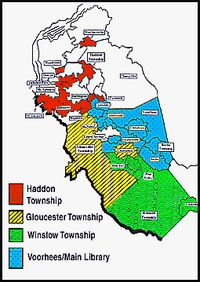
| Service Areas | #Active CardHolders |
%Total Population |
Per Capita Circulation |
|---|---|---|---|
| I. Haddon Township | |||
| Audubon Park | 35 | 3.0 | .46 |
| Berrington | 793 | 11.7 | 2.26 |
| Bellmawr | 697 | 5.5 | .85 |
| Brooklawn | 66 | 3.7 | .68 |
| Haddon Township | 3,318 | 22.4 | 6.64 |
| Merchantville | 80 | 2.0 | .31 |
| Mount Ephraim | 319 | 7.1 | 1.07 |
| Oaklyn | 317 | 7.2 | 1.30 |
| Tavistock | 0.0 | 0.0 | 0.0 |
| Woodlynne | 84 | 3.3 | .39 |
| II. Gloucester Township | |||
| Clementon | 963 | 17.2 | 2.80 |
| Gloucester Township | 10,146 | 18.9 | 3.45 |
| III. Winslow Township | |||
| Chesilhurst | 132 | 8.7 | 1.78 |
| Pine Hill | 1,034 | 10.5 | 1.94 |
| Pine Valley | 1 | 5.3 | 4.11 |
| Winslow Township | 5,351 | 17.8 | 3.57 |
| IV. Voorhees Township | |||
| Berlin Borough | 902 | 15.9 | 2.51 |
| Berlin Township | 606 | 11.1 | 1.79 |
| Gibbsboro | 441 | 18.5 | 3.17 |
| Hi-Nella | 146 | 14.0 | 3.36 |
| Laurel Springs | 509 | 21.7 | 4.35 |
| Lawnside | 390 | 13.7 | 1.93 |
| Lindenwold | 2,228 | 11.9 | 2.07 |
| Magnolla | 721 | 14.8 | 3.42 |
| Somerdale | 1,079 | 19.8 | 3.58 |
| Voorhees | 6,306 | 25.7 | 5.47 |
| Cherry Hill | 7,768 | 11.2 | 2.21 |

Strategic planning and staff training have prepared the library to expand information technology services as funding and ready partners have become available. The following initiatives are most notable.
Using the technology of networked information, the Camden County Library today is positioning itself within its community as “the gateway to the world.” This same networked information technology enables individuals and organizations across the county, not just those who come to the library, to use this gateway to information worldwide. Looking to the future, library director Claudia Sumler says, “Technology is the way libraries will stay vital.”

CamNet A Wide Area Network connecting the public library directly with schools in Camden County, CamNet is the centerpiece of the library’s use of technology. CamNet is an alliance of 71 institutions that have banded together to provide low-cost access to databases to both schools and libraries in the county. Through CamNet, users in member institutions have access to journal indexing and texts in EBSCO’s online database, to the county library’s online catalog, and to the Internet. Using the CamNet high-speed connection to the Internet, members then are able to arrange for their own electronic mail services, connect to information resources on the Internet, and mount World Wide Web homepages on the CamNet server.
Check out EBSCO E Publishing for a listing of their services
CamNet had its beginnings in the county Board of Education, which established a technology committee in 1993 to explore ways of offering greater resources and using technology for educational purposes. But it was Deborah Dennis, former supervisor of Automation Services at the Camden County Library, who in January 1994 suggested to this group the notion of linking public libraries and schools together to create an affordable means to share library catalogs and databases. She knew that spreading the cost of an online catalog system, a high-speed Internet connection, and license fees for electronic publications across many institutions would enable the Camden County Library to build the kind of electronic information network the community needed. The idea was enthusiastically received and the technology committee brought the network into being. Seventy-one school facilities public and private, one college, and four public libraries are now connected to the network. Integral to the network is a partnership with Garden State Cable TV, which designed and implemented the wide area network that connects the schools to the library and to each other.

Although CamNet’s origins were in the Board of Education, it has assumed a comfortable home in the public library, where the creation of partnerships with the local schools had been articulated as a strategic objective before CamNet’s conception. As a customer-driven information service institution, the library makes a natural home for CamNet. Says a vice principal from one of the county’s elementary schools: “The library is the logical place for all of this to happen.” Camden County Library serves the network in a leadership role: it is a neutral player among many schools, it maintains the network, and its computer is the network hub. Library staff train CamNet member staff and provide network technical support. CamNet member schools pay the Camden County Library an annual fee for administrative costs and database charges, and costs for cable connections are paid directly to Garden State Cable.
Automation System Provider: DRA
Technology is not new to the Camden County Library. The library has had an online public access catalog for more than ten years. Using the library’s DRA Information Gateway software, users can elect to see the online catalog as well as reference databases (ERIC, Books In Print, etc.) located at DRA in St. Louis. Forming a closer partnership among two CamNet members, Camden County College Library has contracted with Camden County Library to mount its patron and bibliographic databases in the same online system, resulting in a union catalog and enabling users to borrow from either institution.

Sumler is acutely aware that local library patrons are still struggling to understand the online library catalogs that many librarians now take for granted. Camden County Library patrons reminded the library staff of this important issue in their responses to a patron survey that was part of a strategic planning process. As a result, when the library switched to DRA Information Gateway software as the user interface to its online catalog, Sumler formed a Catalog Access Team to supply training and other support needed to prepare both staff and patrons for the change.
At the Camden County Library, as at many other libraries, terminals and workstations at each facility are dedicated to delivering different types of information depending on the locations and capabilities of the particular machines and the amount of progress the library has made toward its own networking goals. For example, journal information from EBSCO is delivered within the main library at a group of workstations in the periodical area, but is not yet available in the branches. CD-ROM reference tools are delivered on stand-alone machines, awaiting the delivery of a reference local area network. Connecting these multiple information resources, multiple work stations, and multiple sites is a significant hurdle, not because the technology is complex, but because the hardware, software, and staff to keep the network connections running are costly. The supervisor of automated service, Lori Schwabenbauer, would like to see “all electronic resources available from any workstation.” But even when all of the network connections within the Camden County Library system are operating according to plan, presenting the many and varied information sources in a way that is logical and coherent to the public from both inside and outside the library will continue to be an ongoing challenge for Camden as for all libraries.
The Camden County Library homepage (http://www.camden.lib.nj.us/) is a key resource for CamNet members and county residents. It ties together some of the library’s disparate information resources and provides links to reference sources on the Internet selected by the library staff to meet community needs. On the homepage these resources appear under useful headings and are arranged in a matrix, which allows the library to perform some of its traditional functions: selecting information and making access possible by directing users to the best and most useful sources available.
The library offers the public access to the Internet, the World Wide Web, and the library’s home page at five workstations in the main library. This service is intended to encourage patrons to browse, get a sense of the capabilities of Internet resources, and, possibly, inspire them to acquire their own Internet accounts though a private Internet provider. The Camden County Library does not offer e-mail accounts to the public, deferring to local commercial Internet providers who do. The library charges no fees for using the Internet workstations because it has no mechanism for collecting them. Instead, as with all library services, staff provides what services they can for free. The library offers free [Internet awareness and training classes((#internet-step-1))] to the public. Users may browse or download information at the public access Internet workstations, but printing is not yet offered.
CamNet Hardware and Software Requirements

The following technical infrastructure makes all of these services possible. The CamNet network is an Ethernet wide area network. As the network hub, the library’s Digital Alpha 2100 computer supports at least 600 workstations and terminals in 71 sites (with eight more planned). CamNet member institutions connect to the library via a Garden State Cable TV broadband network. A leased T1 line provided by KAPS, Inc., a commercial Internet provider, connects the library to the Internet.

Within the Camden County Library System 19 (29 by the end of 1996) PC work stations and 40 terminals are available for general use in public service areas. On the high end, five of the workstations are Pentium-class PCs which offer full graphical capabilities (to the World Wide Web, etc.). The library offers access to reference sources on CD-ROM at four stand-alone workstations, which will be upgraded later in 1996 to a reference area local area network offering 21 CD-ROM titles at eight work stations. Two PCs in the children’s area are networked. There is no formal computer laboratory.
The library’s catalog is maintained locally on a DRA system, and the electronic text of journals is acquired online directly from EBSCO. The online catalog, the EBSCO journals database, and other reference sources online at DRA may be viewed in the main library, and, through Internet and CamNet connections, they may be viewed in the three branches and any CamNet institution. Four modems enable other institutions and members of the public to dial in to the library’s catalog. Four percent of the library’s collection development budget is spent on materials in electronic form (leased, licensed, or purchased).
Overview Strategic Plan 1994-1998
The key to understanding the mission of Camden County Library and its recent accomplishments can be found in the library’s strategic plan, a carefully crafted document for the years 1994-98 that lays out goals and defines “customers” in very specific terms. The focus of the plan is the people of Camden County, the individuals and special groups that reside in the area the library serves. In providing customer service, the library strives to ensure broad access to materials in a variety of formats. The strategic plan targets “people not traditionally served by the library system” as a group that will receive the library’s special attention and concern. Among those underserved groups, the library identified schools as being the most important. The strategic plan states that “A number of different innovations . . . are taking place both in libraries and in schools that would suggest greater cooperation is a natural evolution.” However, rather than waiting for the slow process of evolution to effect change, the Camden County Library took charge of the situation and built partnerships with the schools through the CamNet project.
The strategic plan targets “people not traditionally served by the library system”.
The strategic plan for 1994-98 describes where the library wants to be in the future and provides a map of how to get there. A grant from the New Jersey State Library provided the funding for the planning process. During a year’s time, a planning committee toured all the facilities in the system, met with branch managers and staff, and analyzed demographic information about the county. After a series of meetings with the library staff, library commissioners, and members of various library Friends’ groups, the planning committee revised the library’s mission statement and determined three service roles that would receive priority: popular materials center, reference center, and formal education support center. The public was brought into the planning process and a detailed strategic plan was prepared before the end of 1993. One of the primary goals of the library is to provide users “of all ages and backgrounds” with “access to materials, information and services.” The detailed demographic analysis of the plan for each part of the county provides a basis for accomplishing it. Having a plan based on a broad consensus has helped prepare the library to take advantage of funding opportunities. Further, a consistency flows out of the plan’s thoroughness, and out of the consensus of direction that seems to exist among CamNet partners.
Camden County Library’s methodical planning and management breeds confidence, but in the business of running a library, problems invariably crop up and the best laid plans may not stay on schedule. In her capacity as library director, Sumler leads the library down specific paths, mapped to enable the library to reach its intended destination by means of careful planning, attention to details, and open lines of communication. Sumler has a realistic attitude about what can be accomplished and what cannot. “Sometimes,” she says, “there is no exact fix for things.” She has created a climate conducive to experimentation and risk-taking that enables the library’s workers to explore new avenues and develop new ideas. Under her guidance, library staff members take pains to ensure equitable access but, as she explains, always on a reasonable basis. Her efforts, she says, are directed primarily toward “getting everyone to be more customer oriented.”
“What the customer wants and needs are the guiding factors.”
Claudia Sumler

“What the customer wants and needs are the guiding factors,” says Sumler. Toward that end, the library has relied on needs assessments, market surveys, focus groups, and community evaluations to provide direction for its programs, particularly for CamNet. Although CamNet was not included as an explicit element in the library’s strategic plan, it fulfills several major goals in the plan by means of its careful conception and implementation.
Being ready to respond when opportunity calls is something that the Camden County Library is proud of and claims to have done often. Its best example, however, is CamNet, which began in the educational sphere of the county government but which has now found a permanent home in the main library. At the time of its formation, there was no specific plan for an electronic link among the library and the county’s schools; none of the institutions had a budget for such a project. It was, finally, the investment of staff time among all the partners–the library, schools, and Garden State Cable–that made CamNet possible and got it up and running. The library became central to CamNet’s operations, largely because the library was willing to take on the project and had an experienced and willing staff to do the work. There were no models to follow for what had to be done, how it should be done, or to what extent the library should be doing it. Sumler admits, “It all made everyone very nervous.” But trust, she says, got the network going and kept it going–trust between the library and its partners.
Teams are the work structure upon which the library’s plans are based, and teams have become the means by which the staff has been made to feel more comfortable with change and the advent of technology in library services–two things that the Camden County Library system continues to experience. This acclimation to change has resulted from the combined experiences of team members working through new process and procedures. As they are confronted with change and with the prospects of innovation, team members each have responded differently; but ultimately the whole team becomes accustomed to the nature of the change at hand and reacts not only as individuals but also as a team.
A number of people have said they follow the news on the Internet because it is more comprehensive and up to date.

Training has been a high priority and has been another key to acceptance of information technology. The library takes advantage of training provided by ALA, NJLA, PLA, and PALINET, but, in addition, provides workshops in-house to all staff. In 1995 and 1996, workshops have been offered on the Internet–an introduction, an orientation to the library (including its history, policies, and customer service orientation), technostress, and conflict resolution. Sumler expects that the library’s investment in training will pay off in enhanced customer service and in new efforts, by a well-prepared staff, to teach the public about electronic information.
A man was using the system to improve his computer/Internet skills in order to get a job.
The library has an Automation Services Departmentof four: a supervisor, an assistant supervisor, and two part-time computer operators. The staff supports the main library and three branches, coordinates technical training for staff and the public, and provides technical support and training to CamNet members. Department supervisor Lori Schwabenbauer finds that balancing the response to in-house and CamNet service calls is a challenge, and that in-house calls sometimes take a back seat. She would like to get one person dedicated solely to CamNet, perhaps an intern or part-time graduate student. Although the library has a staff that understands libraries and the library software intimately, Sumler would like to be able to hire a staff person with a computer background, not necessarily a librarian, to fill the need for someone who understands the hardware inside out. Hiring technical people is difficult, she notes, because of the difference in pay scales for technical employees and librarians.
With the creation of CamNet also came a host of problems, some of which were foreseen, others not. Sumler reports that the high demand for Internet access within the public library and the steady volume of use were predictable. The library, however, had enough funds to set up only five public workstations with Internet access; the number of computers will increase as funds become available.

What was not predictable was the extent to which the scope of the CamNet project with the schools exceeded expectations. The demand for Internet access in the schools expanded and enhanced the CamNet project. From the initial concept of interconnectivity among the schools and to the library with access to library catalogs, databases, and text on the Internet, it expanded quickly to encompass the World Wide Web. CamNet began with an expectation of limiting each school to four computers and has expanded to 250 per school.

The other problem that the Camden County Library staff did not predict was users’ frequent and blatant viewing of pornographic images from the Internet at the library’s public access work stations. Library staff assumed that making monitor screens highly visible to passing patrons and staff would keep users discreet and conservative in their choices. That has not proven to be the case. Instead, users are bold in their Internet selections and do not seem inhibited about displaying explicit or offensive materials on their screens. The problem has vexed Sumler and her staff, especially because confidentiality is an important value in the library, and librarians purposely do not monitor how patrons use the Internet workstations.
CamNet began with an expectation of limiting each school to four computers and has expanded to 250 per school.
After receiving some complaints, the library staff installed Cyber Patrol software to block the display of offensive pictures on library workstations but found it too cumbersome to maintain. Instead, the library hopes to resolve the issue by purchasing new tables for the public access Internet workstations. Monitors can be recessed into these tables to afford users greater privacy and their work less visibility to passers-by. CamNet schools experience the same problem, but in schools it is possible for staff to monitor Internet use and to deal with specific offenders rather than to limit access for all. In short, the schools have a more controlled user environment and are concerned with meeting specific educational objectives; the public library focuses on facilitating open inquiry.
The best indication of CamNet’s success can be found in user responses. In the schools, teachers are using the network to obtain complete lesson plans. The exposure to the Internet is stimulating classroom ideas and approaches and is making accessible materials that could not be brought into the classroom before. School systems are finding free interactive staff development programs on the Internet. But it is the students who have profited the most. “The kids won’t keep their hands off it,” says one elementary administrator about CamNet in the schools.
“If I took the Internet out of the schools tomorrow, I’d have a walkout on my hands.”
An Assistant Superintendent.
On the high school level, courses are being offered on “Surfing the Net,” and members of a student group called the “Yahooligans” serve as mentors for teachers and students alike. In the elementary grades, students have had interactive experiences with Arctic and Antarctic expeditions, have taken field trips to art museums without leaving the school, and have been able to use the library databases for researching papers and special projects. “The quality of these elementary school term papers has definitely improved since CamNet came up,” says one superintendent. Teachers have noticed that students approach their assignments with more enthusiasm and consult a wider range of both electronic and traditional sources than before CamNet was available. “If I took the Internet out of the schools tomorrow,” says an assistant superintendent,” I’d have a walkout on my hands.”

Teachers also note that the availability of electronic information sources has enabled them to strengthen their teaching of valuable skills such as problem solving and critical thinking. They note that teaching students how to evaluate information sources is especially important. Applying these three critical skills to inquiry on the Internet, says one librarian, “is the place where teachers and librarians come together”–where their shared missions of education and learning intersect. CamNet has enabled students to see “real world” aspects of what they are learning or researching. The powerful images of multimedia information give them a better appreciation for their subjects.
Directory of all institutions participating in CamNet
Economic statistics for the library’s community
Users in the public library have also discovered new worlds on the Internet and CamNet. Some users have benefited by learning about employment possibilities and job openings; others have used the system to research technical information related to jobs, locate Web sites that discuss their favorite hobbies and pastimes, and look for auto parts catalogs to find the right parts to rehabilitate an old car. Recently, in one month the Internet was used 1,950 times on the library’s computers-an average of 67.2 uses per day. Use statistics show that Camden County Library patrons use the Internet for a wide variety of purposes and that there is broad interest in using the Internet-well beyond a few people who may be die-hard fans.
Based on its successful experience with CamNet, the Camden County Library has some advice to offer other libraries and communities that may wish to establish community and library networks:
The library will serve as Camden County’s “gateway to the world.”
In Camden County, the experience of creating and maintaining CamNet has benefited many people, enhanced education throughout the school system, and brought the library, schools, and the local cable company together in a unique partnership based on the desire to get information into the hands of people who need it the most. It has also had another dividend, particularly for the Camden County Library: it has made the library more important to the community as a whole.
Where will the library go from here? It will continue to move toward fulfilling the goals of its long-range plan and to serve as Camden County’s “gateway to the world.” But it must also forge a new plan, one that deals with the future beyond 1998, incorporates even more integrally the electronic technology that is changing the role of libraries in communities, and takes full advantage of the interactive capabilities of these electronic media. The library is poised to greet the future. With local partners it has moved steadily to build a telecommunications infrastructure linking organizations and individuals across the county. How the library chooses to use these communication facilities and how well it serves the community in its choices will determine the place of the library within the community in the coming years.
| Service Areas | 1991-2 AFDC per 1000 |
1992% Total Residential Property |
1989-$ Per Capita Income |
|---|---|---|---|
| I. Haddon Township | |||
| Audubon Park | 14 | 0.0 | 12,639 |
| Barrington | 6 | 75.8 | 16,327 |
| Bellmawr | 12 | 65.1 | 14,281 |
| Brooklawn | 13 | 66.2 | 13,136 |
| Haddon Township | 1 | 79.2 | 18,400 |
| Merchantville | 12 | 80.3 | 17,041 |
| Mount Ephraim | 5 | 81.0 | 14,276 |
| Oaklyn | 8 | 81.5 | 15,120 |
| Tavistock | 0 | 32.4 | 168,182 |
| Woodlynne | 36 | 91.0 | 11,037 |
| II. Gloucester Township | |||
| Clementon | 30 | 73.7 | 13,097 |
| Gloucester Township | 5 | 83.6 | 15,393 |
| III. Winslow Township | |||
| Chesilhurst | 32 | 80.3 | 11,196 |
| Pine Hill | 11.7 | 82 | 14,642 |
| Pine Valley | NA | 48.3 | 41,245 |
| Winslow Township | 12 | 77.3 | 14,016 |
| IV. Voorhees Township | |||
| Berlin Borough | 18 | 70.4 | 15,777 |
| Berlin Township | 7 | 53.9 | 13,504 |
| Gibbsboro | 3 | 58.6 | 16,386 |
| Hi-Nella | 23 | 49.1 | 13,132 |
| Laurel Springs | 25 | 79.5 | 14,453 |
| Lawnside | 30 | 57.4 | 13,991 |
| Lindenwold | 14 | 67.3 | 14,745 |
| Magnolla | 14 | 77.9 | 13,681 |
| Somerdale | 15 | 68.1 | 14,019 |
| Voorhees | 2 | 64.6 | 24,962 |
| Cherry Hill** | 3 | 65.8 | 24,458 |
The Strategic Pan reflects the vision and efforts of a group of dedicated community representatives- and library staff who worked together over the period of a year to Chart the System’s immediate future. This overview gives you a glimpse of that plan with emphasis on the roles selected and the goals we will pursue as we prepare for the 21st century and the opportunities it will bring for all of us. For more details. please ask to see a copy of the plan in the Reference Department.
PRIORITY ROLES
Popular Materials Center
We will provide and promote current high- demand, high-interest materials in a variety of formats to adults and children in our diverse community.
Reference Services
Center
We will provide timely, accurate and useful information for individuals of all ages, businesses, government and community interests.
Formal Education Support Center
We will assist students in meeting educational objectives during their formal courses of study from kindergarten through two years of post-secondary education.
MISSION STATEMENTWe are in the business of meeting the recreational, informational and educational needs of our public.
VISION STATEMENTThe Camden County Library strives to be the gateway to the global network of recorded thought and information. We pledge to enhance the library’s potential to benefit the lives of individuals and the welfare of our communities.
We are committed to working as a team to:
GOALS
SOURCE: ADAPTED FROM THE CAMDEN COUNTY LIBRARY Strategic plan 1994-1998 overview
Computer System Configuration
Number of workstations allowed: 1 to 252
Required Network Hardware
Provided by Garden State CableTV
Provided by Camden County Library (upon receipt of their signed contract)
Considerations
Contacts
The following four pages are from the Library publication, “INTERNET: STEP 1: A Free Introduction to the INTERNET Offered by the Library for the Novice” (5/22/96)
http://www.clerk.net/pub/lschank/explore/www.html
In the nineteenth century, Andrew Carnegie brought plaster casts of European sculpture home to the Carnegie Library and Museums of Pittsburgh to offer the public a window on the world. Today, that same library uses a network of electronic information resources to bring more of the world to residents, 85 percent of whom have lived only in the Pittsburgh area. The Carnegie Library of Pittsburgh is a large urban system, serving a population of 1,336,463 through services provided at a main library, 18 branches, and three bookmobiles, as well as online. In 1995, the library collection included 6,000,000 items, the library circulated 3,000,000 items, and staff answered 1,500,000 reference questions. In 1995, the library received support of $21.00 per capita. The library’s mission is to be a proactive force for its community, serving the educational, information, and cultural needs of individuals and organizations. Providing equal access to all information for all people is a core value in this library.
Three adjectives describe the recent orientation of the Carnegie Library of Pittsburgh: regional, strategically focused, and collaborative. The library’s base of funding, scope of responsibility, and sphere of influence are increasingly regional rather than municipal. Its projects to build a telecommunications infrastructure and a community information network are on a large, regional scale. The library approaches these large projects strategically: initial investigation is followed by planning, then, in turn, by fund raising, implementation, and evaluation, resulting in a well-documented process of institution building and program development. In the development of information resources and community programs–smaller scale initiatives–the library management seems comfortable to serve as either a catalyst or a responsive service provider, willing to try things as opportunity arises but within the framework of the library’s overall strategic plan. Over the last decade, the library has increasingly built programs in collaboration with organizations in the community, including local libraries and other nonprofit organizations. Looking to the future, library director Robert Croneberger sees the library trying new ways to carry out its primary role as a purveyor of educational, informational, and cultural resources by serving as an editor, publisher, and distributor of local information, especially in electronic form.
The Carnegie Library of Pittsburgh is part of the larger Carnegie Complex, which also includes a concert hall and two museums. All are housed in imposing, 100-year-old stone structures set next to colleges and universities in the Oakland section of the city. Although the association with the Carnegie Complex suggests a picture of strength and solidarity, the facts are different: unlike the museums, the library has no large endowment. As a public trust, the library had depended on city and county tax dollars that have fluctuated with the politics and economy of the area. During its first 50 years, the library was financed entirely by the city; in the second 50 years, it expanded its support base to include funds from the county.
In 1986, the president and CEO of the Carnegie complex, Robert Wilburn, who also serves as president of the library board, called for a study to examine the library’s tenuous financial situation and to communicate the need for new directions in the future. The city and county were involved in the study, as were traditional library supporters. In addition, each branch library had its own study group, each of which has evolved since to become a Friends of the Library group. The resulting document, Report of the President’s Advisory Committee on the Library (April 1990) incorporated many community interests and concluded that the Carnegie Library of Pittsburgh was seriously underfunded and required an additional three million dollars per year to meet the basic needs of the system. It also concluded that library services in Allegheny County were unevenly distributed and poorly funded.
In 1991, Frank Lucchino, controller of Allegheny County, wrote a persuasive report, The Quiet Crisis: Libraries in Allegheny County, describing the then seriously inadequate level of support to the libraries and uneven quality of services provided across the county. In response to recommendations from this and the 1990 president’s report, a state law was passed that mandated funding for all libraries (and other cultural programs) in Allegheny County, including the Carnegie Library of Pittsburgh, through a one percent sales tax administered at the county level by a newly created body, the Regional Asset District Board. The Carnegie Library of Pittsburgh receives about four million dollars annually of the 110 million dollars collected. This stable revenue stream supports the main library and its branches and assures equitable library services to all residents. The move to county-wide tax support was a timely one, since the city recently has cut back its financial support.
Today, the library is working to enlarge a modest endowment with a broader, more solid regional financial base, and it has received ten million dollars in private foundation funding to support a three-year program of regional library electronic network development.
The library’s tradition is strong as a free institution. There have never been fees, except for a nickel-per-day overdue fee (with periods of amnesty). Even with the advent of printers connected to public access work stations in the main library, there are no fees for using printers or for paper. The tradition of fee-free services has implications in an increasingly technology-rich environment. For example, librarians report that one patron has printed more than 1,000 pages of song lyrics off the Internet at no charge.
In 1995, the Board of Trustees was expanded from eight life appointments and ten ex officio elected officials to include an additional 12 citizens actively concerned about library services. Newcomers to the board include representatives of the Urban League and the Friends of the Library groups. The terms of these new officials are three years. The new board, says director Croneberger, is proactive and strongly supports innovation. He believes it is the first board to pass the “access to electronic information” policy of the American Library Association that calls for unfettered access to information in a non-judgmental environment.
Dan Iddings, assistant director for networked and automated services, believes that if Andrew Carnegie were alive today, the millionaire would choose to invest in electronic technology rather than in buildings. Although a multi-year renovation of the main library is nearing completion, the Carnegie Library of Pittsburgh also is concentrating capital investment in technology to expand its reach. Library management is developing a comprehensive approach to providing electronic resources and has modeled its efforts after the Cleveland Public Library Electronic Library, which supplies many online resources through a central network hub to workstations throughout the region using World Wide Web technology.
World Wide Web Site The Carnegie Library of Pittsburgh homepage provides a window on the world through a single user interface. The goal is to configure public workstations to offer the library’s homepage (http://www.clpgh.org), which leads seamlessly not only to Caroline, the library’s online catalog, and Internet searching, but also to electronic resources selected or developed by the library. Its clearly and carefully crafted organization follows the physical departmental organization of the library, which is not necessarily the same as an end user’s mental model of the topical organization of the world of information. Iddings acknowledges that the homepage is designed for use from within the library and should consider external user needs as well. A collaborative project with the University of Pittsburgh School of Information Sciences to evaluate the effectiveness of this user interface has been suggested and could be very useful not only to the Carnegie Library of Pittsburgh but to other libraries and information providers as well.
Electronic Information Network Ten million dollars in grant money from local foundations is already in hand to build the electronic information network (EIN), a cooperative project that expands the reach of the Carnegie Library of Pittsburgh’s electronic library to the 40 municipal libraries in Allegheny County. In September 1995, as phase one of the EIN, workstations were installed in each Allegheny County library to connect it with the Carnegie Library of Pittsburgh/EIN’s networked information resources and the Internet. Beyond building a technical communications infrastructure, the project will fund retrospective conversion by Autographics and authority control by Blackwell North America of all 40 library catalogs to one online union catalog of 3.5 million items. It will also support the acquisition and installation of one new online integrated library system from DRA. This will enable patrons throughout Allegheny County to see in one database all participating libraries’ holdings and to borrow from any library in the system via a shared circulation system. As the network hub, the Carnegie Library of Pittsburgh connects county libraries and their branches, at a minimum, to the union catalog; indexes, abstracts, and full-text of journals; Internet resources; the EIN Web page that links to selected Internet resources by topic; an image database of historic Pittsburgh photographs; and local information on the Three Rivers Free-net.
Technical Support and Training The office of Networked and Automated Services is responsible for technical support for the Carnegie Library of Pittsburgh system, but information in electronic form is delivered to the public at workstations distributed throughout the library’s departments and branches. This means that staff throughout the system must understand the electronic tools, and that electronic information resources can be used near the corresponding reference collections. The philosophy of introducing new technology to patrons is, “We throw the doors open and let them go,” although some classes are provided for the public in Internet use.
In addition, members of the Networked and Automated Services staff monitor EIN network access and services. There is one technical support staff member within the library and EIN for every 50 PCs in the network, which Iddings describes as a standard ratio. This same EIN technical staff conducts in-house training for “everything that it [the network] touches.” Four EIN staff members, called consultants, provide training to library staff and Allegheny county librarians as well.
Technical Infrastructure The Carnegie Library of Pittsburgh connects with its branches and other public libraries in Allegheny County via the EIN wide area network over leased telephone lines using frame relay technology. Staff members in the 40 EIN libraries and Carnegie Museum connect to the EIN and the Internet through a PPP connection. The library connects to the Internet by a leased T1 line provided by PREP-Net (Pennsylvania Research and Economic Partnership Network). At the network hub, the library’s DEC VAX and DEC Alpha computers support 1,100 workstations and 100 dial-in connections.
Within the Carnegie Library of Pittsburgh main library, 75 to 80 PC workstations (both Pentium and 486-level) are available for general use in public service areas. Users can also gain access to the online catalog and Internet resources from terminals throughout the library system and can dial in from their homes, offices, or schools. Within two years, 1,100 Pentium processor workstations will be installed in the EIN libraries, with up to 700 workstations in place by the end of 1996. Each of these EIN workstations is networked and uses Netscape to provide patrons with a graphical user interface to the World Wide Web and the library’s online catalog. Twenty of the workstations in the children’s department of the main library are networked. There is a computer laboratory with ten workstations that is used for staff training. In addition, there are two more laboratories at other sites in the county with eight workstations each for staff and public training.
The central database for the Allegheny County libraries’ union catalog is mounted at the Carnegie Library of Pittsburgh on a DRA system. The electronic text of journals is acquired online from IAC and EBSCO. In 1996, 25 percent of the library’s collection development budget was spent on materials in electronic form (leased, licensed, or purchased). A 100-line modem pool enables other institutions and members of the public to dial in to the library’s catalog and web servers. The catalog may also be used through a remote telnet connection.
In 1995, the library published The 1995-2000 Strategic Plan of the Carnegie Library of Pittsburgh after an extensive examination of the community it serves, the relative importance of the roles it plays in that community, and the challenges and opportunities it faces. Funding from the Vira I. Heinz Endowment supported this three-year planning process, which was guided by the Public Library Associations’s Planning and Role Setting for Public Libraries and involved some 40 focus groups across the city. Library staff and community volunteers determined that three of the library’s functions were most important to the community: supporting lifelong learning, providing information, and serving as a cultural center. The planning process further produced a mission statement, a vision statement, and identified guiding principles, critical management issues, and goals.
In a parallel effort, funding from the Buhl Foundation enabled the library to engage a library technical consulting firm to develop project plans and a budget to implement the “information strategies for Allegheny County Public Libraries” which both the 1990 president’s report and Lucchino’s The Quiet Crisis report had recommended. With both a technical development plan and a library strategic plan in hand, the library was able to make the case to local foundations that the 10 million dollars required to build an electronic information network to serve the entire Allegheny County was a wise investment.
The library administration and staff are following the technical plan for now, but within two years, they expect that the technical plan will change as technology or the community changes. “A plan provides a good base,” say administrators, “but we must keep it flexible. It will change, but we won’t have to re-do it entirely. It’s very important to move ahead whenever we can.” In other words, they do not let the technical plan stand in the way of progress.
The library’s ability to adopt new technologies is due in large part to staff attitudes toward change, according to several supervisors. Younger staff are hired into the library ready to work with the technology, while several long-term staff members are learning to use computerized resources. “The Internet is a fantastic resource. Any librarian interested in books and information can’t help but like it,” is how one long-term staff member described it. “You use the same kind of research techniques and traditional detective work as before, but it’s much faster.” Staff agreed that there is a valuable and vital place for librarians in this expanded information environment. “We can help patrons select better resources; we can provide the kind of assistance that many people need,” noted one librarian. “Just as we select the books that patrons need, we can help them select resources on the Internet.”
As the library has assumed greater responsibility for the regional network and for programs built through community partnerships, its staffing structure has evolved. The library maintains an office of three people for development and planning, including one librarian. Development functions include not only writing grant proposals but also keeping funding agencies informed in a variety of ways, from grant reports to social events. In this library, the placement of planning and evaluation functions with fund raising is highly strategic. The library’s office of networked and automated services also was planned carefully, with staffing structures, functions, and even salaries developed by the consulting firm that wrote technical specifications for the EIN. The funding raised for the EIN then covered the cost of the staff to support it.
The solid stone Carnegie buildings have provided the library with the space for a turn-around. In the mid-1980s, many of the upper floors of Carnegie branch libraries were vacant, and Croneberger, the then-new library director, began cooperative arrangements with community organizations by offering an asset that the library had in abundance: office space. Many of the library’s partnerships today in highly technical projects began when nonprofits and social services agencies were invited to use the buildings. Among the first collaborations was the Pittsburgh office for the Foundation Center.

“By joining with other groups and organizations the library reaches a broader section of the community and is able to enrich its program offerings,” states the 1994 annual report. Library managers see the institution as one of several local organizations and foundations, each with its own mission, that are cooperating to make a difference to the community. “We want to be working in community problem-solving,” says the EIN project director. Organizations approach the library for assistance. Local connections are made when staff members serve on boards of local agencies and organizations. Purposeful contacts like these between library staff and community leaders or service providers are common and encouraged by library management.
The cooperation that began with offering office space to social and public service agencies now includes extending invitations to develop homepages on the library’s Three Rivers Free-net. The library offers to nonprofit organizations World Wide Web presence, information, and training in web site building and management. The organizations bring to the library content of local interest, labor to prepare the content, insights into community needs, distribution channels, and public goodwill. Alliances with local organizations have fostered many cooperative projects. For example, the library and Point Park College will open a shared library downtown which will serve as both the college library and as a business branch for the Carnegie Library of Pittsburgh. The library also provides support to computer workstations in senior centers and homework assistance centers in public housing to be used for dial-in access to library and Internet resources.
The library has achieved a new level of collaboration with the local United Way, which will move its information and referral service (Helpline) staff into the library to consolidate its regional information collection and dissemination activities. Projects like these have positioned the library to be a leader in promoting public participation in city and county programs.
According to Croneberger, the Three Rivers Free-net is the first community network in the nation to begin within a library. Free-net director Susan Holmes reported in March 1996 that although the Three Rivers Free-net had not yet been formally opened, the community had been very enthusiastic about helping to build it and was eager to use it. Since early March 1996, more than 100,000 people have used the Free-net (http://trfn.clpgh.org). “The public is learning about it through word of mouth [and] calls are coming in every day.” Nonprofit organizations and governmental entities are developing homepages on the Free-net, and links will be made to commercial pages where appropriate. Holmes is training volunteers who will then train members of other agencies to develop their own pages on the Free-net. As additional pages and services develop, the Free-net staff is exploring ways to track not only use but also satisfaction of users.
Bringing the Free-net into homes has had unanticipated benefits for citizens. For example, blind users with voice synthesizers on their home computers are able to use the community information network to obtain restaurant menus, bus schedules, and other community information. This developed naturally from earlier activities: the library has one blind volunteer and is the provider of Blind and Physically Handicapped Services for half of the state. Another user is creating Web pages that explain cancer research to laypersons. Job and career information is expected to be one of the strongest areas of the community network. Since the library has a job information center, the network will be able to draw upon and expand this service using information provided by nonprofits and governmental agencies, and also through links to business community information.
Library administrators hope that the organizations providing Internet services will work cooperatively to develop Internet access for all sectors of the greater Pittsburgh area, with the library taking the lead for nonprofits. Holmes would like to see the library serve as a safety net for organizations that are unable to pay for a World Wide Web presence on a commercial Web server.
Multiple bridges across three rivers connect important transportation routes in Pittsburgh. Similarly, the library is working to build electronic connections within the community through a project entitled “Bridging the Urban Landscape.” In this project, the library collaborated with Common Knowledge: Pittsburgh (a coalition for technology in education centered in the public schools), to create a database of photographic images of Pittsburgh neighborhoods. Photographs from the library’s Pennsylvania Department collections were made available on the Internet via the World Wide Web. The image database is accessible to library patrons throughout Allegheny County through the local library computers that are connected to the Electronic Information Network. In this way, the library is reaching out to schools to support curriculum-related needs. The Bridging the Urban Landscape project was supported by a grant of $551,000 from the National Telecommunications and Information Administration of the Department of Commerce. It will also connect three Pittsburgh schools, the Hill House community center, and the library via the Internet.
Library staff at the main building have been both heartened and challenged by the introduction of work stations to access the Internet. “When you see 16-year-old boys–considered the most difficult group to get to use a library–rushing in at the end of the school day to surf the net,” said one manager, “you know you’re doing something right.” A public services staff member added that, for other audiences, “We first have to demonstrate to a patron that computers can have a positive benefit for them.” As the need for Internet expertise grows among patrons, the staff is challenged to find ways to train themselves and their users. When the World Wide Web is provided more widely at branches, public training will be offered. During National Library Week in 1996, the library provided demonstrations of networked resources on various topics, such as scientific information and career or job opportunities. In this early stage of providing in-library Internet access, there are only a few patrons who seem to be using computers exclusively. In many cases, the Internet is used when traditional library print resources are all checked out (because of school homework assignments on the same topic).
More needs to be done, staff admit, to promote the new services of the community network. As part of the Electronic Information Network, the library will install 1,100 terminals not only in libraries but also in housing projects, kiosks, and senior citizen centers. Senior citizens have begun to use the work stations actively, librarians discovered, by searching Internet resources on pending congressional legislation and e-mailing representatives about their views. Homework help centers also have access to the EIN and are staffed by county employees assisted by library staff and volunteers. Although building a technical infrastructure is important, the library administration acknowledges that it is even more important to get the word out about the new services and to prepare the whole staff and the public to take advantage of the technology.
One of the main goals of the Electronic Information Network project is to even out the library’s information services in all areas, according to planners. “We want the less economically advantaged neighborhoods to have the same level of information available to them, no matter what their tax base,” said one staff member. “We are striving toward good service–free service–to all,” which is simply an extension of the motto that has stood over the doors of the Carnegie Library of Pittsburgh since its founding: “Free to the People.”
At Hill House community center, described by library administrators as being located in an impoverished area, there is a great deal of interest from the African-American community in having access to the Internet for the empowerment of their community. A recent forum sponsored by the Council on Humanities held at Hill House generated many questions about how that community can become a better informed electorate. At Hill House, one of the public access sites to the Electronic Information Network, people are aware that computers are making a difference in their access to information and in connecting them to persons with similar goals across the United States. This kind of people-to-people connection is especially valuable when the people prefer to remain physically in their own neighborhoods but still have access to the ideas and programs of others.
The library’s current course of program and infrastructure development follows the 1995-2000 strategic plan. As the Library looks beyond the initial three-year EIN project of network development, it will be useful to see whether a library-developed and coordinated system can move beyond information access and delivery to provide a tool for true interaction and problem solving among community members. The library will make additional electronic information resources available through the EIN, especially resources published by the library through collaboration with local nonprofits. Given the comprehensive, one-big-network approach to building network content, how will the library serve the unique information needs of individual branches and libraries throughout the region?
The library will attempt to answer such questions through a program to evaluate the Electronic Information Network and its usefulness to people of all ages. A three-year project (for which the library is seeking funds) is being developed to evaluate the regional impact of the access to new information on the Internet. The project is not designed to evaluate the technology itself but instead to evaluate the use of the World Wide Web as an interface to information resources. The results of this evaluation will be of interest to library and community information network professionals far beyond the Carnegie Library of Pittsburgh. The results will enable the library to fine tune the plans to better meet community needs.
Reaching out further to non-profits and underserved populations, and building a wider technological base to do it, will require money. The odds are that Carnegie Library of Pittsburgh, with a strong record of building strategic local alliances upon carefully laid plans, will continue to find ways–even innovative new ways–to do it.
 .
Cedar Falls, with a population of 34,300, is situated on the banks of the Cedar River in northeastern Iowa’s Black Hawk County. It is a short drive from Waterloo, a city that is twice as large and is home to the headquarters and assembly plant of the John Deere Company, the nation’s largest tractor and farm machinery manufacturer. Both cities, which are nestled among the low hills and flat fields of large-scale farms and agricultural co-ops, have developed modest suburbs.
Although Waterloo and Cedar Falls share a newspaper (The Waterloo/Cedar Falls Courier), an airport, and the labor and retail establishments draw on regional markets, each city has its own distinctive character. Cedar Falls has its own local industries, manufacturing products such as rotary pumps and farm equipment, and is working to attract more commerce and business, especially high-technology industries. One of the main sources of its relative affluence, however, is the presence in the city of the University of Northern Iowa. The university enrolls about 12,500 students. The students, professionals, and faculty contribute to a lively economic environment–retail malls at the outskirts of town are busy, thriving places; the center of town is quieter but still very active. The turn-of-the-century town center is being restored and refurbished as part of a community-wide project to increase the city’s appeal to tourists.
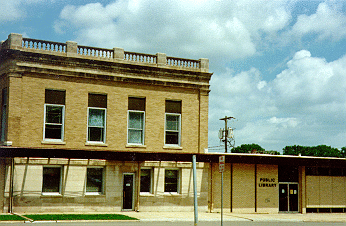 .
The Cedar Falls Public Library occupies a 1903 Carnegie building with several later additions. All areas of the building are in heavy use and the library has no branches. The library director, Carol French Johnson, remarks that the library has outgrown the building. Together with the five other full-time professional and 12 support staff, she is hoping that voters will approve funding for the construction of a new building when it is placed on the ballot in the near future.
The mission of the library is “to provide, within the constraints of the budget, necessary resources, personnel and programming to meet the educational, informational and leisure time needs of the community.” To that end, the collections contain 91,000 items; 305,345 items were circulated in fiscal year 1995, and 23,213 reference questions were answered. The library spent $72,700 for print materials and $7,000 for electronic collections (leased, licensed, and purchased). Support per capita is $22.32. City funding for the library has remained stable, although the book budget is down from some years ago. Supplementary funding is provided by the Friends of the Library, which makes possible a summer reading program and young adult events.
The library is part of the Human and Leisure Services Department of the City of Cedar Falls and is governed by a working board of nine individuals appointed by the mayor. The university has a larger, and, one staff member remarked, “well funded” library (58 full-time staff; about 750,000 volumes), so students appear not to make much use of the public library. Given this situation, the director says it may have to work a bit harder than other libraries in cities of comparable size to show growth in library statistics, but the presence of the university does not affect the library’s service orientation, which is to the general public. Neither does the library expressly “market” itself to the college’s students and faculty.
Over the past few years, the Cedar Falls Public Library has been working hard to map its future course and identify the place it hopes to occupy in the community in the decades to come. As a result, the library is engaged in the following activities:
The Cedar Falls Public Library has positioned itself to take advantage of unique opportunities in the community and to become the trendsetter in helping the city to become a “wired” community with connections among the library, city services, and every citizen’s home. In this way, the city hopes to attract new businesses, industries, and residents to Cedar Falls.
Since October 1994, Cedar Falls Public Library has been in the midst of several technical projects to improve the ability of its users to find and retrieve information electronically. They include planning for a shared online catalog, helping to develop a community information network, implementing public access to the Internet and a library home page, and developing electronic information (for community use) in partnership with local government agencies. In the words of Carol Johnson, "these are exciting times" for a small library that to date has not had an online catalog of its holdings. Some of the ongoing projects were initiated by the library staff; others happened elsewhere, but enabled the library, with the public and private sector partners, to move ahead to build an information infrastructure for the entire community.
Municipal Fiber Optic System As background to these developments, in October 1994, city voters endorsed a $6 million bond issue to enable Cedar Falls Utilities, the municipally owned company that operates electric, natural gas, water, and communications services, to build for the city a fiber optic backbone, connected to a broadband network, that eventually will serve every residence in the city. The library has been on the backbone since mid-1996.
Voters endorsed the bond issue overwhelmingly despite vigorous advertising in opposition by a national cable television system. Although individuals may not have been aware of the technicalities of the proposal, the vote was based on the historical record of good service provided by the municipal utility. It also helped that a feasibility study was done by a citizens committee. "The public asked us to do this," says Curtis S. Johnson, manager of electric and communications engineering of Cedar Falls Utilities. The intent of the new utility when fully operational is to provide "full-service" community access that is much broader than cable television. For instance, the system eventually will connect all schools in the city. Also since mid-1996, the city has provided telephone service through the fiber optic network.
The fiber optic system is designed with five primary and five secondary loops circling the city, instead of the central-hub-with-spokes layout of the commercial cable provider, and will provide complete redundancy in case of a system failure. "We're building a system that's world class and will be of interest to world class providers," says Curtis Johnson. The mayor, Ed Stachovic, adds, "if and only if you have your own utilities can you do what we are doing here."
The library is more than just a potential network user; it promotes intelligent use of the network. For instance, in June 1995, the library planned and moderated a presentation with the university and Cedar Falls Utilities on the basics of communications options for the city. More than 200 residents turned out for the symposium.
Shared Catalog The library, in conjunction with the University of Northern Iowa library, will use the new fiber optic system to implement a shared online catalog of the university, the Cedar Falls Public Library, and, eventually, Hawkeye Community College, opening up new sources of information to all library users. The discussion about Northern Iowa hosting the public library on its system began informally a few years ago between the Cedar Falls library director and university library technical personnel; after "taking it one step at a time," the process is now at the stage of vendor contract negotiations. The plan is to automate the public library's catalog by sharing the university's Innopac system. If all works out as expected, the public library will leapfrog over a stand-alone system to a shared system at an affordable cost. Eventually, all patrons will have access to the catalogs of the three institutions plus a host of information that Northern Iowa makes available through its catalog, such as full-text databases. The online catalog also will be available through dial-in.
CedarNet The Cedar Falls Public Library joined with seven public libraries in Blackhawk County and other organizations, including hospitals, schools, and public and private sector organizations, to organize and develop a community information network, CedarNet, which became operational June 1, 1995 (http://www.cedarnet.org). Local residents may become CedarNet members at no charge. With membership, they receive access to the Internet through the World Wide Web, information about government and community agencies, and individual e-mail accounts. The network supports users with graphical browser software.
World Wide Web Site The library developed and mounted the first public library Web site in Iowa in January 1995 (http://www.iren.net/cfpl/). Since then, the site has been expanded to feature information about the library's mission, services, collections, and facilities, a youth department, information about the Friends of the Library, a suggestion box, and the Ask-a-Librarian reference service. The site links to The New York Times Best Sellers List, information about other libraries, and selected resources on the Internet.
Internet Access The library opened a public access workstation to the Internet and CedarNet in September 1995. This Internet access is important to the community, which, when Council staff visited, had yet to receive fiber optic connections to all locations from the city's utility company (although a commercial cable television provider is making private Internet connections available through its own fiber optic loop). The library's public access workstation, which is connected to the Internet via the municipal utilities fiber optic network, is located behind the reference desk and defaults to the library's Web site. Patrons may reserve time on the workstation, print on a laser printer (at ten cents a page), and purchase diskettes for downloading. The Kiwanis Club donated the equipment and the library board voted to use foundation funds to acquire direct access to the Internet through the Iowa Research and Education Network (IREN). According to the library director, IREN is unique in the nation as a nonprofit consortium representing collaborative efforts between librarians and computer professionals. Members include Iowa's two- and four-year institutions of higher education, public libraries, and other educational organizations and community interests. IREN enables these organizations to develop and enhance communication on the Internet by providing training, conferences, a mail server, free World Wide Web space on the IREN server, and technical support services.
Community Information Provider The library has taken the initiative to both define its role in the community as an information provider and position itself as the "technology expert" by designing and mounting information on the World Wide Web about other city departments, the mayor's office, and the City Council. Although the library does not provide e-mail accounts to the public (they may be obtained from CedarNet), it will provide e-mail accounts to city employees and train them in Internet use. To do so, it applied for and won a $30,000 grant from the American Library Association/MCI Telecommunications Corp. (the MCI Library LINK project). It was one of nine city libraries in the country to win an award.
The project began informally in 1994 at a mayor's meeting where the library director, using a laptop computer, presented information about the possibilities of technology to heads of city departments. The director of the Department of Public Works, C. Budd Curttright, was impressed with the possibilities of electronic communication. He also wished to address complaints that the "government was doing things but the people didn't know about them." Hence, he thought that the department could convey to the public useful information about trash pickup schedules, snow removal, and other services via computer.
Public Works took the lead in the effort to add city information to the library's Web site. Curttright, helped by library staff, even took classes to learn hypertext markup language (HTML). It took seven months to put up the first application, a demonstration of how to use a new kind of automated trash machine. Other information has been mounted, with the public works director instrumental in supporting the project, and acquainting other department heads with the Web site.
Within the library, six computer workstations (five PCs and one Macintosh) are available for use by the public in public service areas. The high-end workstations are Gateway Pentiums. Two of the library workstations offer Internet access with full graphical capabilities. A fiber optic cable connects the library to the Internet through the municipal Cedar Falls Utilities and IREN, which is the Internet provider.
The library maintains one local area network for circulation. The machine-readable version of the library's catalog is maintained on OCLC. In the future, it will be made available through a union online public access catalog on an Innovative Interfaces system shared with the University of Northern Iowa. Indexing and full text of journals in electronic form are accessed online from First Search, the Iowa Locator (an Iowa database), and other resources on the Internet. Approximately six percent of the library's expenditures for information resources are for products in electronic form (leased, licensed, or purchased).
To the outside visitor, one of the most striking facts about Cedar Falls is the extent to which it is aware of and refers to itself as a “community.” It has invested in community institutions to an unusual extent. For example, the local hospital is publicly owned and operated, and the Cedar Falls Utilities have been publicly owned since 1888, the result of the Populist and Progressive movements at the end of the nineteenth century. Several people mentioned that one generally does not feel competition among various groups in the city, and that the university, led by a new president who places a great deal of emphasis on outreach, is increasingly becoming a part of the community.
The city has just completed its second ten-year strategic plan–the objectives of the first having been accomplished ahead of schedule–which involved a great deal of community input. It is not sitting on the shelf, but is being used as a living document to move forward into the next century. The library has made a commitment to carry out significant responsibilities as part of the plan. One of the plan’s broad aims is to provide city-wide quality education and training; to that end, the library is charged with enhancing the accessibility of library services. It is the lead agency designated to “tap the educational potential of broad-band telecommunications,” under the city-wide aim to develop effective, accessible information-sharing technological applications and relationships.
The strategic plan has provided the city a framework for understanding itself. Community members are aware that, as a community, Cedar Falls can either thrive and prosper or stagnate. It is now a stable, fairly homogeneous community, with a few worrisome trends, trying to make the best use of what it has. One of the frequently cited attributes of Cedar Falls is that it is safe. It is a good place to bring up a family. Ironically, however, not only has the total population dropped slightly in recent years, but the school-age population is dropping, and the community is aging: 11 percent are over the age of 65. The mayor recognizes the need for different demographics if the city is to continue to prosper. The challenge, he says, is to increase household formation by attracting new businesses and jobs to the city, and by diversifying and increasing the supply of affordable housing in this upscale community. The city’s economic development campaign scored a recent success with the relocation to Cedar Falls of Team Technologies, a high technology firm, which was attracted by the partnership between the city and the local community college.
Library statistics reflect the change in the community. Although use of the library building is up each year, circulation of library materials is down. The library director notes that fewer youths participate in library programs and that, at some point, the library may have to think about restructuring to provide special services to seniors. She says that one way of attracting more users might be to increase the number of work stations with access to the Internet, and she believes the library could use five more. However, in the old Carnegie building it would be difficult to run the wire required for more networked workstations, and, in any case, there is simply no room for more.
Despite lagging statistics in some areas, the library is clearly a major player in the Cedar Falls community. In addition to viewing the library as a symbolic center of the community, today people are beginning to regard it as a “trendsetter.” People from various sectors of the community attribute this reputation to the library director. At a time when “lots of people don’t know quite what to do [with computers], although they’re excited about them,” the library director is an energetic speaker who is able to get people excited about her vision for the library as an information provider. She publicizes the library and works at integrating it into the fabric of the community. The director has just completed a year as chair of the Cedar Falls Chamber of Commerce, where she helped develop the City of Cedar Falls’ strategic planning document for the next ten years. She also serves as secretary to CedarNet, and she and other library staff are involved with additional community groups. The director states that her service to municipal and community groups is an integral and important part of her job. Everything she does is with the intent of promoting the library, and she does so as a forward thinking, innovative, community citizen.
The library staff makes sure that the library’s electronic services align in some way with traditional library services. This is partly because the community is aging, and many older voters do not see the necessity for new machines or electronic resources. Because a few library board members share these concerns, the library workstation that provides access to the Internet was procured with private funding from the Kiwanis Club.
The director has a well-defined philosophy of librarianship that guides the way in which the library makes electronic resources available to the public. She believes that “users depend on librarians to identify and collect sources of information that are accurate, valid, and credible,” and that much of the value added by librarians to raw sources of information lies in this “authentication” function. She adds that while librarians have well-defined collection development procedures in place for evaluating traditional materials, there are no similar systems for evaluating electronic resources, except for an occasional article in a professional journal. “It is an awesome task,” she says. The library’s staff spends time, therefore, in evaluating online sources of information and creating pointers to them from the library’s home page. It checks information for accuracy, and credibility, and user friendliness, and tests all links periodically to make sure they work. In addition, just as the library acts on suggestions to purchase specific titles if they are within budget and the library’s collecting policy, the library has added an interactive link that allows users to suggest URLs for the library’s Web site. These are forwarded to the reference staff, who make the final decision.
The director and others are concerned about the survival of the library in the information age. A long-time older library user says, “People are used to going to the library to get information. Now that we can pick up information on the Internet, I think perhaps the library is not as busy.” Some patrons with Internet access at home still use the library workstation. One says “while we subscribe to [an online service], using the facilities at the library allows us to save money as well as having access to the library’s staff when questions arise.” However, Aleta Anderson, the public services librarian, says that, after installing the workstation with Internet access, “I don’t think we have the enormous numbers that we predicted. Some use the workstation as a testing ground prior to getting their own e-mail accounts.”
One reason for this may be that Cedar Falls has a relatively affluent, educated population, and the proportion of households that own their own computers is likely to be greater than average. While the Software Publishers Association reports that 34 percent of American households owned some kind of computer in 1995, an informal survey done four years ago in Cedar Falls showed that about one-third of households already owned computers, and the percentage is undoubtedly higher now. The director fears that the library may become no more than “an expensive reading room,” if it does not provide electronic information in addition to its traditional collections. The choice of electronic information is important, and here the library should embrace its potential for adding value to the information through selection. The Cedar Falls Library’s electronic interface with the community is designed with “quality” links; the user wastes no time “surfing the net” but can go straight from the home page to information of value. As the library continues to find ways to add value to electronic information and thereby increase its usefulness to the community, it will increase its capacity to be the community’s information hub.
The library has developed its electronic resources with an eye toward serving the whole community, including those who might not come in the door or telephone the library. Since visits to the library by young people have declined recently, the library advertises that “you can visit the Youth Department of the Cedar Falls Public Library without ever leaving your home,” by choosing the library’s home page on the World Wide Web. The Youth Department points to information about other Internet sites for young people, but also, importantly, lists books that the library owns on various topics of interest to young people and gives a schedule of upcoming library programs. Drawing young people via electronic media into the library, where they will find traditional resources and perhaps become lifelong users, might be one way to ensure that users will continue to physically patronize the library, even as the library’s electronic interface with the community becomes more useful and attractive. The premise of the Cedar Falls Public Library is that there is more than one way to serve that audience and, in fact, more than one way to serve the entire community.
Through the development of its Web site, the library has gone beyond serving the local community. The library’s Web site is so graphically appealing that it is frequently rated one of the nation’s top ten library sites on the Web. Its designer says with quite a bit of pride that “people don’t know how small we are.” This may lead to a conundrum: the site may promise more than it will be able to continue to deliver.
The library’s service orientation is demonstrated on the Web site. One prominent feature is the “Ask A Librarian” section, where anyone may ask a reference question. No local affiliation is needed to use the service; the reference librarian answers questions from all over the country and even abroad. She does not know how much longer she can continue to do this, but for the moment the volume of questions seems not to be a problem. Library staff believe that Internet use has spawned an increase in interlibrary loan requests from its patrons. The reference librarian says, “If people really learn how to do this, interlibrary loan will skyrocket.”
How did this small library, which is positioning itself as the “technology expert” in the community, develop its staff expertise? With grant funds, the library contracted with Steve Wells, a young, self-taught Internet/computer consultant, to implement the MCI Library Link program. He also acts as network consultant for the library and has been primarily responsible for the innovative work on the library’s Web site, particularly suggesting and designing graphics for the site. Carol Johnson, the library director, started out not knowing exactly what to do with the Web site, but by talking with others and by experimenting with ideas she has gradually fleshed out a distinctive philosophy of providing electronic services. The new technical services librarian, Barbara Dunn, who will be responsible for the library’s Web sites (and for providing technological support to the city’s various home pages) when the grant period is over, is a recent library school graduate who has both library and technical training. Newer library school graduates get useful technical training, but the library, even with its small staff, finds that it now needs a network person. The next time the library hires, it may hire a computer technician, not a librarian.
The librarians find that many of the people who use the library’s workstation for access to the Internet require guidance from the reference staff. The library provides what help it can, but cannot spare a great amount of time to do so. There is a manual and a tutorial, and library staff find that in general patrons are very willing to experiment and accept some delays. Besides instructing users, staff time is also used to evaluate the electronic resources, in addition to more traditional reference, collection development, and technical services functions. The public services librarian says they manage to “squeeze it all in.” What suffers, she says, is professional reading.
Practical realities could limit the library’s vision of providing an expanding variety of quality information resources to the public via traditional and electronic delivery. One is the current physical facility. The state of Iowa has recently constructed a statewide fiber optic network, the Iowa Communications Network (ICN), and Cedar Falls has been selected as one of the public libraries in the state where an ICN classroom will be established in 1999. It is hard to imagine where that will be located in the current building. A single networked workstation, used both by reference staff and patrons, will prove to be insufficient as information about the universe of electronic information expands and more people seek access. Training the public in the use of electronic technology, for which the library has assumed responsibility, can be difficult logistically. The library offered 21 workshops on the Internet over the spring break in 1996, which was too many, they found, for the restricted staff and space of the library. Others within the community, including CedarNet and commercial and educational providers, offer classes in using the Internet, and they provide an alternative means of delivery.
Fiscal realities–reflected in the library’s own mission statement, which is to provide resources within budget constraints–are another understandable limiting factor to the adaptation of technology in the library. One gets the sense that the library has learned to work within limitations over a long period to make the best use of what it has. In this respect, Iowa’s sense of community has a negative as well as a positive side. Because community identity is so strong, there are no formal county or regional library systems to help support Iowa’s “535 struggling public libraries.” According to a former library board member, Iowans are “pretty resistant to library systems.” The library director has been asked to direct the public library in the neighboring city of Waterloo in addition to her job in Cedar Falls, and if she accepts, she will find it an interesting, if risky, experiment to see if there is value in sharing certain resources between the two libraries. Although the metropolitan community leadership is behind this experiment, many community residents are very much against the idea of sharing their library director with another community–another manifestation of the close identity people have with Cedar Falls as their own community. But the willingness of the director to take this step illustrates part of the route Cedar Falls already has taken in its approach to technological innovation: be creative, put yourself on the line, develop supportive leadership, take advantage of opportunities, and take it one step at a time.
The Cleveland Public Library is an urban research library that has taken a comprehensive approach to offering electronic information, as it has with library materials in more traditional physical formats. With the strongest public collection in the United States outside of New York, the library has developed electronic resources that mirror the breadth and depth of its significant collections. The library has also adopted a regional approach to library automation, and in this regard serves as a leader among Cleveland area public libraries.
Growth and expansion are the library’s watchwords. It is constructing a new modern wing of the central library, equipped to handle tomorrow’s technology and to provide better service, and is building new branches to serve outlying districts in the metropolitan area. At the same time, more and more people are using the library and its electronic resources. As a pioneer in library automation, the Cleveland Public Library over 17 years has constructed a vast, but carefully selected array of electronic information resources, gathered seamlessly behind one online user interface, called The Cleveland Public Electronic Library. Through an alliance called CLEVNET, the library provides electronic information, technical support, and delivery services to 23 libraries in the metropolitan Cleveland area.
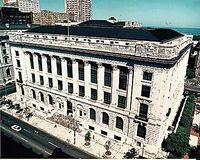
Cleveland is a reading public, and the metropolitan area of Cleveland is rich in library resources, as well as in staff and library leadership. Seventy-five percent of Cleveland residents visited their library in the last year, not including dial-in patrons. There is a sign hanging on the office wall of Robert Carterette, who serves as the information systems manager of the Cleveland Public Library. The sign reads: “Vote for 27: Our Library is Worth It!” The sign says a great deal about how the library is viewed and valued by the community, for every five years voters must go to the election polls to renew the tax levy that supports the public library system. Time and again, voters have pulled the lever for proposition 27–or whatever number the library referendum item might be that particular year–and have reasserted their basic belief that the tax they spend on Cleveland’s sophisticated and growing library system is, indeed, well worth it. As a result, the library staff knows that providing good service increases the chances of renewing the levy every five years. Few public institutions have this opportunity and level of independence.
The Cleveland Public Library system serves the half million people of Cleveland through services provided at the main library and its 27 branches. As a regional support library, it also serves the greater metropolitan area of Cleveland and the state of Ohio. In 1995, the library collection included 9,132,744 items, the library circulated 5,210,449 items, and staff answered 1,924,763 reference questions. In 1994, the library received support of $70.96 per capita.
The library has developed an electronic library that complements, rather than replaces, the traditional library. “This is the philosophical foundation for all that we do,” says library director Marilyn Gell Mason. “We are building a comprehensive approach through the electronic library, the new east wing of the main library, in all our branches–we see the library as being an information powerhouse.” The library aims to offer all people access to electronic resources whether or not they have a personal computer at home.
About the direction of the library, Mason says, “We serve the same roles as ten years ago. The principles of librarianship are the same: good bibliographic knowledge and selection of materials.” The library has not selected the Internet as an information resource; rather, it is a carrier of information. Librarians select electronic resources, including those delivered via the Internet, to meet the library’s collection development standards and the needs of the public. To a great extent, the Cleveland Public Library, which is seen as a pacesetter and an innovator, has taken its model of effective library service and applied information technology to it. Whether such an approach might, in the future, inhibit Cleveland’s leadership as an innovator is not known. New technology may not, with the passage of time, fit as comfortably into existing library categories as it seems to now. For the time being, the traditional roles have worked well at Cleveland, particularly to emphasize the fact that the library as an information resource is still, in the end, a library after all.
The Cleveland Public Library, which was early to implement information technology, today serves municipal, regional, and worldwide constituencies through a highly developed system of electronic resources.
The library management empowers employees by letting them have a voice in the development of policy and programs. The library prides itself, however, on its lean organizational structure. The administrative staff consists of half a dozen of the library’s top executives and department heads. “We have no coordinator positions,” says Norman Holman, the deputy director. Instead, committees related to issues are formed, make recommendations, and then disband. Implementation is left to those on the working level. Although this approach enables the library to foster a democratic atmosphere, it can have some drawbacks. For example, the library administration must ensure that communication across departmental lines is open and is being used by staff.
When asked to describe the personnel situation, management team members respond, “we staff lightly” (60 percent of the budget goes into personnel and 40 percent into collections and buildings) but, on the other hand, they say, “we pay well” and, as a result, have a low 1.6 percent annual turnover rate. The low turnover, however, has meant that there are few opportunities for adding staff with new skills or different experience. As a result, the library’s administrators rely heavily on the ability of existing staff to adapt to change, keep communication flowing, and reduce the sources of tension as much as possible.
Two principles of management govern the operations of the Cleveland Public Library. First, information must be shared across departmental lines to facilitate communication. Second, there must be clear responsibility for who will get the job done. As Holman points out, “Committees don’t do the work–individuals do.” Both Mason and Holman praise their staff for coping with change, accepting innovation, and being flexible enough to handle new jobs and new responsibilities that have come as a result of growth into new areas, particularly technological areas. Mason says that small steps are important. “We do not leap toward change, we take it in small steps,” she emphasizes. “In that way, we don’t have to cover long distances in a single step. We get there gradually. . . . We take small steps toward change, then measure and see the effect before taking the next step. We never commit a lot to any one step.”
The Cleveland Public Library has framed a strong mission statement and a precise definition of what the library is to determine the directions in which it is is moving. “The library is not a social service agency,” Holman points out. “It is a library, and as such, we provide information to our patrons and users.” Keeping the focus on library services and access to information has enabled the Cleveland Public Library to maintain a balance between traditional and electronic services. One will not supplant the other, so long as it remains focused on its role as a library and information deliverer.
The Cleveland Public Library tries to make technology just another ordinary thing within library operations. The aim is to behave like a library in a networked environment. Members of the management team have a common vision of the library’s relationship to new technology. They see their role as organizing good information: traditional roles applied to new media. The library has tried to build networked resources within the budget (rather than through grant support), creating resources and services that they consider to be part of ongoing library service, as opposed to programs that come and go with external funding.
According to the director, what is different in an electronic environment is that the Cleveland Public Library is a stronger support for smaller libraries, special libraries, and CLEVNET libraries. Academic libraries, too, depend on the electronic resources of the Cleveland Public Library. Librarians at local universities have been known to use their Cleveland Public Library cards to dial in to the library’s network for their own patrons’ needs.
The Cleveland Public Library became involved in technology early when it mounted the library catalog on a Data Research Associates (DRA) system in 1979. By 1988, dial-in access to the catalog was available from eight ports, and, in 1989, the library offered public access to the Information Access Company’s (IAC) General Periodicals Index database.
Library staff members like to note that in 1990, the Cleveland Public Library was the first public library in the nation to connect patrons to information resources via the Internet, an accomplishment that a few other libraries in the country also have claimed. But whether or not Cleveland was actually the first, it was among the very earliest public libraries to provide public access to Internet resources. The connection was made possible through a grant to academic libraries in northeast Ohio from the Pew Charitable Trust. The Cleveland Public Library’s portion of the grant provided a $25,000 benefit: router software and a dedicated phone line to an Internet node. For the public, this meant that the Cleveland Public Library was available by telnet, and that the Cleveland online system could make other libraries’ catalogs available, as well as a weather service and other resources.
In 1992, the library began to offer unlimited public access to OCLC’s FirstSearch databases and to the full text of journals indexed in IAC’s General Periodicals Index at library terminals in all CLEVNET libraries and by dial-in. The library provides free public access to these databases through licensing agreements that restrict use to registered library borrowers. In 1993, the library expanded online resources to a gopher-based Cleveland Public Electronic Library with menu selections for selected gopher-based resources available via the Internet. Since then, the library set up a World Wide Web server, mounted Library of Congress bibliographic and authority files locally for cataloging, and offered access to the union list of serials in 60 Cleveland area libraries and to the Cleveland News Index.
Since 1995, the Cleveland Public Electronic Library has provided access to hundreds of specialized and general databases across a wide range of subjects on its web site (http://www.cpl.org/). After the library reorganized the web site and the resources it points to by topic, the use of individual databases doubled. The volume of use of the electronic library as a whole is about 12 million searches per year and is increasing by about 25 percent per year. Use is expected to increase rapidly when all branches are on the World Wide Web. This electronic library has evolved into a highly crafted service built on DRA web software. Users see one common interface to the library catalog, licensed database resources, and selected resources on the Internet. Unlike many other libraries offering networked access to periodical indexes and articles on CD-ROM, the Cleveland Public Library contracts for online access to these databases over the Internet at a cost of approximately $200,000 in 1996 (the library’s share of $350,000 for database contracts with the 24 CLEVNET libraries). This access enables Cleveland to offer its electronic resources through one service, a single consolidated delivery system.
Planning is an important element in the administration of the library, although formal planning efforts have become less important than setting sights on specific goals and getting the job done. The library had a five-year plan for automation from 1987-92, but since that time, no new plan has been created because technology is changing so fast. Automation planning now takes place at weekly staff meetings, although such efforts may receive less introspective consideration and scrutiny than they might in a purposely wrought strategic plan. The library has long gathered statistics online to facilitate decision making about electronic resources. For example, library usage statistics for each file on the menu of the electronic library are recorded. This type of information has been used by the library to determine on a file-by-file basis whether the library will subscribe or pay per use.
CLEVNET evolved from the moment when Steven Wood, director of the independent suburban Cleveland Heights/University Heights Public Library, asked to join the Cleveland Public Library contract with DRA to form an online union catalog. CLEVNET began formally in 1987 with a group of 16 libraries, and within three years these CLEVNET libraries were also using the Cleveland Public Library online catalog to gain access to Internet resources. CLEVNET libraries together are responsible for an online union catalog of more than two million records.
CLEVNET is not a cooperative but a service that the Cleveland Public Library makes available on a full cost recovery basis to 23 libraries across seven counties in northeast Ohio. The prices make automation affordable for the large and small libraries within this alliance. As an example, Carterette estimates that among the CLEVNET libraries some 40 automation staff members would be required if each maintained its own online services. The Cleveland Public Library maintains the Cleveland Public Electronic Library and makes it available to CLEVNET subscribers using a lean automation staff of 12.5 full-time equivalents. This larger base of libraries (24 including the Cleveland Public Library) enables patrons immediate access to collections in CLEVNET libraries and provides the capital to make a full range of information available. With the participation of the CLEVNET libraries, the Cleveland Public Electronic Library has become a more attractive venue for local information providers as well as for commercial database vendors who need a laboratory to try something new.
In surrounding independent libraries, such as those in the community of Cleveland Heights, CLEVNET is seen as a worthwhile service that is, in part, helping to increase traditional uses of the library, circulation, and special services. Wood says that CLEVNET provides services that his library could not afford on its own. For example, in 1995, Cleveland Public Library paid the Internet provider OARNET approximately $15,000 per year for a T1 connection from the main library to the Internet, which cost each CLEVNET library $220 per month when shared across the CLEVNET system. More and more, says Wood, “We are using technology to enhance our public services and to provide community information and resources.” Getting their hands on the hardware they need is a major difficulty, Wood concedes, but he expects that they will obtain the equipment that they need.
In 1994, the state of Ohio sought to enable other public libraries to offer electronic services like those that the Cleveland Public Library supplies. As a result, Ohio has taken an aggressive stand to make telecommunications affordable for public libraries. State legislation established the Ohio Public Libraries Information Network (OPLIN) as a two-year funding initiative ($12.8 million from 1995 to 1997) that will provide a connection to the Internet for each public library in the state. Each library building will receive a World Wide Web-equipped work station and fees paid for a connection to an Internet node for the 1995-97 biennium. This will enable each CLEVNET library to connect to the Cleveland Public Library and the Internet by T1 line and will bring 64KB digital leased lines (replacing voice-grade Centrex lines) and the World Wide Web environment to each of the Cleveland Public Library branches.
Preservation is also a priority at the Cleveland Public Library. The library is one of the few public libraries in the country to operate a fully equipped conservation laboratory and a full-fledged preservation program. A new library initiative will digitize materials that are in poor condition or that for other reasons are in need of preservation. The use of digitization will be a cooperative effort between the preservation and information systems departments. Portions of the library’s extensive photographic collection also are being digitized, as is a catalog supplement to a recent exhibition of antique chess boards and pieces. Although some of these digitization efforts are directed toward making information available to the greatest number of people, there is also a preservation element in their intent and purpose.
The library maintains an Ethernet wide area network supporting users at the Cleveland Public Library, at CLEVNET member institutions, and at home or work sites. As the network hub, the library’s VAX Cluster of DEC 8400 Alpha computers, with the help of five Unix or Windows NT servers, support 185 workstations and 314 terminals within the Cleveland Public Library at 30 sites. They also support 650 additional workstations and terminals in 9 CLEVNET library systems (which comprise 61 additional locations in nine counties in Northern Ohio.) Branches connect to the library via the wide area network over 64KB digital leased telephone lines. The library and each of the CLEVNET libraries connect to the Internet–and to each other–by a leased T1 line. The cost of connecting each CLEVNET library system to Cleveland Public Library is currently paid for by the Ohio Public Library Information Network (OPLIN).
Within the Cleveland Public Library, 60 workstations and more than 100 terminals are available for general use in public service areas. All have access to Internet-based information resources. A project is under way to replace all of the dumb terminals with workstations. Most of the workstations are Pentium-class PCs offering full graphical capabilities. Large local area networks are maintained in the main library, the remote technical services facility, and the administrative area. Smaller LANs are being developed in every branch location and each of the CLEVNET libraries. The library offers access to reference sources on CD-ROM at 28 stand-alone workstations and 11 networked workstations in the main library. One of the networked workstations is in the Children’s Literature Department. The stand-alone workstations will be connected to the network over the next few months. The library is investigating a method for offering access to CD-ROM resources in branch facilities from a centralized repository.
The central database for the union catalog is mounted on a DRA system. The electronic text of journals is acquired online directly from IAC and EBSCO. Self-initiated document delivery options are also available through FirstSearch. Forty-seven modems enable other institutions and members of the public to dial in to the Cleveland Public Electronic Library, which includes the shared catalog of the Cleveland Public Library and the CLEVNET libraries. Sixteen remote users may use the electronic library at one time through telnet, and the Library’s World Wide Web server offers unlimited access. The library spends 11.8 percent of its collection development budget on materials in electronic form (leased, licensed, or purchased).
A guiding principle in the development of the library’s programs and its technological innovation has been to pay close attention to the needs of the community and to the library’s patrons. “You must listen to your public,” says library director Mason. The process of renewing the library’s tax levy every five years affords an opportunity for the library to measure the level of its public support. Moreover, the customer drives the library’s programming and services. The library is outwardly directed and focused. The design of its new east wing, with large glass windows, is an appropriate metaphor for how the library casts its eye on the community to determine where it should be headed.
The use of technology has enabled the library to reach out to people who do not regularly use libraries and to serve a growing clientele of business and professional people who are hungry for information. Mason has made sure that the library is positioned so that it is the first place people go when they are in search of information. The library uses a professional polling service before each tax levy goes before the public. The library administration uses what it learns to design campaigns; for example, they have learned that children’s services and books are popular and create support for the renewal of the tax levy. This is an interesting observation at a time in library history when electronic resources receive far more media attention than books, and in a city with an extensive public electronic library.
“We routinely try pilot projects at branches and develop ongoing programs, not one-shot activities. We try out new programs; if they work then we spread them across the city,” says Mason. Library programs concentrate on children, foreign language literature, English as a second language, and preservation. The library’s manager of foreign language collections reports that in 1995, the circulation of non-English language materials surpassed the circulation of English language fiction. She has worked hard with branches to promote foreign literature collections, reaching out to other libraries, organizations with an ethnic emphasis, ethnic restaurants, and bakeries to encourage use of the library’s collections.
One of the Cleveland Public Library’s priorities is to strengthen its services to children over the next five years. In partnership with community organizations and the school system, the library sponsors a wide variety of reading programs and computer activities. Programs include computer software for learners of English as a second language and computers for children to use for word processing. So many of these programs are now part of the library’s ongoing services that the staff considers them part of the routine and not necessarily special. Nevertheless, these programs do enhance library outreach through technology.
The Cleveland Public Library online systems always have offered patrons a facility for leaving messages online for library staff. But the library decided early not to offer e-mail or usenet communication functions. Because the Cleveland Free-net was offering these services to the same audience, this choice was not controversial. The Cleveland Free-net and the Cleveland Public Library have complementary services with some overlap, described by the library as, “we point to them, and they point to us.”
In the near future, a new wing of the central library building will open, offering increased capabilities to respond to technological change. The library is looking to take on the role of digital publisher by converting materials to make them accessible, most likely public domain local history material. In cooperation with the library’s preservation laboratory, a staff committee will determine selection criteria for materials to be both preserved on acid-free paper and digitized for access. The library would also like to mount (or point to) more local civic information on the network; for example, candidate information supplied by the League of Women Voters, property tax and sales records from the county auditor’s office, and comparative information about hospitals supplied by the Cleveland Health Quality Choice not-for-profit group. The library’s philosophy is to keep track of electronic information of interest to the community rather than to generate it. Staff members like to find discrete groups that have information, then offer advice and consultation about access, and mount or point to the information from the network to make the information more accessible.
Given its strong local financial support, the Cleveland Public Library has been able to steer an independent course. Nevertheless, the library administration has formed alliances of two types in developing the Cleveland Public Electronic Library. One is the contractual relationship with the CLEVNET libraries. The second is a form of ad hoc partnership with information systems and database vendors in the testing and development of new products and services. With both types of alliances, the whole has become greater than the sum of its parts and has enabled the library to try new things and develop the Cleveland Public Electronic Library more quickly. The choice of partners has enabled the library to push forward with technology a few steps ahead of other libraries. In the future, the library will have to make strategic decisions about whether to partner and with whom.
The library administration hopes also to assess the effectiveness of its networked electronic resources by accumulating use records that will provide a better understanding of what the library has been doing in the community and how much the system is relied on by a wide range of users. Counting the number of hits on the library’s home page does not provide enough information. They want to know who is using the services and how often they are used. This type of information will help the library continue to fine tune the high quality of library services that the community has become accustomed to receiving. It will be most effective if it is used in conjunction with community information needs assessment, and within branch service areas as well as across the metropolitan region. “Creativity is easy when you have the right tools,” says Mason.
An area with a deep sense of its history, Georgetown is a rural county of 800 square miles with a population of 46,302 (1990 census). Georgetown City, the county seat, today contains many homes and churches dating from the Revolutionary to Victorian times, and large plantation homes on the outskirts. County residents of both European and African American heritage influence profoundly all aspects of the area’s cultural life and history. The cultivation of indigo, and later rice, caused vast plantations to thrive before 1860. The Civil War, hurricanes, and competition from rice fields in Texas destroyed the rice culture by the early twentieth century. A slow post-Civil War economic recovery showed real progress only after World War II. Current industries include paper mills, a steel mill, shipping, and tourism.
The county has three distinctive population centers. Georgetown City (population 29,174) is an eighteenth-century port town. Today, as a racially mixed community and county center of commerce, Georgetown enjoys the reputation as one of the 100 best small towns in America.1Andrews (population 9,766) is the least prosperous community of the three; the percentage of its population over 25 with a high school diploma is almost 25 percent lower than the average in Georgetown County. Pawleys Island/Murrells Inlet (population 9,647) is the fastest-growing, wealthiest, and most highly educated area of the county, with a sizable retiree and part-time community. Overall, the county’s annual population growth rate of nine percent is the state’s highest. In 1990, the population was 43 percent black, 56 percent white, and one percent other; 20.2 percent lived in poverty (compared with 13.1 percent for the United States).
The Georgetown County Library provides services at a main library, two branches, and one bookmobile, as well as through online services. An independent agency within the county, the library is governed by an appointed library board and receives funds annually from an elected county council. Service to the community began in 1799 with the establishment of a library society in Georgetown City. Remnants of this early collection are preserved in the library’s special collections department. The first fully public library, established in the 1930s with WPA resources, moved in 1953 to the renovated town jail, Georgetown’s first public library building. In 1989 and 1990, three new facilities were opened to the public as the first structures specifically designed for public library use: a central library in Georgetown City, a branch in Andrews, and the Waccamaw Neck branch in the Pawleys Island area.
Library director Dwight McInvaill reports that in fiscal year 1995, the library collection included approximately 600,000 items, the library circulated almost 200,000 items, and staff answered 17,530 reference questions. In 1995, the library received support of $13.44 per capita. A staff of 26 (17 full-time equivalent) includes three professionally trained librarians and many longtime senior employees with highly developed community knowledge and library experience.
McInvaill began his directorship of the Georgetown County Public Library in January 1996. The previous director, Virginia Nilles, had written to the Council in July 1995 describing the Georgetown County Library and her vision for its future. This case study documents the library and its programs as it moves through a leadership transition and the process of formulating new vision and goals.
McInvaill quotes the library’s mission as one that “expands and enriches the lives of residents by providing and promoting the use of the library system’s information, education, and recreation resources.” But he also has a vision of the public library as the people’s university, the link between the great richness of the past and the resources of tomorrow. In this context, the library has made the following strides in applying technology to serve the needs of the community’s learners of all ages.
Nilles, who set these technology projects in motion, reported that she worked hard to foster a sense of adventure and an improvisational approach to technology to get the staff excited and knowledgeable. From the enthusiasm for technology expressed by staff at all levels, her approach seems to have worked. Both Nilles and McInvaill have followed a strategy of funding the purchase of hardware, software, and some electronic publications through outside funding sources, as McInvaill puts it, “so funds for books are not diminished.”
The library’s Gaylord Galaxy online catalog system is available via wide area network in all three library facilities and to patrons outside by dial-in. Since July 1995, the library has also made journal articles on CD-ROM available through the Supersearch capability of the online catalog and the wide area network to the main library and two branches. An LSCA grant of $4,630 from the state library funded the purchase of two network CD-ROM subscriptions: general interest journals and the Health Source on the Infotrac Mini Magazine service. The latter provides articles on more specialized health topics than the library could afford previously in printed form, and supports postsecondary programs in medical technology in the region. The Pro-Quest magazine database (1988- ) on CD-ROM is available in the main library to supplement subscriptions to individual journals. As a pilot project, the library experimented with supplying newspaper texts online from a commercial vendor. However, it later decided to stop the service because of infrequent use.
In April 1995, a $15,000 grant from South Carolina State Library LSCA funds enabled the library to open three Starburst Centers, equipped with multimedia electronic workstations and educational software for children and parents. Two stand-alone workstations were installed in the children’s department of the main library and one was put in each branch. Children of ages three to twelve are the target audience, and the focus is on reading incentive and reading readiness. The library has spent approximately $2,500 to date on CD-ROMs and software for children (in the main building), and will spend $1,000-1,500 in the coming year. Children’s librarian Shelia Sullivan reports that ongoing selection of CD-ROM or software titles for children is guided by the appropriateness of the topic and quality of content, and not by the fact that it is electronic.
Since July 1995, the library has offered a teaching center for adults in the main library and a computer workstation loaded with word processing, graphics, and other software to encourage creativity. Reference staff members have learned, through experience with public use of the computer, to reduce their verbal instructions (better than written instructions, they find) to three key steps taking no more than five minutes. A workstation for the blind and physically challenged is also available.
In March 1994 the library became the first–and remains the only–public agency in the county with access to the Internet, including the schools. One computer terminal near the reference desk in Georgetown is available for patrons to search the Internet with staff assistance. Patrons may sign up for time in blocks of an hour and buy diskettes for downloading. Until recently, the library used CompuServe and America Online for Internet access, each of which required long distance phone charges. Since May 1, 1996, a local provider has offered unlimited Internet access for a flat rate for each library facility. The library can now establish public access, Internet-connected workstations for its patrons, and local citizens can get their own e-mail accounts through the local provider. Workstations for public Internet access will be made available (one in each branch and two in Georgetown) in fall 1996 through funding from an LSCA grant and from local Rotary Clubs. The funds also will pay for a dedicated phone line for Internet access for one year for each of the three library buildings.
Since the departure of Virginia Nilles in 1995, the direction of automation has shifted somewhat. Nilles had initiated a project to place workstations networked to the library in fire stations to serve rural isolated areas of the county. However, the state library withdrew LSCA funding when a change in library directors occurred. A project to convert the information in a printed directory of community service organizations to a file on the library’s online catalog did not live to fruition because of delays in federal funding and increased software costs. Assistant director Peggy Loyd reflects that, in the end, the latter project might have been outdated by now, and that it might be better to create a library homepage on the World Wide Web and then put community information on it. McInvaill muses, “technology moves so quickly that we are already outdated.”
The following technical infrastructure makes all of these services possible. A central Digital Alpha 200 computer serves as hub for a network of 19 workstations and terminals. The library maintains an Ethernet wide area network over leased 56KB telephone lines to connect the main library and two branches. Throughout the three library facilities, eight PC workstations and ten terminals are available for use by the public in public service areas. The high-end workstations are Intel Pentium 486/586, of which the library has eight. Two of these library workstations offer Internet access to the public with text only and two offer Internet access with full graphical capabilities. The library’s catalog is maintained locally on an online Gaylord system. The online catalog may be viewed at six workstations and fifteen terminals within the library system, both in the main library and in the branches. Modems enable four users at a time to dial in to the online catalog. Electronic journals are acquired on CD-ROM from Infotrac and ProQuest and made available at eight workstations and three terminals in the main library, in the branches, and by dial-in. Of the totals above, four public access workstations and four terminals are available in children’s service areas. In 1995, the library used 14 percent of its collection development budget for electronic resources (leased, licensed, or purchased) and 86 percent for traditional format library materials.
Prevention of illiteracy through reading readiness and reading incentive services for young children are a high priority for the Georgetown County Library. Shelia Sullivan, the children’s librarian, presents story hours at the library to Head Start classes and in the process introduces children to the library as a welcoming place and teaches them how to use it. She makes visits to school groups and encourages project-oriented visits to the public library by school classes. Sullivan’s vision of the future is to work with the local schools by bringing into the library a teacher and four students at a time to work on skills. The children’s staff encourages development of parent-child relationships through books. Literacy is a problem among older children, who use–and like–the software in the Starburst Centers. For young adults with low reading levels, it is important that the library maintain an extensive young adult fiction collection, juvenile nonfiction collection, and software appropriate for their use. If the children’s department had additional funds for technology, the department staff would like to renovate and reorganize its space to make more effective use of the existing technology. Children’s department staff members report that technology has made a difference by enabling them to offer a wider range of information. But it has brought frustrations, too. Staff installed Fortress security software, but they report “kids keep bringing down the systems anyway.”
James Carolina, the reference librarian, also is reaching out to community groups that would bring in potential Internet, and library, users. As county offices look to the library for Internet planning, he is teaching their staffs about the Internet. Carolina also made a presentation to administrators within the local school system to describe Internet resources for teachers and students and encourage experimentation with Internet connectivity.
Georgetown, as the seat of a regional court (circuit court), has a law library in the courthouse. With space at a premium in the court house, pieces of the law library have been brought to the public library, although they are housed in a separate location in Georgetown City. Online legal databases have supplanted some of the law library’s holdings. The library staff can, and would like to, help local lawyers as they make the transition from print to electronic resources. The library is pushing for physical consolidation of the legal resources in one public place, even though many of the resources can be pulled together through the online databases available in the library.
Active community member Florida Yeldel says that the library has built a “community of caring,” especially for retirees, and that both newcomers to and natives of Georgetown County are served equally. The Senior Scholars, a morning lecture program for adults, is an example of a program developed to serve the senior population.
Access to training opportunities for technology can be a problem in rural South Carolina, and even in the largest cities, opportunities are seldom sufficient to meet the needs imposed by rapidly changing technology. The former library director noted, “We have to train ourselves for the most part so we encourage each other to reach beyond what we know.” The library holds in-service training for its staff two half days per year. Staff members teach each other based on the courses they have attended. The approach has encouraged team building and learning how to work together. Everyone agrees to serve as a teacher and looks forward to it. Library staff members report that the South Carolina State Library provides excellent training for staff at all levels. The library tries to send each staff member once a year to these offerings. For example, Georgetown sent 98 percent of the staff to a free Internet training course.
Staff members report that the state library also provides strong support by phone for technical questions, but training, learning by doing, and phone support are not enough. Library managers would like to have a technical person on the staff to address hardware and software problems. A local computer club, which has helped the library in training the staff and the public, may be called in for volunteer technical support.
Public services librarian Trudy Bazemore and reference librarian James Carolina report that electronic information has already had a significant impact on reference service. At the reference desk, access to the Internet has changed the pattern and order in which they use reference tools to help people. Certain key reference tools that are bulky in print form, updated frequently, and heavily consulted will be acquired only online. Saving shelf space is important. They note that having access to the Internet has made it easier to interest patrons in research and involve them in doing the research themselves. Also, local online access to journals has reduced the need to get back volumes in microfilm and to bind back issues.
The library has a long history of support from three Friends of the Library organizations: one each for the Georgetown library and the two branches. These groups have raised significant amounts of money. Members report that, together with the library director, their advocacy for the library system was so strong that they persuaded the county to build three new library buildings at the same time. The Friends groups are vocal about community programming, innovations in traditional library services, and the use of Friends-raised funds. For example, Friends at the Waccamaw branch initiated a self-supporting best-seller book rental program called Quick Picks that enables those willing to pay two dollars to read current titles sooner, rather than to wait on a reserve list for the library’s free copies.
Individuals appreciate the library for different reasons and use it in different ways.
In 1995, “A Community Report, Needs Assessment of Georgetown County,” issued by the Georgetown County Needs Assessment Partnership Committee, pointed to the library as one of the 12 major strengths of the county. Community members express strong support for their library; 48.64 percent of the population has registered for library cards (compared with a fiscal year 1995 state median of 33.76 percent). Each of the library facilities is used as a cultural center, and rooms are filled with community groups so often that library staff at times need to seek other space for staff meetings.
The Georgetown County needs assessment outlines the issues of greatest concern to the health of the county. The assessment describes community problems, many of which require information for their solution. Although the needs assessment report mentions the library as one of the county’s strengths, unfortunately, the group of community professionals interviewed for the report did not include a librarian or other information professional. The library is making significant efforts to prepare preschoolers for school, prevent illiteracy, and provide health information. But if the needs assessment report is any indication, the library is not perceived as a player that is helping to solve these community problems.
Four initiatives that will enhance library services and collections in the near term are planned or in the grant proposal stage.
The Georgetown County Library is experiencing a moment of opportunity. It stands between the leadership of a former director, who was forward looking and energetic, and a new director, who brings new ideas and plans to the library. The library that the Council staff visited and has documented here is a place that is evolving into something new, and though every library the Council has studied can be said to be undergoing change, the fact remains that Georgetown is facing the unique challenges that come with a change in leadership, which inexorably must mean a change in course. Looking to the future, McInvaill knows what services he would like the library to provide: an environmental library, a prison library, a special AIDS collection, and expanded archival functions. County library board chair, Samuel Hudson, sees expanded electronic access as a key the library’s future. He envisions offering access to library resources by dial-in at home, and for those without computers–especially the poor in rural communities–by dial-in to the library from local schools. Friends of the Library have their own hopes for the library in the future–for enhanced space, collections, and services, and for new technology. In time, these separate visions, guided by the library’s leadership, will become the basis for a common view of the library of the future, what it can accomplish, and the roles it will play in the community.
The county library board and county manager are looking to the library for technological innovation. Meanwhile, the community at large is not yet technologically active or equipped. It is looking to the library to lead the way, but it is not funding the library sufficiently to lead. With a capable staff, new facilities, experience (both library and technical), loyal friends in the community, and a strong positive image among community members, the Georgetown County Library is well-positioned to assume a stronger leadership role in the community. In fact, the library director must take a strong leadership role to create a vision of the library’s future that all can endorse and rally around.
To date, the Georgetown County Library has taken a go-it-alone approach to technology, for example, as the first to provide Internet services in the county. But it is unclear how the library will pay for continued technological development. Generally, it is difficult to sustain technological innovation without partnerships–that is, without the broad-based support that comes from building and sustaining relationships with agencies, businesses, or service organizations. Such partnerships afford opportunities for solving common problems, addressing wider needs in the community, allocating costs among the partners (rather than assuming all costs alone), and broadening constituencies and political support. Given the technological infrastructure and expertise that the library staff is building, the library has the opportunity to engage with local agencies in addressing issues in the report of the Georgetown County Needs Assessment Partnership Committee. With the kind of energy and ingenuity that brought the library this far technologically, the library should be attractive as an able partner to local organizations with similar visions of the future. Working in strategic partnerships with community organizations with similar aspirations and common concerns for the county’s information infrastructure, this strong library may realize untapped potential for service and financial sustainability.
1 Crampton, Norman. 100 Best Small Towns in America. Prentice-Hall, 1993.
The Jefferson-Madison Regional Library system in central Virginia serves the largest geographic area of any public library in Virginia, encompassing four counties and the independent city of Charlottesville. The library’s constituency of 162,000 includes the University of Virginia in Albemarle County, where 50 percent of adults are college educated, but also counties where 20-25 percent of adults have less than a high school education. The library employs 75 people to support a central library, a bookmobile, and eight branches. Of the branches, five serve rural communities. The library director, Donna Selle, describes the organization as a medium-sized library with a flat management structure. In 1995, the library collection included 402,179 items, the library circulated 1,455,783 items, and staff answered 108,322 reference questions. In 1994, the library received support of $19.85 per capita.
In 1981, the staff and services of the library’s central branch and regional headquarters moved into a larger civic building, the former Post Office building in the heart of Charlottesville. The renovated previous quarters, the McIntire Library building, became a library branch housing the local historical society and the joint local history collection of the library and the historical society. Charlottesville is a place where community history and civic buildings are a source of pride. Even in the electronic environment, a grass roots group representing community organizations has chosen to use pictures of civic buildings as icons on the opening screen of the Monticello Avenue community-based information network.

The library director points to three interrelated accomplishments in information technology: a community-based information network called Monticello Avenue (http://avenue.gen.va.us) with the library at its core, a new public computer laboratory in the central branch of the library, and an initiative to network all branches. As part of these networking initiatives, local businesses have laid fiber optic cable to make Internet access affordable to local citizens; that is, without costly long-distance telephone charges. A high level of community commitment and involvement has made these accomplishments possible. The computer laboratory in the central branch opened to the public in November 1995. Managed by the library’s community network coordinator, David Shumaker, the computer laboratory makes the Monticello Avenue network and the Internet available to the public. The library reference staff holds classes in how to use the Internet for both staff and the public. Volunteers from the community supervise the operation of the lab during public hours.
Late in 1996, the library will have networked all branches, via a wide area network, making available to all its patrons networked reference sources on CD-ROM, the library’s online catalog and circulation, open access to the Internet, the local Monticello Avenue network, and other state-wide library networked resources. Five branches and the central library will be linked by fiber optic cable at that point, and three branches have increased telephone budgets to cover dial-in costs until fiber optic cable reaches their facilities. The library will be the first in Virginia to network all branches, making similar services available to each of the five political jurisdictions served. Bringing equal access to all branches has been and continues to be a library priority.
The community-based information network, Monticello Avenue (referred to here also as the network), has been developed as a grassroots effort and was opened for public access via Internet or dial-in connection in November 1995. The concept of a network began at the University of Virginia. The university wanted to encourage community involvement and was further motivated to help the community find ways to access the Internet on its own (not via university systems). In 1994, at the suggestion of the university, a group of community leaders from Albemarle County, the City of Charlottesville, the University of Virginia, Adelphia Cable, Sprint Centel, and the Jefferson-Madison Regional Library put together a grant proposal for National Technical Information Act (NTIA) funds to establish a community-based information network and the local telecommunications infrastructure that would make Internet access affordable to citizens and business alike. The sum of $250,000 in matching funds was raised from local private and public sources. When the Charlottesville community was not chosen for the NTIA grant, they decided to do it themselves.
An executive committee from the institutions named above began meeting regularly. The university moved a network server to the library and provided technical assistance. Adelphia Cable and Sprint Centel began laying fiber optic cable. The library was fortunate to have an equipment fund of $100,000 and used it to begin to address the costs of networking. Albemarle County and the City of Charlottesville supplied additional funds to the library’s operating budget for network coordination before the network opened. Volunteers representing community organizations formed the Information Providers Advisory Council, which supplies content guidance. The library’s community network coordinator (employed by the library) is the public face of the network, managing the computer lab and coordinating the efforts of the information providers. In addition, the University of Virginia has supplied technical support to the library to maintain the network server and the networked information resources.
A well-thought-out plan seems to be commonly held in the minds of the many community members involved in the network development, although there are no written strategic planning documents for the library or Monticello Avenue. The network executive committee, the Information Providers Advisory Council, the library director, and the professor and students in instructional technology at the University of Virginia Curry School of Education, who have provided technical guidance, articulated this shared vision of the direction of the network. The network would enable the people of the community to access the Internet and to develop a networked community resource any way they choose. The library director believes that during the preparation of the NTIA grant proposal, the agencies involved in Monticello Avenue developed the guiding principles that are now commonly understood and followed.
The following technical infrastructure makes all of these services possible. A central IBM RS-6000 computer is the hub for the library’s local area network, which serves 30 workstations and terminals. It is also the server for the Monticello Avenue community network. Fiber optic cable supplied by Sprint Communications connects the library to the Internet. The central library provides 12 modems to support dial-in access by seven branch libraries and numerous community organizations. The branch libraries use the dial-in access to maintain World Wide Web resources, send and receive e-mail, and research reference questions.
Within the central library, 17 computer work stations (six PCs and eleven Macs) and eight terminals are available for use by patrons in the public service areas. The library has 11 high-end workstations, which are PowerPCs. In addition, there are a total of five public workstations and 14 OPACs in the seven branch libraries. Of these public work stations, 13 offer Internet access with full graphical capabilities. Public Internet access in the branches is envisioned in the near future.
The library’s catalog is maintained online locally in a system from Inlex. The online catalog may be viewed in the main library, in the branches, and via dial-in access. Workstations and public terminals in all library branches will soon be able to access an online periodicals database maintained by Infotrac. Of the public Internet access workstations, two are available in the reference department and 11 are located in the computer laboratory.
The Charlottesville community was ripe for network development. Since the early 1980s, local schools had been talking to each other on the VA-PEN network, developed at the University of Virginia, linking 2,000 schools across the state. Two network executive committee members attended a community networking conference in 1995. They heard community networking advocates agree that libraries have to be involved in the community in projects like this “or they will die.” Previously, to draw the library and community together, the library’s Board of Trustees asked, and Selle agreed, to concentrate on the community rather than become involved in library professional associations. Since then, the library has focused on local community service through the development of networked information resources, and especially the Monticello Avenue network. In the library’s 1995-96 budget, ten percent of the director’s time is identified as an expense of the Monticello Avenue information network. Meanwhile, she had become actively involved in the community–for example, joining the Chamber of Commerce and serving on the United Way Board of Directors and as president of a 3,000-member service club, the Senior Center, which was responsible for 60,000 hours of volunteer community service in 1995.
Taking a leadership role in local library automation and encouraging school/public library technical cooperation, Selle has invited school librarians to attend meetings and participate in the public library’s process of finding a next-generation online system vendor. She also served on the planning committee for the building of a new regional high school that considered the feasibility of building a library that can be used outside of school hours, in effect, like a branch public library.
Selle describes the Jefferson-Madison Regional Library’s relationship with the University of Virginia Libraries as an unusual partnership from which the public library benefits. The university library, although open to the general public, is not easily accessible because of parking constraints. The public library has a daily courier service, and the university library provides materials on interlibrary loan and does online database searching for the public library. The university library and the public library have cooperated in the development of book and serial collections and now maintain a dialogue to keep each other informed of electronic resources acquired.
It was important to center the Monticello Avenue network at the Jefferson-Madison Regional Library. Community leaders describe the library as the physical heart and central focus of the community. The executive committee chose to house the network (i.e., the network server and community network coordinator) in the public library because it is a neutral place and because the library was already regional in mission. Further, these leaders say that without the library, the network may not have happened. Executive committee members expressed the view that it is important to continue the network as configured now with a library center. If the library’s support were discontinued for some reason the private sector would pick it up, but perhaps with a different agenda and set of priorities.
The Monticello Avenue network was built by taking advantage of opportunities. The executive committee focused on what it wanted to do, rather than waiting for the money–a strategic choice. The mayor of the city of Charlottesville and the Albemarle County executive are supportive of the library and its management and have cooperated well on development of the network. Sprint Centel was interested in using the area as a pilot project.
Building for tomorrow while keeping today’s library going requires making difficult choices. At the Jefferson-Madison Regional Library some things may be delayed, such as performance evaluations or the director’s routine visits to the branch libraries. Selle expressed hope that these types of delays would be temporary. She notes also that expenditures for electronic periodicals and other online resources have increased significantly, affecting the amount spent on non-fiction and reference book collections. Of the library’s 1995-96 collection development budget, the library spent 91.75 percent on print or other traditional resources, and 8.25 percent on electronic resources (on lease, purchase, or contract). Although a $40,000 donation from the Friends of the Library for the purchase of CD-ROMs will change that ratio dramatically in 1996-97, Selle expects expenditures for electronic information to level off at around 10 percent in subsequent years.
The Monticello Avenue network executive committee looked at other community networks and decided that they would not provide personal Internet accounts or e-mail capability, but, rather, would cooperate to enable local commercial Internet providers to do so. This decision helped to ensure that the scale of the project was appropriate to the community. In contrast, community networks in cities such as Charlotte, NC; Broward County, FL; and Pittsburgh, PA, provide e-mail services. With the laying of fiber optic cable in Charlottesville, six private-sector companies have begun to provide Internet access and services to the local area. In an effort to assist private-sector development, Selle even went to a local bank to support a company’s loan application by pledging that the library had no intention to compete by providing e-mail service.
The network executive committee decided not to place the University of Virginia at the center of network development, either functionally or financially. This was a conscious choice aimed at ensuring sustainability of the network by the community at large. The library and executive committee chose to let the community decide the direction that Monticello Avenue would take. Across the community, the principals in the network development express the belief that community members needed to buy in to the network, and to feel “ownership,” if the network was to succeed. This high level of neighborhood and community involvement is central to successful networks, as seen in Charlotte, Broward County, and other communities as well.
To involve the community, Monticello Avenue invited each agency in the community design and create its own Web page to serve the needs of its own constituency. Bringing in a professional Web page designer might have resulted in a faster or prettier job, but the community would have had less ownership of the project. A committee took nine months to develop the network’s main menu, and “graphic designers hate it.” But the icons for civic buildings on the opening screen are significant and come out of community roots. Asking “who is the network for?” elicits different answers from different groups, and different answers suggest different design approaches. There is no scientific way to design for the Web using grass roots methods, but principal players in the development of this network feel it is worth doing for the level of community ownership and support it builds.
Content guidelines for the network stipulate that only eligible organizations, not individuals, may mount information. These include local government, educational and regional entities, state agencies with a local presence, non-profit agencies, and neighborhood associations. In addition to the content provided by non-profit organizations, the Market Square section of the network provides pointers to the Web pages of local businesses and to commercially maintained information services, both local and national.
A number of graduate students in information technology at the university’s Curry School of Education are assigned to work with community organizations in preparing content for Monticello Avenue. Each student helps with the design of World Wide Web pages and teaches the organization how to maintain the pages. The students get academic credit, the organizations get free training, the university gets publicity, and the network grows. The students are supervised by the university. Identification of the community organizations is coordinated by the community network coordinator at the library.
The information technology coordinator for the local Charlottesville schools (and a member of the Information Providers Advisory Council), described Monticello Avenue’s three-phased approach to providing information about the community: 1) make information organized and available on the network, 2) establish the computer laboratory (and soon branch libraries too) as a hub and access point, and 3) encourage direct interaction between the community and agencies. Three months after the network and computer lab were opened to the public, the Monticello Avenue project was at the end of stage two.
Providing access to information on the Internet is not enough. Officials from both county government and the university echoed the opinion that the public wants and needs information from “trusted sources.” The library is a trusted source. Ideally, community information would come through the trusted source as intermediary. In this way, the library adds value to the information by helping people sort through masses of information.
Shumaker, the library’s community network coordinator, pointed out that content alone is not enough. There must be an audience for the network content. Since Monticello Avenue has been accessible to the public only since November 1995, the audience and full impact are not known at this point. Over time, it is local content that can pull the community together. By actively encouraging new content providers to come forward with proposals for information resources, the library continues to increase its connection to the community and the potential for use.
The network provides a new means for communication on civic issues. The school administration, the community government, and the library reference department are receiving questions and comments through Monticello Avenue’s World Wide Web page mail response capabilities. The issues communicated are very practical. For example, schools communicate to parents about school closings in a more timely fashion, parents send comments to school administrators about school programs, and citizens communicate directly with city hall about potholes.
Neighborhoods and communities have been drawn together through the Monticello Avenue network. A new regional tourism council was formed to produce content for the network. The network was the basis for initiating cooperation. Charlottesville’s Federation of Neighborhood Associations became the conduit for identifying and encouraging neighborhood projects with a network component and further helped to form a network community. As an example, the friends of a local park not only held a festival with local school children to raise awareness and money for park renovation, they also documented the day in text and color photos on a World Wide Web page.
Oral history projects involving school children interviewing senior citizens in their own neighborhoods have been initiated in conjunction with Monticello Avenue in the neighborhoods of Kelleytown and Belmont. Oral histories in text or sound with accompanying photographs are published on the community network. The process builds community in many ways. These oral history projects can have a wider impact when the products are preserved and distributed electronically than in the printed book or audio tape formats that often have been available only in limited editions. Projects are considered as consequential educational activities, not just refrigerator art. Through oral history projects, economically disadvantaged children from these neighborhoods can use life experiences in their own neighborhoods as a basis for broader conceptual learning.
Monticello Avenue gets information to people who can’t attend meetings for self-help or caregivers. One of the most extensive resources within this network is the resource guide for home health care providers, a gem that other health-related networks should cite. The page grew out of the experience of a former home health care provider who had used the library to find information herself 15 years ago and now (as a University of Virginia Medical Center employee) has made sure that the resources are easily accessible for today’s home health care providers.
Introductory Internet workshops are central to the network’s mission. Comments from these public Internet training classes in the library’s computer lab are positive and show the wide range of motivation across the community for taking classes. Participants have included retirees, job seekers, grandparents with grandchildren, and home schoolers.
In describing the impact of the opening of the Monticello Avenue network and computer lab to the public, Selle noted the lack of effective ways to measure impact of these library efforts but cited some of the usual library measures:
Selle also reports a major shift in the nature of the work that reference librarians do. While on public reference duty, librarians are spending more time helping people find information on the Internet. The reference librarians’ time away from the public reference desk, previously spent on traditional collection development and preparation of bibliographies, is focused now on mining the Internet for information to suit local needs and building pointers to it on the community network. In fact, reference librarians are using new methods to add value to the information by selecting it, based on quality and community need, and organizing it.
Preparing an older building for networking has required significant effort and expense. Wiring, equipment installation, and building preparation took significantly longer than expected, causing frustration, and using time and resources in ways that could not have been predicted. On the other hand, according to Selle, the library staff has taken well to the physical changes and to the introduction of Internet services, unlike the transition from a card catalog to the online catalog, which was more difficult. With the transition to an online catalog, the staff had to give up something–the card catalog. With Internet access and a computer lab, they have gained something, and have taken to the Internet “like ducks to water.”
People from all parts of the Monticello Avenue project acknowledged that you need people with strong communication and interpersonal skills to coordinate the network content; preparation of Web pages; and training of staff, volunteers, and the public; and to provide for community participation. The network coordinator also has to be community oriented. Community leaders acknowledged that hiring a community network coordinator with these skills was key to moving the network forward. Choosing the wrong person for the job can stall a project.
Shumaker felt strongly that, in the long term, a single network coordinator is not enough. More reasonable, he believes, is the Charlotte’s Web (Charlotte, NC) model with three principal network employees: a director, a coordinator of volunteers, and a technical person. Even if it were possible to find one person who had all of the necessary skills, there isn’t time to do all three jobs and also learn from what other communities are doing. He noted a new inter-network professional organization that sounded useful, but admitted that the demands of his job had left him with little time to read materials from the organization’s listserv, much less participate fully.
The library board and Albemarle County administration have been concerned about minors accessing objectionable content on the Internet. The library director recommended, and after much discussion the board adopted, the American Library Association’s “Access to Electronic Information Services Networks: An Interpretation of the Library Bill of Rights,” which advocates equal and equitable access to information for all, including minors. Understanding that public libraries, unlike school libraries, depend on parents to guide their children’s Internet use was important to the board’s decision. A disclaimer on the library’s Web site summarizes the library position and refers patrons to the “Child Safety on the Internet” Web site for further information. On a practical level, library staff believe that software to block access to objectionable sites will not work because sites can change their addresses, but reference librarians do clear bookmarks from the Internet work stations after use. In six months, three questions on this subject have been received from library patrons. In each case, an explanation of library policy by the director has sufficed to answer the question. Nevertheless, she is far from complacent that this is the end of the subject for the James-Madison Regional Library.
Selle would like to find out how other networks are assessing the outcomes or impact of their efforts. So far, traditional means of counting and anecdotal evidence show that individuals and groups have uniformly given positive responses to the network, but is this enough? In order to make decisions and justify expenditures, the library is looking for both guidance and funding to analyze the impact of its efforts.
Universal access to both the Internet and to World Wide Web technology, like rural electrification, will take time, but eventually anyone who wishes to will be able “to publish their own passion on their own Web server.” The Monticello Avenue network will evolve as more and more links are made throughout the community and to outside entities. The library is at the intersection of these links, the community, and the information resources beyond.
 .
Livingston County Library serves a rural section of northern Missouri in the county seat, Chillicothe, a town dating from 1837 with a current population of 8,804. Chillicothe is a town of brick-fronted buildings and facades more Western than Midwestern (the county is in the heart of Jesse James country). Both the town and county are growing, but not fast. Some 14,592 people live in the 500 square miles of Livingston County–a statistic that library director Karen Hicklin quotes frequently and precisely. Although Chillicothe is surrounded by large-scale agriculture, its residents are employed in a variety of occupations. According to 1990 census figures, 62.2 percent of the county is employed in service jobs, many connected to agriculture. Everyone in the town seems to know everyone else. Everyone certainly seems to know the library director, who makes a point of being involved in the community, knowing the public she serves, and making sure the library is something that the county residents know and care about.
The library operates from one building, a former post office in the center of Chillicothe, with a staff of 12, including three librarians. The building was refurbished to accommodate the library’s needs; individual rooms, such as an old federal court room, have been renovated or restored. The collection contains about 53,000 items. Annual circulation for 1995 was 166,777–up 45 percent over the past five years. The library does not have a reference desk per se, so it does not keep statistics for reference questions. Funding for the library is provided by a tax levy of 27 cents per $100 of the county’s tax revenue of $92,319,382; this amounts to support of $17.08 per capita. Other sources, including funds raised by the Friends of the Library, also provide income. The library sets its own tax levy rate, without any direct involvement by the county government. This is significant, for it has enabled the library to rely on the support of the voters–and not solely on the good will of a board of supervisors or on an appropriation from the county administrator.
The Livingston County Library has made its mark by bringing electronic information services to the community in four important ways.
A primary goal of the Livingston County Library is to make the library’s holdings as accessible as it can and to make sure that it meets the county’s information needs. Its mission is straightforward: “The Livingston County Library endeavors to develop collections, resources, and services that meet the cultural, informational, recreational, and educational needs of our community.” To do so, the library has turned to technology, which has opened a new world of information resources to the community it serves.
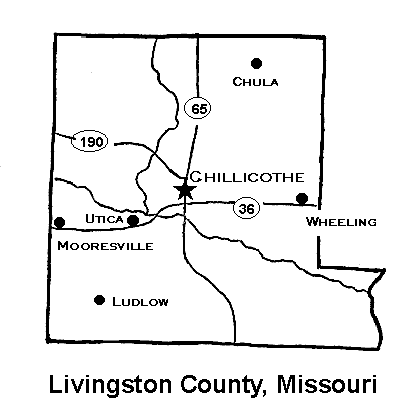 .
Indeed, the difference between the Livingston County Library and a large urban library is one of degree, not kind. On a smaller scale, the Livingston County Library is attempting to do the same as other libraries: provide patrons access to more information and supply that information 24 hours a day through the World Wide Web. The library, however, is careful to warn its users: “Have fun exploring the Internet but please remember that many times you will find the specific information you need right here . . . in books and periodicals.” By presenting users with traditional library resources and online access to electronic resources through the Internet and the World Wide Web, as well as an array of other services, the library is fulfilling its mission with enthusiasm and innovation. The resources in Chillicothe are more limited, naturally, than they might be in larger communities, but the same motivating spirit is there–to provide patrons with what they want and need.
The community supports the library and what it is doing. When the library recently asked for an increase in the tax rate (from .15 to .27 percent), the library director conducted a low-key campaign by talking to clubs, civic groups, and other groups throughout the county. There was no media campaign. The library simply presented its message directly to the public, the residents of the county weighed its merits, and the voters approved the increase in the tax rate. As in so many other communities, the library in Livingston County is valued, appreciated, and supported.
Working on a balanced budget, the library carries no debts. Its annual operating budget (including salaries) is about $250,000. The tax-derived base is supplemented by a small state appropriation and funds raised by a Friends group that was recently created to bring in money for special projects. Among these projects was the restoration of the old courtroom on the second floor to serve as a meeting place. The library’s regular operating budget covers all technology purchases.
Innovation is not hard to find in the library. On a table just outside the director’s first-floor office are the two computers that offer public access to the Internet and the World Wide Web. Such access is, of course, not that unusual in a public library; but in Chillicothe, where resources are limited, it is worth exploring how Internet access fits into the library’s service to the community.
The answer is to be found in the philosophy that drives all of the library’s programs–knowing what the community wants and needs–and delivering it. Libraries have different ways of determining what their users want. Some conduct surveys or study census data to determine a community’s characteristics and needs. In Livingston County, the mechanism is less scientific, but no less reliable in its reflection of community desires. The library director makes an effort to interact with community members and takes part in community events. She also serves users directly as the titular reference department. With characteristic modesty, she says: “I’m not sure I know what users want; I only believe I know what they want.” But her level of familiarity with the community makes all the difference. She meets regularly with the local chamber of commerce, civic groups and clubs, and other stakeholders.
The library staff uses the Internet to find information for patrons, such as book reviews, information about special interest books, journal articles, young adult titles, and other materials that the Livingston County Library cannot itself afford. As a result, interlibrary loan requests have increased over the past year. Traditional library materials and electronic resources together are filling the community’s growing need for information services.
Adult services assistant Sheila Davis–who taught herself the new technology– designed, developed, and mounted the library’s World Wide Web page (http://vax2.rain.gen.mo.us/~lclibrary/). The homepage provides access to information about the library’s dial-in catalog; a children’s library; Internet access policy statement; a young adult section; and information about the library, the county, and the state of Missouri. Two high school students supply the technical support for the library’s computer system. They began work in the library as shelvers, but now serve as the technical experts and maintenance staff for the system.
The spirit of experimentation is pragmatically based. In deciding to provide Internet access to patrons, for instance, the library chose to locate a computer in a public area and then see what would happen next. “We created the demand by making the Internet available,” says the library director. Inspiration came from her own first exposure to the Internet several years ago when she saw a demonstration of how the Cleveland Public Library used electronic technology. “I figured that what they were doing in Cleveland, we could do here, too,” Hicklin remembers. In making electronic information available to its patrons, the library decided not to invest in CD-ROM technology. “We skipped that,” says Hicklin, who explains that the library had no room to install a CD-ROM carousel or server. “We went straight to on-line Internet access, just as many other, bigger libraries have done.”
The library director points out that the library has stepped very carefully into the future. It has purposely avoided making a “big splash” by offering as much as it could all at once or trying to make resources available before the library was ready to deal with them. She warns that the tendency of some libraries is to jump the gun and raise the public’s expectations before they can be fulfilled. The library is also concerned about its ability to handle the potential volume of response. So far, it has not widely advertised the fact that the Internet is accessible through the library, fearing that it will be flooded by patrons and requests for information when the word gets out.
Livingston County Library has been responsible for putting together a partnership that provides Internet access to library patrons and others who live in the region. In 1994, Hicklin gave a speech at the local Rotary Club about the Internet, with little reaction. She was persistent, however, in her efforts to spread the word about the information revolution. Later that year, as others in the community called for access to the Internet, the library sponsored several organizational meetings, which were attended by about 25 people. The local telephone company, Green Hills Telephone Corporation, and seven other rural phone companies collaborated to bring Internet access to northern Missouri (the consortium is called RAIN, Rural Area Information Network). However, their actions were catalyzed by the library director’s leadership and the needs expressed in public meetings arranged by the library.
With the telephone company’s fiber optic service in place, the library staff set up a public access computer for Internet service. A local bank donated a second computer. Green Hills Telephone Corporation gave the library a place on its web server so that the library could mount its own homepage. The homepage provides visibility in the community not only for library services, but also for the telephone company and RAIN. The library offers Internet instruction and a place for residents to try out the Internet for free. Green Hills Telephone Company, through RAIN, provides a commercial Internet access and email service to organizations and individuals in the region. Through partnership, the community is served.
The library also is affiliated with MOREnet (Missouri Research and Education Network), which is a state-supported network serving universities and colleges, elementary and secondary schools, state agencies and organizations, and public libraries. MOREnet’s mission is to stimulate and be a foundation for the development, maintenance, and use of information sharing in Missouri. It fulfills its mission by introducing new communication technologies and educating people about them; maintaining, managing, and operating a statewide network; fostering cooperation among its members; and supporting its members’ education, research, and service missions. Members can be any public or private education institution or library, or any federal, state, or local government agency. The MOREnet consortium enables the Livingston County Library to share resources with the school, state, and university libraries on the system and to take advantage of the licensing arrangements that MOREnet has negotiated with information providers such as EBSCO. MOREnet has provided funding for public libraries to gain access to the Internet through a cost-effective network connection appropriate to the size of the library. Blazing new trails, in 1996 the Missouri legislature has funded MOREnet to coordinate state support of the development of local community information networks.
The library offers two public access workstations, which are used primarily for Internet access. These workstations are “homemade” 386-level PCs that have been upgraded to Pentium class. A local trust fund is donating money for two Pentium Pro/200 machines that will also be designated for public use. The library uses a 56KB leased line to connect to the Internet through MOREnet, which is the local Internet provider. The library’s homepage resides on the Green Hills Telephone Corporation (one of the eight rural telephone companies in RAIN) World Wide Web server in Chillicothe. The library maintains its catalog on a LISTEN system (St. Charles City County Library’s system). Patrons may use the catalog on eight public terminals in the library or through dial-in. The library makes periodicals in electronic form available to users through the EBSCOhost online service. One local area network connects the automated circulation and catalog system, and another connects the Peer to Peer Network that provides the Internet feed.
Livingston County Library attempts to make the most of its direct connections to the community. The library board is made up of active, interested supporters. One member, for example, is the county’s superintendent of schools, another is a political candidate, and another is an optometrist. All seem to share a deep concern for the library and the services it offers, and their pride in the library is apparent.
The library’s use of technology seems to have had a positive impact on the community. The computer terminals are used frequently, and attendance at evening training classes is strong and increasing. Users are experimenting with the opportunities offered by the Internet. One user, a retired businessperson, has worked to create a homepage and related links for a family business, located out of state, that his sons have taken over. But it might be too early to tell precisely how much difference access to electronic resources through the library will make in Livingston County. Green Hills Telephone Corporation, for example, so far reports limited response by individual customers to its Internet services.
In some respects, it would appear that the library is a bit ahead of the community by providing a service that the residents do not fully understand and are not demanding for themselves. The library director is probably correct in noting that the presence of the Internet terminals in the library is creating a demand, not satisfying one. Nevertheless, the library is looking toward the future, and the library director–who spends much of her time talking to community groups and businesspeople–is paving the way for the information revolution to arrive in northern Missouri. “I don’t think I’ve made a lot of changes in Livingston County,” says Hicklin, “but other people seem to think I have.” It is safe to say that in Livingston County one can see the impact that a strong library director with vision can have on a library and a community. Chillicothe is poised and ready to enter the 21st century partly because the library has provided the necessary leadership to make sure that when the new communications millennium arrives, Livingston County will not be left behind.
Tony Wening, a representative of MOREnet, claims that the Livingston County Library is not unique–the statewide network is allowing small and remote libraries all over Missouri to offer Internet resources to their patrons. Even so, this library stands out because of its accomplishments in a small setting, the energy of its library director, and its leadership in the community. In Chillicothe, there is only one place to go if you need information. It is the public library.
Hicklin’s impressionistic approach to community assessment, as useful as it is, cannot uncover the full range of community wants, much less the total information needs. At some point, a more solid assessment of the community could provide more reliable indicators of what the library should be doing and how it can use technology to satisfy various–and perhaps very different–community needs. Eventually, the library director might also be able to use technology to determine those needs, particularly of residents who live in more remote parts of the county.
The library may not have a strategic plan, but this does not mean it lacks a course to follow. Under the guidance of the library director, the Livingston County Library will continue to lead efforts to create networking opportunities in the county and the region. This includes efforts to provide Internet access to individuals through a community information network, a commercial partnership with cable television, or other means. Even without specific plans, the library is dedicated to offering greater services and increased access, particularly through technology.
At the same time, however, the library’s success in increasing public access will bring new challenges. For example, some of the librarians are concerned about the amount of information on the Internet. There is a need to instruct users–especially children–how to evaluate the information they find for reliability and credibility. Also, as more patrons use the Internet, the library will have to develop solid strategic and contingency plan–for expansion of services, enhancement of technology, and new sources of funding–so that it can know more precisely where it is going and what resources it will need to get there.

In 1977, the state Library of Michigan established 14 regional cooperatives to administer programs that allocate state aid to libraries. In addition, historically, the cooperatives have enabled public libraries to guarantee citizens access to information by providing services that can be delivered more efficiently by a larger organization. Examples of such services include group purchasing, central processing, or coordination of interlibrary loan. The Mid-Peninsula Library Cooperative (Mid-Pen) serves six counties in the rural Upper Peninsula of northern Michigan (http://blue.up.lib.mi.us/midpen/home.html). The constituents for Mid-Pen are the 13 public libraries in this large and sparsely populated area. The Mid-Pen member libraries together serve 129,667 people in an area larger than the state of Connecticut. The 13 libraries are located in communities that range in population from 2,000 to 15,000. The area is noted for lumbering, mining, and both summer and winter tourism. Communities are geographically dispersed, and harsh winter weather further isolates individuals from each other, heightening the need for alternative communications media.
At the Mid-Peninsula Regional Library Cooperative, important leadership changes have taken place since Council staff members visited in July 1996. Gary Silver, the Mid-Pen director, resigned in mid-July, and Mary Cary of the Escanaba Public Library has been serving as the acting director while the search for a new director proceeds. In this case study we have chosen to present our snapshot of Mid-Pen as it was taken at the time of the Council’s staff visit.
In July, Silver described the primary functions of a regional cooperative in Michigan today: to nurture local libraries, funnel state funds to them, provide technical support, and train library staff. Over the last ten years, Mid-Pen has evolved from a cooperative that served small, non-automated libraries, primarily through interlibrary loan and reference services, into one of the most technically advanced cooperatives in Michigan in its support of libraries’ automated services. It continues to offer reference and interlibrary loan services, as well as printing, discount purchasing, continuing education classes, books by mail, and the reprinting of local history books. But since 1994, the mission of Mid-Pen has expanded to include developing the information infrastructure of the region. This has allowed Mid-Pen to offer fee-based Internet services directly to the public, generating income to expand free public services in member libraries.
The cooperative is governed by a nine-member board of community members. Librarians from member libraries serve on a separate administrative council which advises the board and the director. In 1995-96, the cooperative derived 47 percent of its income from the state, 51 percent from federal sources, and 2 percent from contracts. Mid-Pen does not receive funds directly from the cities and counties it serves, but it does receive fees from member libraries for certain contract services, such as printing flyers and brochures. The cooperative itself does not serve the public directly as a library, but rather is a service agency that supports libraries. In 1995-96, the staff of the cooperative supported member libraries by circulating 9,210 items from its professional collection of 10,000 volumes, and answering 933 reference questions.
The Mid-Pen libraries themselves are funded in various ways. Each receives state funds of roughly $.45 per capita and local penal funds (all fines received in their jurisdiction). In addition, some cities, townships, and counties impose a tax based on property values. Regional cooperatives in Michigan, like Mid-Pen, allocate state and federal aid to level the resources available to public libraries.
 .
Within the Mid-Pen region, traditional library automation (circulation and catalog functions) was accomplished through a group purchase of Brodart LePac software for stand-alone systems in libraries. Two libraries had already automated with Dynix systems. Interlibrary loan is done through OCLC Group Access, and plans are under way to create a union CD-ROM catalog of Mid-Pen libraries. Mid-Pen purchased reference material for each library to use on public workstations and negotiated a group contract with OCLC for access via the Internet to the FirstSearch online reference service.
Of the many services Mid-Pen has provided over the years, librarians cite computer repair and maintenance servicing as the most important new thing that Mid-Pen does for them. In October 1995, Silver reported to the Mid-Pen board of directors that the cooperative’s technical support is cost effective now that each member is heavily computerized. For example, the Ontonagon Township Library (pop. 5,260) is typical of a small Mid-Pen library. In 1995, Ontonagon had one telefax machine, two Macintosh computers, and eight IBM clones. Of these, one IBM clone is used for OCLC/GAC interloan, five IBM clones are used for the library’s online catalog, one IBM and one Macintosh are for public use, and one IBM and one Macintosh are used for administrative purposes. The telefax machine is used for document delivery and interlibrary loan.
At the Mid-Pen office, a central Power Macintosh 8150 World Wide Web server supports the full range of Internet host services and the local area network for the Mid-Pen offices and training center. The Internet training center is a classroom with 20 networked workstations (ten PCs and ten Power Macintosh 6100/66 with DOS cards).
In the summer of 1994, representatives from the state Library of Michigan and from some of the more technologically advanced regional cooperatives (including Mid-Pen) met at a conference in Cincinnati to use the “Tell-It” method to evaluate the development and use of technology in their state. These library leaders developed a mission statement for Internet access for the state of Michigan. This statement is important because it is centered on Article 6 of the state constitution, which reads: “Every citizen should have access to all libraries.” In the context of electronic access to information, these library leaders interpret the constitution to mean that every citizen should have access to the Internet as well.
Subsequently, in 1994, the Library of Michigan initiated a statewide effort to provide Internet access across the state through a direct grant program. With LSCA support, the Library of Michigan granted individual libraries funds to connect to the Internet and regional cooperatives funds to develop regional technology training centers and connect to the Internet. Funds supported the establishment of additional Internet nodes, training and education, conferences and teleconferences, multi-type library planning, and projects such as community network development. Gary Silver credits the Library of Michigan for having a vision and moving quickly to invest in training library staff and building the infrastructure required for Internet access.
In May 1992, Silver and the Mid-Pen board decided not to replace interlibrary loan personnel upon retirement, but instead to use the money to attract outside funds to improve information technology and the telecommunications infrastructure in the Mid-Pen region. In order to connect the Mid-Pen libraries to the world through the Internet, in 1994 the board decided to “take it big.” This decision broadened the cooperative’s mission to include bringing the Mid-Pen region local access to the Internet and assuming an entrepreneurial role to ensure the financial sustainability of Mid-Pen and library services. The board realized that bringing the Internet to the Upper Peninsula would be a significant undertaking, since at the time Merit could provide only a few dial access ports within the existing infrastructure. That service would not be adequate or affordable in this isolated region. The decision also required that the board and staff of the cooperative be willing to take a financial gamble.
The gamble paid off and Mid-Pen is responsible for the presence of the T1 line in the Upper Peninsula that connects Traverse City to Iron Mountain to Marquette. Mid-Pen cooperated with Merit’s network MichNet to develop a MichNet backbone node to provide high quality Internet access to local communities. Since January 1996, Mid-Pen has operated a T1 line. As a backbone node, Mid-Pen pays no telecommunications fees, much to the benefit of its public library members. By late 1996 each of the six counties in the Mid-Pen region will have 56KB dedicated lines (six go directly into libraries) and public dial-in access through a local phone call. K-12 educators and students in the Mid-Pen area may also gain access to the Internet through Michnet via Mid-Pen.
The presence of the T1 line gave Mid-Pen the technical connection required to develop fee-based Internet services for the general public, which in turn helps to pay for free information services provided by the Mid-Pen member libraries. Mid-Pen’s Community Access service (http://www.up.lib.mi.us/Access/home.html) provides individuals or organizations unlimited connections to the Internet (including the World Wide Web, ftp, and e-mail), software, technical support, two e-mail addresses, and free Internet classes for a monthly fee of $20.00 and a one-time installation fee of $20.00. The fees received from each account are split equally between Mid-Pen and the customer’s local library. Mid-Pen’s Internet server has a 45-modem private dial-in pool for use by the approximately 450 subscribers to the Community Access service.
Because of the Mid-Pen T1 connection to the Internet, two additional Mid-Pen staff members have been employed, bringing the total staff to six people. The new staff members provide technical support, customer service, and training in a mix of free and fee-based services, to both member libraries and to the general public. For example, Mid-Pen member libraries pay the salary of the Mid-Pen’s web master, providing a low-cost means for maintaining web pages. Revenue generated by fee-based services covers the ongoing cost of the T1 line, server maintenance, technical staff, and ongoing investment in technology and training for Mid-Pen libraries. As a regional service organization, Mid-Pen supplies leadership and consultation, and sometimes serves as the incubator for new program ideas. For example, Kelly Sodergren (Mid-Pen’s systems administrator), Mike Gach (a technical consultant to Mid-Pen from Media Products Group), and Silver hatched the idea to circulate time-dated Internet passwords to the public for free, much as books are circulated. This would enable patrons to try out access to Internet resources from their own computer. Barbara Roark, director of the Spies Public Library in Menominee–a Mid-Pen member library–has adopted the idea and it will be a reality in her library by the end of 1996.
Mid-Pen used leverage to attract funds to support widespread Internet access for all libraries in the system. Mid-Pen’s Internet initiative began in May 1994, when it applied for an NTIA grant. Although the proposal was not funded, Mid-Pen learned a great deal in preparing it. In October 1994, a similar proposal was funded through LSCA I funds to build a training facility. Merit paid for installation of the T1 backbone, with the understanding that Mid-Pen would pick up the ongoing charges for the node. A $35,000 grant from the National Science Foundation in 1995 for “rural datafication” purchased equipment to offer public Internet access in libraries via dial-in to the MichNet backbone and modems for the Mid-Pen server. Installation of this node provided something that Merit wanted as well: a T1 redundancy to the Upper Peninsula of Michigan. This means that nodes now ring the peninsula, preventing any one network failure from cutting off all other nodes. A 1995 Library Services and Construction Act grant from the Library of Michigan equipped Mid-Pen’s training center with audiovisual and microcomputer hardware, a local area network, staff, and training materials.
From 1989 to 1996, members of the greater Iron Mountain community, including Mid-Pen, worked together to form a community information network called Walden III. The process welcomed total community involvement and produced an information system of content by and about the community. It linked public libraries; local government; schools; charitable and service organizations; social service agencies; and the medical, business and professional communities. The local government, school, hospital, chamber of commerce, and Mid-Pen served as chief partners. Mid-Pen was the physical home of the Walden III network and played an important role in the early growth of the project.
In 1994, Mid-Pen with other local organizations applied for an NTIA grant for a community networking project. Although the proposal was not funded by NTIA (but was subsequently funded with LSCA funds from the Library of Michigan), the 1994 guidelines for NTIA grant applications influenced the direction of the Walden III project: The community network was developed at the grassroots level and was nurtured by community resources. Gary Marsdon, a local businessman and backer of the community network, described the early excitement of developing the concept of Internet access through a community network–excitement shared by the library system, business partners, community leaders, educators, and social service agencies. People were generous with their time, hoping to see economic rewards and community services “on the cutting edge.”
In October 1995, Walden III incorporated as a membership organization, but after the new board of directors was elected the organization faltered. Significant differences of opinion and competing visions developed within this new board. In this case, the competing visions of how information service for the community should be developed and operated led to problems. As a result, many of the visionaries, including Silver, chose not to be involved with the network leadership and left the group in March 1996. Walden III became the Dickinson County Community Network (http://www.diisd.k12.mi.us/). The new Dickinson County Community Network is affiliated with the Dickinson-Iron Intermediate School District, which now provides a server, system maintenance, and ongoing volunteer student labor to help nonprofit organizations develop and maintain web sites.
Although there has been a breakdown in the development of this community network, Walden III was not a failure. Mark Ponti, a local businessperson active as an advisor to both Walden III and the successor Dickinson County Community Network, observed that Walden III “stumbled over procedural and organizational structures.” He suggests that new directions for the Dickinson County Community Network are being defined. The network is now “divorced from the business side.” It does not maintain information for commercial organizations, but instead points to a separate, newly developed homepage for the county Chamber of Commerce.
The Mid-Pen experience shows that community networking can be dynamic but fraught with conflict. There are many issues to be negotiated and resolved, such as whether the network should be an open or closed organization; whether it should provide free or fee-based services; whether it should have a local or a global homepage, and if the content should be local or global; and how publicly funded libraries and commercial vendors of information products and services can coexist. There is a need to separate nonprofit from commercial interests, at a minimum, to handle contributions and grants.
Beyond these organizational issues, the principal players in the Walden III network experienced a conflict of values. Librarians involved felt strongly that as much information as possible should be made available as widely as possible to all. They believe that the concept of ownership of information and the perception of commercial advantage or disadvantage derailed the most sincere efforts for cooperation among not-for-profit and commercial organizations. Also important to librarians, but not universally held among Walden III principals, were beliefs that the community network should serve as a forum for the people and that if everyone shares, resources will be unlimited. A joint “sense of ownership” of the community network became a very important issue. For some parties it was important that the technology be used and owned by all, but for others the need to “own” specific parts of the technology (the hardware, the software, the content) was important, and thus became a divisive issue. Mid-Pen experienced “virtual battles with real scars” over issues of ownership.
As a regional support system for libraries, Mid-Pen also struggled with finding the appropriate role for itself in local community network development. The Dickinson County Community Network is now independent of Mid-Pen. One community observer predicted that eventually the pendulum will swing back to involve the local library and Mid-Pen in the Dickinson County Network, for example, with the change in the directorships of both of these organizations since 1995, and with the ongoing redirection of the community network.
Mid-Pen now has a body of knowledge from the Walden III experience that it is using to support the four newer community networks in Escanaba, Menominee, Ontonagon, and Ironwood. Mid-Pen provides access to the Internet backbone, education and training, and technical assistance, and serves as a channel for state aid. Silver believes that getting support from many sources and leveraging the pieces to create a new service is key to making a community network work.
The Internet Kiosk was developed jointly by Media Products Group and Mid-Pen. Primarily local funds, and some LSCA I funding from the Library of Michigan in 1996, supported the development process. Mid-Pen now owns 20 percent of the product, which has the potential for commercial sales. The kiosk offers an interactive tutorial on using Internet information resources and Internet access through easy-to-use technology. The kiosk is designed to be used in library public service areas to handle routine Internet instruction and guidance, and in public areas, such as shopping malls. These instructional features and guided search functions are especially important to help librarians in small, often one-person, rural libraries concentrate on the more complex parts of finding information for patrons and less on routine instruction.
The kiosk is designed as a PC with touch screen in a box, similar to an ATM machine. The product is an interactive multimedia CD-ROM with an Internet connection, which can also be used on a high-powered, multimedia personal computer–that is, without the box. Netscape is integrated into the product, which can display a screen split between the interactive, multi-media teaching resource and the online Internet activity. The local library can modify the front-end software to show the library name, a local map, and local information resources.
An LSCA III grant from the Library of Michigan was made for production of a prototype for beta-testing in fall 1996. The product has been demonstrated at several library conferences and to Michigan librarians, who were enthusiastic about it. Mid-Pen librarians, too, have reacted favorably, commenting that it is “simple [in] design and very accessible but with complex functionality.” The developers are searching for venture capital to bring the product to full development and to the marketplace within the next year.
When asked his views on the impact of the Internet, one frequent user of the local community network and Internet chat services said, ” I don’t go to the library anymore!” He speculated that attendance at the library had dropped. But at this point, his own local library had not yet set up public access to the Internet. He felt that Internet access at the library would be desirable, because “the Internet is a way for people to become more knowledgeable about everything.” He reported that his personal Internet contacts have increased his automobile business, and praised Mid-Pen for being the first to offer Internet access in the area.
 .
The Mid-Peninsula Regional Library Cooperative has made great strides toward addressing what Gary Silver describes as the “long-standing need for a communications process that overcomes our geographic sea of separateness.” Community networking efforts set in motion by Mid-Pen are still in an early stage. As the efforts evolve, Mid-Pen and other regional library cooperatives with community networking experience can perform a great public service by sharing their experience and information. Further, Mid-Pen “drove a golden spike” for telecommunications in the Upper Peninsula. Silver says, “with information infrastructure development and electronic community networking, there are going to be as many golden spikes driven in this region as there are communities needing and willing to drive them. At the grassroots level, each community must discover the mix of action that brings success.”
For the time being, building and maintaining the physical telecommunications connections required for community information and networking services will continue to preoccupy libraries, as it has Mid-Pen. However, Silver notes, Internet access services are a passing thing. In the future, homes will be connected by cable directly to the telecommunications infrastructure. To prepare for the future, he advises, libraries must concentrate on content–on selecting or creating high quality, usable electronic resources–rather than providing access alone.
Small, isolated public libraries will benefit greatly from new products and services being developed by both the commercial and nonprofit sectors to make information available in electronic form. The Interactive Internet Kiosk, for example, while intended to assist the library patron in any setting, can be used in remote locations with no access to trained information professionals. Such products will help connect people to information and to other people, with instruction and guidance built in for those who need it, in ways that would not otherwise be possible.
How will Mid-Pen continue to support the technology growth that will connect more of its constituents? Silver would like to find the funds to expand the distribution of Internet access, develop local content on community networks, save for second-generation library automation systems, and greatly increase training opportunities. Through Mid-Pen, Silver has found innovative ways to sustain the cost of electronic services through some fee-based services, but also through a variety of partnerships and funding coalitions. Leadership with vision has brought to Mid-Pen, its member libraries, and their constituent communities a strong foundation of information access services upon which to build information and communication services for the future.
 .
The Public Library of Charlotte and Mecklenburg County (PLCMC) was established in 1903. It is the largest public library system in North and South Carolina. The main building of the PLCMC occupies the site of a Carnegie free library that was established in Charlotte around the turn of the century. The site is significant, for just as the old Carnegie library served the community by providing information in a new age, the PLCMC today aims to give the community the information it needs for the emerging electronic era.
The library system reflects its environment–a city that values information and education and is increasingly rich in technology, business acumen, and entrepreneurship. Charlotte is a city that supports civic and cultural activities with gusto. Much of the central downtown area (actually called “uptown”) is under total revitalization with new high-rise buildings, many still unoccupied, replacing old buildings. The preservation of historic sites and buildings seems to be a fleeting concern. The library is located within this matrix of new skyscrapers, new plazas, and gleaming glass. Historically, the library has had a solid presence in its city and county; today it is a strong component of a city that is striving to become a leader in business, technology, and information.
The PLCMC consists of a main library and 23 branch libraries. The branches, like the glass buildings uptown, reflect the communities in which they are located throughout Mecklenburg County. Each branch develops its on-site collections based on walk-in patron needs. The library serves a population of 570,000 residents and 3,000 non-residents. Its collections consist of 1.3 million items. A growing circulation (more than 5.5 million items in 1994-95) and a busy reference desk (which answered nearly 2.1 million queries during the same period) reflect the library’s level of service to its public. The library’s information systems also are made available to the local public at 105 computers at 63 community sites and 40 school sites.
A decade ago, it became clear that the library could not keep pace with a changing community environment by simply maintaining existing services and resources. The renovation of the main library building and the hiring of a new director, Robert Cannon, in the 1980s provided the opportunity to rethink the long-term vision of the library as a community resource. As it turns out, much of the vision that sparks the library’s programs today was formulated during its temporary occupation of a warehouse as the renovations to the main building were underway.
The library’s leadership has set a course for PLCMC that is ambitious and visionary. The five-year plan for 1995-2000 sets the goal in very particular terms: PLCMC wants “to be the best public library in the nation.” That goal has even been incorporated into the library’s mission statement. But the strategic plan also expresses a corollary for the library: “It is the goal of PLCMC to be the most innovative, creative, original and forward looking library system in the country.” Indeed, in 1995, it was named National Library of the Year by Library Journal and Gale Research, Inc. In the same year, county voters passed PLCMC’s largest single bond authorization for new branch libraries–$9.7 million.
PLCMC is governed by a seven-member Board of Library Trustees, six of whom are appointed by the Mecklenburg Board of County Commissioners and one by the Board of Education. One of the library’s legacies as a Carnegie Library is the fact that its governing board is independent and thus can determine for itself crucial portions of the library’s mission without political interference. The county, however, provides 95 percent of the library’s operating budget, and the voters have a direct say in library expenditures when bond referenda go on the ballot. Per capita support for the library amounts to about $23.
Other revenue sources include state and federal funds, library-generated revenues, and gifts and grants. Businesses that support the library and its activities include Microsoft (particularly for providing under-represented portions of the population with the means for acquiring information through technology) and NationsBank (which maintains its corporate headquarters in the city). The library also receives a share of money that comes from the profits of liquor sales made through state-operated ABC stores.
 The Virtual Library learning laboratory offers a place to learn and experiment with new technology.
In its transition from traditional to new technology, library staff describe the stance of the PLCMC as “stepping over a stream,” with one foot placed firmly on each bank, representing the new and traditional. However, the library is experiencing tension between old and new, between books and computers.
Partnerships with local businesses and community organizations, while providing the impetus for change and expansion, also raise user expectations as well as the visibility of new services. The community attracts those who embrace new technologies. In this environment, the library is able to move quickly and effectively to take advantage of opportunities for new funding and the availability of volunteers to meet its community’s information needs. However, the pace and level of change necessarily limit the ability to develop solid, long-term goals. As technology and the PLCMC evolve over the next year or two, elements of the institution’s five-year plan may change substantially.
The PLCMC system has been a front-runner in the use of technology and did not wait for state support to move ahead with technological innovations. It has since augmented its own programs by being the first public library system in the state to become part of the North Carolina Information Highway, a state-sponsored interactive network. A newly renovated and technologically equipped auditorium in the library’s main building has been outfitted recently to handle the interactive programs of the NCIH. But long before the inception of the NCIH, PLCMC was implementing its own plans for increasing public access to electronic information.
At the heart of PLCMC’s innovative endeavors is the support it receives from businesses and the community. That support, however, does not come without costs. Despite business and community support for introducing new technology, there are real concerns about technology start-up costs and the licensing fees for network use of software. Acquisitions budgets must be planned carefully to strike an appropriate balance between books and software to meet the needs of all types of users. Technology, in other words, costs money, and the PLCMC’s ambitious plans face the ever-present challenge of funding.
The cost comes not only in dollars. For all its innovation and high standards of service, PLCMC has had to contend with the strain that is created by the introduction of technology into the context of traditional library services. There is great community concern that print materials not be replaced by digital information. An autonomous Board of Trustees helps assure patrons that traditional services will not be forsaken; at the same time, the board’s independence allows it to exert pressure as necessary to bring about technological innovation. The library leadership expresses its intention to make a “graceful transition into technology.” Yet the fear among many residents–even in Charlotte with its high-tech, information-rich business climate–is that the print world will be neglected. As the library puts greater emphasis on technology and receives more funds to support electronic expansion and development, it becomes increasingly difficult to support other library operations.
Change is a hallmark of operations at the PLCMC, whether or not new technologies are involved. The library’s management encourages tactics such as challenging the status quo, encouraging action, and downplaying the importance of the routine in favor of innovation. It is important, the director believes, to “always be offering something new.” In that kind of environment, it is difficult to provide the necessary checks and balances that would help make expansion and new ideas more deliberate and targeted. It also is difficult to integrate the best from past experience into the new environment.
The library sponsors numerous special events and offers many services, with more added each year. The five-year plan notes that the library “will ‘reach out’ to new customers and provide new services to reach those customers.” Much of the progress occurs in an “experimental” management mode that encourages risk-taking. An overriding and explicitly stated value is to concentrate on moving forward with varieties of new projects, products, and services, while finding “some way” of maintaining ongoing activities. As one staff member explains, “At least 50 percent of my job is working with users on new services; somehow, we just have to find time to do the rest.” It is not entirely clear, however, where that time will come from. The desire to create an environment that tolerates mistakes, especially when those errors become building blocks of learning for later successes, sparks creative change, but may lead, inadvertently, to carelessness. In addition, leaders are aware that risk-taking jeopardizes the stability of ongoing services–those day-to-day activities that make up any library’s routine and, to a certain extent, are its raison d’etre.
The library makes Internet resources, an online catalog, indexes to periodical resources (via CD-ROM on building-specific local area networks), and Charlotte’s Web (the community network) available in the main library and throughout each of the branches. Users outside the library may gain access to the library’s online catalog (a Dynix-based system) as well as Charlotte’s Web.
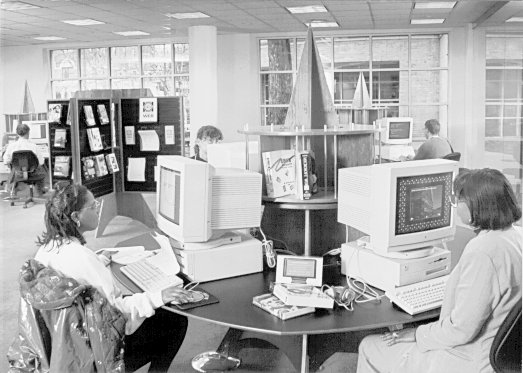 .
The Virtual Library, a technology laboratory opened in 1995 in the main library building, provides public access to the Internet and to the community network, Charlotte’s Web. Library staff and numerous community volunteers lead five to seven workshops and six introductory tours each month in the Virtual Library that are aimed at teaching Internet and computer fundamentals, and several other courses on specific software packages and computer applications. The Virtual Library houses 20 high-performance workstations and three local terminals. Half of the stations are Macintosh Power PCs and the other half are Gateway Pentiums. The inclusion of both platforms allows patrons to explore the different qualities of each. Most stations include 16M of RAM, double-speed CD-ROM drives, and full multimedia capability. Five new stations are used for imaging, multimedia, and Geographic Information and Analysis (the library is one of two public GIS sites in the state). These stations have 32M of RAM, 1 gigabyte hard drives, quad-speed CD-ROM drives, and 20- or 21-inch monitors. The Virtual Library LAN connects workstations to two file servers, 24 networked CD-ROM drives, the library’s T1 connection to the Internet, and both a black-and-white and a color printer. The PLCMC calls this the “world’s first all electronic public library.”
Charlotte’s Web, the community network providing free e-mail accounts and electronic computer access to educational services, resource materials, and public information, is a project of the PLCMC in partnership with other community organizations. The library provides the institutional foundation for Charlotte’s Web, whose five staff are library employees. Start-up and continuing funding have been provided by two Telecommunications and Information Infrastructure Assistance Program grants from the U.S. Department of Commerce, along with matching local funds. Technical specifications for the network are described in several pages on the Web site, along with the following comment by the system administrator: “Most commercial information providers and computing centers refuse to share specific details of the inner workings of their systems. This is the only such system description publicly available that we know of.”
The library director and other top managers speak the language of business visionaries, with most of their time and energy–and communication–focused on the library as it will be two to three years down the road. The tools for translating such a vision are in place. The management team bridges between this future orientation and the daily activities; staff and users understand that they must help make this ever-changing venture succeed.
How a risk-taking, entrepreneurial management style can be reconciled with providing consistent, credible, and dependable service to users depends upon the talents and enthusiasm of department heads, managers, and staff members. Staff at all levels are urged to think about new possibilities, and they can be visibly enthusiastic and excited when they discuss their part in the library’s changing situation. Working in a library that has won so much recognition encourages the staff, even when stress is a part of most work days.
As the library continues to provide traditional and electronic services, professional librarians have been supplemented with other types of staff and expertise (including computer specialists) throughout the system. It is far easier, the director admits, to gain and fund a technical position than to hire a librarian. Like the tension between books and online access, the tension between traditional and new skills must be accommodated. In some cases, positions have been filled by newer library school graduates with a grounding in the tenets of librarianship along with the training to manage new technologies. In other cases, longer-term MLS personnel are learning new skills on-the-job. In a number of cases, skills from other professions are being applied to the library’s changing environment: the head of the public Virtual Library left the world of retailing in mid-career to become a librarian. The director of Charlotte’s Web, Steve Snow, is a former editor of the Arts pages of the Charlotte Observer. A key volunteer coordinator is a former special education teacher. One of the biggest challenges is keeping the personnel structure in balance and not allowing technological needs and expansion to outweigh the need for solid knowledge of library principles and practice.
Staff develop their own job descriptions and evaluation criteria; the five-year plan clearly articulates how a multifaceted, complex vision can be broken down into tasks that are possible to accomplish. The staff must learn what is necessary to keep up, but without degrading or neglecting service to patrons. Each library employee’s job description contains an element that requires up to 50 percent of his or her professional activity be devoted to customer service. This emphasis underscores the latent importance of traditional values at PLCMC. Service is something professional librarians are trained to give and to give well. PLCMC has become a dynamic example of the opportunities and the challenges that public libraries must confront as they straddle the old and the new.
The library is perceived as a leading and contributing partner in city activities. It also is seen as a means for obtaining trained information workers for business. Because of its very real contributions to tourism, the work force, and the information needs of the community, the library is supported by businesses and the general public alike. Charlotte likes to think of itself as the “can-do city.” This “can-do” attitude and the effective follow-through in making the technology relevant to the lives of citizens and the needs of business is primary in the library being seen as a key resource in Charlotte.
Charlotte’s Web emerged from various initiatives for a community network and from a declared need for a local information provider that could augment dissemination of community information. When the time came for action, the library evolved as the institution to lead the management and expansion. Many people in the community understand that several other institutions could have assumed leadership of the community network. However, they deem it significant that the library stepped forward, asserted leadership when it was needed, and now carries on the network development and outreach throughout the community.
In many ways, the viewpoints and activities of users, volunteers, and staff members are quite similar. Users express a sense of ownership and personal pride in their uptown library, its branches, and the new technology. A corps of regular volunteers helps other users, volunteers, and staff to learn new software as it becomes available–from simple tasks like turning on a computer to the most complex challenges created by networking and Internet use. The spirit of cooperation and shared knowledge is demonstrated by staff as well. They are aware that only through the cooperation of the community could the public library have advanced to its current technology-rich state and could it continue to implement new branch buildings, services, and technology upgrades.
Today, the technology allows the library to reach out to the community in ways that it previously could not. Since underprivileged and under-represented populations often seek assistance, a number of workshops are geared to their needs. Partnerships with civic groups, such as the Men of Valor (an African-American group similar to the Big Brother program), have increased the library’s reach into the community. The Virtual Library, which enjoys heavy use by the public, places a great demand on the services of staff librarians. Even with its heavy use of volunteers for workshops and other training programs, the librarians have found that they are spending more one-on-one time with patrons in the Virtual Library than in other departments.
Charlotte’s Web also places an emphasis on people and their role in the community. Under the leadership of Charlotte’s Web staff, volunteers are retooling hundreds of donated PCs for distribution to citizens and community centers throughout the county, to provide network service, while other volunteers are developing training materials and leading workshops for community groups. Most recently, the library obtained funding for an eight-month period that enables 25 non-profits in the Charlotte area to develop homepages for the Web.
As envisioned by its director, Steve Snow, Charlotte’s Web is not about technology but about people. As the network developed over 18 months, Snow candidly admits that Charlotte’s Web changed his idea “of what a library is.” The library, he says, “has convened the community in a way that no other community institution could do.” The network “delivers information, creates information, and shares information.” In so doing, it emphasizes “the value that every person has in the community.” Charlotte’s Web is viewed by its founders as “a bastion of little ‘d’ democracy–intentional democracy,” and its continued development is driven by that principle. This philosophy and the technical capacity of the network have enabled the community to draw together and share ideas and information in new ways.
The network is becoming a regional community project, something its founders had not foreseen. Unlike PLCMC, where the director likes to keep things intentionally off balance to stimulate innovation and growth, Charlotte’s Web was designed to achieve a balance in the community. For example, the Web is working with nonprofit organizations to train employees about the uses of technology in their efforts to provide their own institutions with continuity and community support. The point of the network is to deliver services and information so that both individuals and institutions can profit from what’s available on Charlotte’s Web. Although it is not clear whether the intended balance has been achieved, it is evident that the community network already is helping the broader community.
Users have found out that there is educational value to the Virtual Library and to other services offered in the library’s various branches. The Virtual Library and the other parts of the public library provide materials and individualized attention to public school students; they enhance the work of the schools, which often do not have resources to provide as much personal time as students would like to have from teachers. A greater variety of software at the library also enhances student familiarity with computers and their technological capabilities. The Virtual Library offers popular software applications such as desktop publishing, image scanning, and other audio-visual technology. But learners are not only young students. Many adults are discovering self-education through the use of Charlotte’s Web and the Virtual Library, especially in acquiring new job skills. Job seekers look to the library for information about entrepreneurship and small businesses, about developing resumés and job letters, and gaining experience in working with new software programs.
The library also teaches new residents about the community and Charlotte’s Web helps them develop networks for personal or job support and discover what is going on in the area. This means that the library’s new technology is helping old and new residents alike to become better informed citizens and to work together on issues of common interest. The library’s services, particularly Charlotte’s Web, help residents get information about public schools, youth groups, social action committees, and other civic activities. Long-term users become quite knowledgeable about political processes and personalities, and how they could affect support for the library. For example, patrons in the focus group ably articulate which City Council members favor library programs and how decisions are made about library resources. Online, virtual communities are developing around interests, such as public education, children’s rights, and genealogy.
New technologies–within the library buildings and in remote sites–are improving interactions among information “haves” and “have-nots.” Within the Virtual Library room, homeless and jobless persons, along with employed residents, share information and answer each others’ technical questions at groupings of carrels that promote interaction. Outside of the library, five terminals with text interface and e-mail have been placed in a men’s homeless shelter to provide information and job services to the displaced. A women’s and family shelter is also the home for a Charlotte’s Web terminal, which provides text and graphical interface. In the central bus terminal, one finds a Charlotte’s Web touch-screen terminal available to the general public.
There is also an emphasis on how the library can serve the business population of the area. The central location of the library in the uptown district has helped the library’s expansion and the development of new services. The International Business Library (IBL), which includes electronic and print reference resources, was created in 1994 with backing from area firms, including NationsBank. An outstanding business collection, described in a well-crafted section of the library’s Web page, draws researchers from businesses throughout the area. Because the library is located in the business district, it is able to serve its steadily growing clientele efficiently. The librarians and collections enable businesses to search resources themselves, whether from within their company or at the library. In establishing the IBL, the library looked to the local Chamber of Commerce, the local chapter of International House, and local international businesses to define what the IBL should be and what services it should offer. Business donors have continued to provide funding that sustains the operations.
In the branches, users rely on new technology and their electronic linkages to Charlotte’s Web and the World Wide Web, but they also perceive the branch locations as community centers. The placement and use of branches is another example of the “seamless” library in action. “Unity in essentials; diversity in community” is a guiding principle for the development of branches. It is a testament to the library’s role as a gathering place that bond issues continue to support upgrading and building of branches.
It is unclear exactly how this new information network is affecting the community. As yet, no user surveys have been undertaken to show how the citizens are responding to the services that PLCMC offers. Likewise, in these early months of development, there has been no scientific measurement of the potential or current user base of Charlotte’s Web and the Virtual Library. Although one can observe that the library is a vibrant, busy place and that access to online information is increasing, user surveys and studies will be needed to help forecast future development.
PLCMC faces some difficult issues in the near future, particularly as it approaches the completion of its five-year plan in the year 2000.
 .
As technology is changing rapidly, libraries must adapt to the realities of shifting technical environments. So, too, they must adapt to new environments resulting from changes in leadership. At the Seattle Public Library, important leadership changes have taken place since Council staff members visited in May 1996. The library director resigned in August 1996, and since then the director of the library’s Center for Technology in the Public Library has moved on to begin a new project elsewhere. Instead of analyzing the forces that lead to changes in leadership, we have chosen to present our snapshot of the Seattle Public Library as it was taken at the time of the Council’s staff visit.
The mission of the Seattle Public Library is to provide broader public access to its vast resources, and to promote lifelong learning and a love of reading. The library’s mission statement reflects its desire to be responsive to community needs. “We exist to serve our customers and we need to be flexible to find ways to do it,” said City Librarian Liz Stroup when the Council staff visited Seattle.
In its brochure, the Seattle Public Library describes itself as “one of the busiest urban public libraries in the country.” In 1994, the library circulated 5.2 million books and other items (10 per person in the city) and answered 1.43 million reference questions. It serves a population of 532,900 (1995 estimate) through a central library downtown, 22 branches, bookmobiles, and online services. The city of Seattle funds the library. In Washington, where there is no state income tax, there is also no state funding for public libraries. The library is governed by a five-member citizen’s Board of Trustees appointed by the Mayor and confirmed by the City Council.
At the Seattle Public Library “serving those who need us most” is a priority. The library has highly visible programs serving teens who drop out of school, teenage mothers and their children, those who are learning English, those who are learning to read, those who have handicaps that prevent them from reading without assistance, the homeless, the unemployed, and economically disadvantaged children who need homework help. The library holds “those who need us most” at the center of program development. It tries to acknowledge and serve the multiple cultures of the city, the most visible of which are the growing African American and Asian American populations. Greater awareness of the considerable needs and cultural diversity within the community has produced an environment in which experimentation is sanctioned as a way of determining which services or information resources might be most effective in specific neighborhoods or for specific groups of people. As a result, programs and services have multiplied. The library’s approach to delivering information electronically is guided by the same understanding that different approaches may be required to serve different audiences.
“Literacy is crucial to the role of libraries,” Stroup says, noting that 70,000 Seattle residents are functionally illiterate. With many recent immigrants to the city, waiting lists are long for courses offered by the community colleges in English as a second language. The Seattle Public Library views initiatives for literacy, reading, and technology as interrelated. The library has established a ten-million-dollar endowment fund from which it uses the income to operate three centers for research and outreach: the Center for the Book, the Center for Literacy Advocacy, and the Center for Technology in the Public Library. Through these centers, the library can try out programs that use new approaches to address community needs. The centers provide the library with experience upon which to base decision making about programs and services.
The library is using technology to serve the community in a variety of ways. The following are among the more notable applications.
Stroup describes the library as having been behind in automation before she arrived in 1988; for example, it did not yet have an online catalog. She notes that great advances in the adoption of technology since then have been “quite a remarkable paradigm shift for our staff.” Working primarily from appropriated city funds, the library has made extraordinary strides in making information in electronic form widely available throughout Seattle. In 1995, Stroup said “The Seattle Public Library is in a unique position to aid in the development of the new information infrastructure and to direct its benefits to the citizens of Seattle.”
World Wide Web Site From November 1994 to March 1996, the library’s gopher site served as the primary online guide to library information, with links to community and government information resources. Since April 1996, these information resources have been available through the library’s homepage (http://www.spl.lib.wa.us) and ongoing development has shifted to the World Wide Web environment. The main menu of this homepage leads to the library’s catalog, a guide to library services, IAC’s Magazine Index (password-controlled for use by registered borrowers), Lynx World Wide Web search facilities, a community calendar, recommended reading lists, and a directory of community organizations. Web site development is decentralized and carried out primarily by public service librarians. This ensures that the library’s web site reflects the staff’s knowledge of community information needs and understanding of the way people look for information.
Online Catalog Seattle Public Library patrons may use the online catalog of the library’s collections and place titles on reserve at terminals or workstations within the library and through dial-in, telnet, or the World Wide Web. In 1994, the library recorded 370,398 dial-in computer users.
Internet Access The library provides gateway access to the Internet free to users within or outside the library for up to 90 minutes per day. Free public Internet training classes, called “Driver’s Ed. on the Information Superhighway,” started in February 1994. These classes are offered several times per week and are filled to capacity.
Homework Centers In October 1995, the library opened its fifth homework center. It is equipped with personal computers, fax machines, copy machines, and indexes to journal articles (IAC’s Infotrac), as well as reference materials, textbooks, and tutors.
Public Information In 1994, the library unveiled a self-service government information kiosk, the Washington Information Network (WIN) kiosk, with touch screen and printer at the central library. The WIN kiosk, developed jointly by the State of Washington Department of Information Services, IBM Corporation, and North Communication, provides information from 20 state and federal agencies in English and Spanish. It lists job vacancies, vehicle registration procedures, immunization requirements, job training opportunities, small business assistance, student loan procedures, and other state information.
In October 1994, the Seattle Public Library became the first public library to offer free access to federal databases online directly from the U.S. Government Printing Office. This service enables users in the library, from branches or by dial-in or telnet, to view texts of the Congressional Record, the Federal Register, and bills of the U.S. Congress days before printed versions are made available.
An electronic geographic information system (GIS) that stores and uses information describing places on the earth’s surface has been developed by the Seattle and King County government departments for the greater Seattle area and is available for use by the public in the central library. The system brings together both spatial and descriptive data from the Seattle Comprehensive Plan and the King County Department of Planning and Community Development. It presents the information from a variety of perspectives enabling use for multiple purposes, such as land use and zoning, public facilities, natural features, hazards, and planning and infrastructure (roads, bridges, and public transit).
Computer Laboratories Through a grant from the Libraries Online! program of the Microsoft Corporation and the American Library Association, the library acquired hardware and software to equip community learning laboratories (computer labs) at four locations. Funding also provided T1-level network connections and acquisition of a CD-ROM collection for each lab. Each lab can carry live video and audio. The library has established one 17-workstation lab in the central library, a ten-workstation lab in the Rainier Beach branch, and a five-workstation site in the High Point branch. In addition, a twelve-workstation lab at West Seattle High School was established as the centerpiece of a community partnership, “West Seattle Learns,” with the high school and TCI, Inc., the local cable company.
An HP 900-K200 computer serves as hub for the library’s online Dynix catalog, which is available at 90 workstations and on 400 terminals throughout the library system and via dial-in and telnet. Electronic journal indexing and full-text are acquired online from IAC and made available at workstations and terminals in the central library and branches, and by dial-in or telnet.
Throughout the library, 90 workstations (85 PCs and 5 Macs) and 195 terminals are available for general use in public areas. Of these, 30 workstations and some 170 terminals offer access to text-based resources on the Internet (only) and 20 workstations offer access to the Internet with full graphical capabilities. The library’s high-end workstations are Pentium P120 PCs. In addition, the library has placed two workstations (one with World Wide Web capabilities) in a self-service library located in a community social service center.
Five Unix machines in the central library support telecommunication services including the library’s gopher services, the library’s World Wide Web site, a web site for libraries in the state of Washington, and Internet mail services. The library system connects to the Internet through a frame relay 512KB line and a leased T1 line. It uses WLN and PSI as local Internet service providers for staff and public use. All branches connect to the Internet through the library’s wide area network at speeds ranging from 19.2 to 56KB and have text-based access to the World Wide Web. Six branches have graphical access to the Internet through dial-up PPP accounts. The library would like to place routers and hubs in each branch and use frame relay technology for network connections. The strategy is to make one branch at a time fully operational as funds permit, acquiring a Tl line and the capacity for using multimedia resources. The library maintains a Novell 4 network in its bibliographic services department. Microsoft NT local area networks operate in each of the community learning laboratories. In the labs, CD-ROM products are loaded on the ten gigabyte hard drives of the network servers to speed local access to interactive multimedia products.
In a proposal submitted to the library Board of Trustees in 1993, Liz Stroup said that while many opportunities exist for using new technologies in libraries, the benefits of these technologies have not been realized. Subsequently, the board approved the proposal, which established a Center for Technology in the Public Library at the Seattle Public Library. The center is a research and development institute dedicated to applying information technologies to public libraries. It is the first public library institute of its kind in the country, and is funded through an endowment managed by the library board. The center director works with high-technology companies, universities, foundations, government agencies, and electronic publishers to explore different avenues for delivering information electronically. The center also serves as a clearinghouse to help others find solutions to their technological problems.
At the time of the Council’s visit in May 1996, the center had a staff of three, including the center director, Willem Scholten. Scholten and his staff were conducting experiments not only to find technical solutions to problems, but also to improve interactivity among organizations. To date, the Seattle Art Museum, community colleges, and high schools have participated in experiments and pilot projects. Library school students (as volunteers or interns for credit) work in the center to gain practical experience in library technology. The center has managed the library’s participation in the Libraries Online! program, and development of the library’s four computer laboratories.
In 1988, using focus groups, the library produced a mission statement and defined three niches for the library: information gateway, point of outreach to those with the greatest need, and center for multicultural lifelong learning. In 1990, a task force began to look at Seattle in the year 2000 and produced two strategic documents: the Master Facilities Plan and the Vision 2000 Document, which describes services. As part of the planning process, the library created a citizen’s advisory board, held more than a dozen public hearings, and conducted more than two dozen focus groups. These efforts earned the library an award for “department of the year” from a Seattle neighborhood group in 1993.
To aid this strategic planning process, library staff used 1990 census and GIS data, which was especially helpful in locating populations of senior citizens and children under 18. The planning process enabled the library to change its emphasis. Previously, the central library had served as an in-depth reference service and the branches had served as providers of popular literature. Now, it has adopted a single emphasis on lifelong learning through out the library system. During the planning process, the library became aware of the growing number of small businesses in the city. In response, it has bolstered services to business through the establishment of a small business collection and a Pacific Rim business information service.
Strategic planning suggested a variety of ways that the public library could become more relevant to the community and improve service to its clients. The library provided multicultural awareness training to all of its staff. Also, staff members are empowered to make exceptions to any rule, except confidentiality, and are encouraged to treat each customer as a very important person.
To make the institution–the central library and branches–more relevant, the library has looked at the whole city to decide what information services are appropriate for each location. Developing and sustaining services to fill the needs of particular communities sometimes requires a give and take, says Gloria Leonard, the advocate for neighborhood libraries (the manager of branch library services). She looks to see who is not being served–displaced workers, for example. She then identifies resources in other parts of the library system that might be “pulled back” to support initiatives for that underserved audience. If, for example, the schools offer services late in the day in one neighborhood, the library might ask if some of its own educational services are redundant at that location. Or, instead of cutting back other services to find the resources to meet unserved needs, the library might find an agency with mutual interests, and, through collaboration, find the resources to initiate or expand a service.
In Seattle, new technology has created opportunities, but it has also required that staff members take on new roles and responsibilities. Stroup observed that there is a natural tension between line operations and the library’s three centers that are trying new ways to carry out the library’s mission. Some staff members are being pushed “outside their comfort zone” as they are asked to try new ways of doing things. For example, Ray Serebrin, the advocate for lifelong learning, describes the library’s community learning laboratories as a way for middle managers to experiment with new services. Library staff members have received orientation to the central library computer lab. After orientation, librarians are asked to invite community groups to the lab. There, they introduce group members to electronic resources of potential interest and learn more about the information needs of various groups. These efforts parallel the way the library approaches the development of programs for adults, and push line staff into greater contact with grassroots organizations. This is in contrast to the more familiar pattern of reference librarians working one-on-one with individuals to find the information requested.
Training staff to understand and use changing technology is a concern for the library system. Leonard emphasized that team leaders and administrators need to build in time for training, as well as time for staff to experiment with technology. Bringing training to the staff is especially important because not everyone can attend professional conferences. She described how the library’s in-service training spotlights services within the system and seems to boost the morale of branch team leadership. Branches need to have resident technology experts, she notes. In addition, however, individual staff members learn through training support modules distributed over e-mail and by using e-mail to share information.
.
Over the last decade the library has been building a technical infrastructure that enables it to serve its public in new ways. The library has developed programs for specific populations, developed local electronic content, and formed partnerships with local agencies to meet specific goals. With the World Wide Web and computer laboratories, especially, the staff is reaching out to new groups.
Community Learning Labs bring technology to the public and provide facilities where groups may use electronic information together. The Rainier Beach branch was chosen as the site for a lab because there is strong community involvement with the branch library, an economically disadvantaged population of diverse ethnic composition lives in the neighborhood, and the branch library is within walking distance of three schools and a community center. An advisory committee of community members governs the use of this lab.
A second lab was established at the High Point branch in a public housing project. The lab is used heavily by children after school. Branch librarian Erica Sternin said that since the computers were installed, more people are using the building (40-50 children after school in two small rooms), and that there has been “a 55 per cent increase in the circulation of children’s materials over last year.” She described the delight of a young Somali girl, daughter of immigrant parents who do not yet speak English, who learned word processing and found information in the lab for a paper. The student earned an A-plus grade for the project from her teacher.
The Central Library Community Learning Lab has been used for group exploration of Internet resources and training. Librarians invite community organizations to the lab, provide instruction, and initiate dialogue. Their librarian colleagues observe the sessions, and in the process learn about teaching technique and how people want to use computers and electronic information. Groups have included preschoolers from three local Head Start centers, elementary-school-age children, and teenage African American males from a club established to build self-esteem.
With the expansion of online services, whether delivered at the library, home, school, office, or community center, individuals may seek information anonymously, on their own terms and for their own purposes. There have been many examples of successful use of the library’s online systems. For example, through the Internet, one user found a scholarship and a student loan forgiveness program just five weeks before the start of school. This enabled her sister, a public school teacher and a parent, to begin graduate studies. Although there are many uses for the Internet, its productive use by homeless citizens of Seattle has received a good deal of coverage in the local press. These citizens use the public access workstations to find information about job opportunities, practice computer skills, or communicate with new friends through e-mail. E-mail enables the correspondents to avoid some of the prejudices that a homeless person might encounter in face-to-face communication. Teenage boys from a local high school became sufficiently skilled that they helped the library staff install Internet workstations in at the central library.
Partnerships with other organizations have enabled the library to establish new services. The library secured a $84,647 federal LSCA grant to establish a self-service library facility and outreach program in the Southwest Youth and Family Services Center, located in the geographically isolated and previously unserved Delridge neighborhood. The area has a large population of senior citizens. Because of this service, the residents of Delridge now have two free public access workstations (one with World Wide Web capabilities) and the opportunity to borrow library materials from a convenient location. The library has used grant funds from the Microsoft Libraries Online! Project to leverage resources and cooperation from new partners: West Seattle High School and the TCI cable company. The resulting community learning lab provides services not only to students, but to the neighborhood as a whole. For example, the lab located within the school is opened to the public one night a week. A visionary principal and an eager high school librarian have helped the public library discover new ways to deliver information cooperatively.
The library has converted to electronic form its community information database called “Community Contacts.” The database describes thousands of local organizations and offers a subject index to the interests of each group. Two other organizations serve local information needs. The Seattle Community Network (SCN) is a Free-net (http://www.scn.org/), which provides e-mail services (Seattle Public Library does not) and community-generated content. The Free-Net uses office space at the Seattle Public Library, and Yvonne Chen, head of library reference services, is on the board of directors. A second network, the Seattle Public Access Network (PAN), provides local Seattle content online. PAN is a city-maintained web site (http://www.pan.ci.seattle.wa.us) with city-generated content. The library’s homepage points to SCN and PAN. The library cooperates with SCN and PAN to disseminate local information to people who need it, and to share computing facilities for large files.
Deputy City Librarian (now Acting City Librarian) Craig Buthod reflected on the challenges that the Seattle Public Library is facing.
COUNCIL ON LIBRARY RESOURCES
1400 16TH STREET, N.W., SUITE 715
WASHINGTON, D.C. 200362217
TELEPHONE (202) 9393370 ï FAX (202) 9393499
Dear [Library Director]:
June 2, 1995
Will the coming “Information Superhighway” bypass your library, run over it, or enable you to make it more valuable to your patrons than ever?
We know you are too busy to write a long answer. But we also know you are likely to have specific plans or projects under way to take advantage of electronicinformation technologiesóprojects of potential value to other libraries.
At no cost to you, we want to identify and publicize such endeavors. All we ask of you is a short paragraphófive sentences at mostódescribing “electronicage” innovations that you may already be planning or implementing. Let me explain quickly.
By the year 2000, proponents of a national fiberoptic Information Superhighway expect to have it in operation. A lot of hyperbole surrounds this undertaking, and a lot of problems need solving before anything like it can succeed. But already, much information from many sources is becoming available electronically, information from government agencies, research centers, and “virtual libraries” around the world, information of potential value to patrons of libraries.
Can libraries make electronic information available to people who themselves will not be able to afford the necessary computer equipment, hookups, and access fees? Can libraries establish sufficient control over electronic information to enable patrons to find what they need amid the mass of electronic material? Can libraries even take leadership roles as advocates for their communities by determining what kinds of information will be most helpful, how to organize it for ready use, and how to increase access to it?
The W.K. Kellogg Foundation and the Council on Library Resources want to help libraries answer those questions. We are looking for innovative plans and projects to publicize nationally.
June 2, 1995
Page 2
Long a supporter of American libraries, the Kellogg Foundation is interested in how new information technologies can be used to strengthen communities and enhance democratic decision-making in our diverse society. The Kellogg Foundation has asked the Council on Library Resources, a private operating foundation that since 1956 has helped libraries solve problems, to identify librarians who are already attempting to take advantage of new technologies for those purposes .
Are you preparing to provide electronic access to anything more than catalogs of library holdings?
Are you working with groups in your community to identify information of use for asserting rights, understanding issues, and solving problemsóinformation available through new technologies?
Are you helping design systems by which your patrons can get access to such information in your library or by remote connection with it?
Are you preparing in other ways to assure your patrons of a place on the Information Superhighway? For example, are you planning to use electronic technologiesóto expand the range of information available to students?
to improve basic learning skills?
If you are planning or making efforts of such a kind, please let us know. Just one short, descriptive paragraph will suffice. From the descriptions we receive, we will select a range of particularly promising projects about which to seek more information. We will share the information we receive with the Kellogg Foundation, and publicize it so that libraries nationwide may benefit from pioneering work that you, among others, may be undertaking.
I hope to receive your paragraph soon. Thank you !
Sincerely,
Deanna B. Marcum
President
DBM/vlm
| Library | Year End | Population Served (1990) | Central Library | No. of Branches | Holdings (Items) | Annual Circulation | Reference Transactions per year | Expenditures per capita |
|---|---|---|---|---|---|---|---|---|
| Brooklyn Public Library Brooklyn, NY1 |
6/94 | 2,300,664 | 1 | 58 | 4,655,894 | 9,494,209 | 6,796,946 | $21.23 |
| Broward County Library Fort Lauderdale, FL2 |
9/95 | 1,338,748 | 1 | 32 | 2,165,163 | 6,831,601 | 3,138,197 | $22.78 |
| Camden County Library Voorhees, NJ2 |
12/95 | 227,000 | 1 | 3 | 370,000 | 964,123 | 89,083 | $16.76 (1994) |
| Cedar Falls Public Library Cedar Falls, IA2 |
6/95 | 34,300 | 1 | 0 | 91,000 | 305,345 | 23,213 | $22.32 |
| Public Library of Charlotte & Mecklenburg County Charlotte, NC2 |
6/95 | 570,000 | 1 | 23 | 1.3 million | 5.5 million+ | 2.1 million | $23.00 |
| Jefferson-Madison Regional Library Charlottesville, VA2 |
12/95 | 162,000 | 1 | 8 | 402,179 | 1,455,783 | 108,322 | $19.85 |
| Cleveland Public Library Cleveland, OH2 |
12/95 | 505,616 | 1 | 27 | 9,132,744 | 5,210,449 | 1,924,763 | $70.96 (1994) |
| Georgetown County Library Georgetown, SC2 |
6/95 | 46,302 | 1 | 2 | 600,000 | 200,000 | 17,530 | $13.44 |
| Livingston County Library Chillicothe, MO2 |
12/95 | 14,592 | 1 | 0 | 53,000 | 166,777 | N/A | $17.08 |
| Mid-Peninsula Library Cooperative Iron Mountain, MI2 |
9/96 | 129,667 | 1 | 0 | 10,000 | 9,210 | 933 | N/A |
| Carnegie Library of Pittsburgh Pittsburgh, PA2 |
12/95 | 1,336,463 | 1 | 18 | 6 million | 3 million | 1.5 million | $21.00 |
| Seattle Public Library Seattle, WA1 |
12/94 | 531,400 | 1 | 22 | 2,050,660 | 4,727,384 | 1,433,622 | $45.62 |