CLIR has published more than reports on topics relating to preservation, digital libraries, economics of information, trends in information use, international developments, and the changing role of the library.
CLIR reports are made possible in part by support from our sponsoring institutions. Sponsors receive complimentary copies of our print publications.
This list is in chronological order with the most recent reports at the top.
Archivist Actions, Abolitionist Futures: Reimagining Archival Practice Against Incarceration
Jan 2025

This collection of brief essays challenges long-held principles of archival practice by addressing the carceral underpinnings of the cultural professions. Contributors explore how complicity with carceral systems and the Prison Industrial Complex undermines equitable access to information and perpetuates systemic harms. Drawing from their experiences working with collections documenting the lives and creativity of incarcerated individuals, the authors reflect on how traditional archival me...
Creating Ethical Temporary Positions in Archives: Best Practices and Case Studies
Dec 2024

Creating Ethical Temporary Positions in Archives reflects on the “hidden collections” era and the impact of the resulting proliferation in grant-funded temporary positions on the employment of archivists. The authors examine why and how cultural organizations have come to rely so heavily on contingent positions to perform core operational work. Grounded in research including a literature review, survey findings, and case studies, their report offers guidelines on how to most ethic...
The Story of the Modern Seed Library: A Historical Analysis of Seed Saving, Its Evolution Through the Ages, and Its Current Impact on Community, Culture, and Connection
Sep 2024

This study explores the relationship between humans and seeds, from the first agricultural societies 12,000 years ago to the modern era of centralized agribusiness corporations. Authors Jennifer K. Embree and Neyda V. Gilman argue that seeds, like any resource, have been a tool for human power, control, and development. As genetic biodiversity in plant life collapses due to climate change, Embree and Gilman offer seed libraries as a community-centered service that libraries can provide to ...
Learning from and Making Use of Digitized Hidden Collections
Nov 2023

This publication contains the keynote address and selected presentations from the 2022 Digitizing Hidden Collections (DHC) Symposium, a capstone event for the Digitizing Hidden Special Collections and Archives program. This program was funded by the Mellon Foundation and issued calls for new applicants between 2015 and 2020. The two-day symposium brought together over 135 participants, with presenters from 23 grant-funded projects, both past and current. Their contributions addressed the s...
The Chinese Archive: A Pocket Manual
Oct 2023

Co-authors Yasser Ali Nasser and Matthew Wong Foreman have crafted this pioneering guide to illuminate the current archival crisis in the People’s Republic of China (PRC) while offering valuable, pragmatic advice to budding scholars navigating a tumultuous era of global academic transformation. This publication is part of the CLIR Pocket Burgundy series which showcases succinct works addressing a spectrum of subjects within the information and cultural heritage communities.
Profiles in Data and Software Curation
Sep 2023

This four-part series highlights the careers and achievements of former CLIR data and software curation fellows. In 2022, Inna Kouper—a 2012-2014 CLIR data curation fellow herself—interviewed eleven former data and software curation fellows who received fellowships between the years 2015 and 2018. The work of these and 40 more fellows was made possible with the generous support of the Alfred P. Sloan Foundation. Dr. Kouper talked to each about their fellowship experiences, their careers, a...
Remotely Useful: Practical Lessons for Northern Community Archiving
Aug 2023

Remotely Useful pioneers a first-of-its-kind guide, bridging the gap between the archival field and the day-to-day concerns of preserving cultural and community records in the North--encompassing the upper latitudes of Canada and the United States. These Arctic and Subarctic regions are on the front lines of the climate crisis, making the urgent documentation and preservation of their histories, traditions, and ecological knowledge vital before they are lost or altered forever. Re...
CLIR Fellowships in Data Curation: Cultivating Resilient Networks of Support for New Scholars
Aug 2023

Between 2019 and 2022, Liz Bishoff of The Bishoff Group and Thomas F. R. Clareson, senior consultant for Lyrasis, conducted a series of in-depth interviews, surveys, and focus groups with participants in CLIR's Postdoctoral Fellowship Program, focusing specifically on the fellowships in data curation for the humanities created with the support of the Mellon Foundation. Over a span of four years, the team interviewed approximately 70 current and former fellows, supervisors, and program lead...
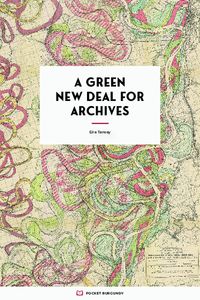
A Green New Deal for Archives
Jul 2023

Archivists preserve the records of the past for the future through their stewardship of archives. As the world moves toward a future that looks increasingly uncertain, frightening, and chaotic because of the impacts of climate change, preservation of the historical record is essential both for continuity of cultural memory and civil society, and for documentation of the ongoing permanent alteration of natural and human environments. A Green New Deal for Archives tackles the pressing challe...
Adventure, Inquiry, Discovery: CLIR-Mellon Fellows and the Archives
May 2023

In this collection of short essays, former recipients of the CLIR Mellon Fellowships for Dissertation Research in Original Sources reflect on the diversity of their experience. From 2002 and 2019, more than 250 student-scholars received support from the program to conduct archival research around the world. Former fellows reunited for a symposium in 2022 to offer perspectives on the future of scholarly work with original sources. Seven of the fellows worked to refine and contextualize cont...
Evaluating Equity and Inclusion in Cultural Heritage Grantmaking: CLIR’s Amplifying Unheard Voices Program
Mar 2023

This report summarizes a yearlong program assessment of "Amplifying Unheard Voices," a major revision of CLIR's Digitizing Hidden Collections grant program. The revision sought to expand the reach and appeal of the program to a broader range of institutions, including independent and community organizations, and to emphasize the digitization of historical materials that tell the stories of groups underrepresented in the digital historical record. Significant changes were made to ...
Supporting Software Preservation Services in Research and Memory Organizations
Nov 2022

This white paper from the Software Preservation Network’s Research-in-Practice Working Group presents findings from a survey- and interview-based study of software preservation service providers, including archivists, librarians, preservation specialists, technologists, and other information professionals. Supporting Software Preservation Services in Research and Memory Organizations identifies concepts, skill sets, barriers, and future directions related to software preservation work. Alt...
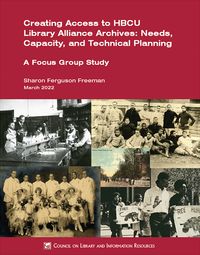
Creating Access to HBCU Library Alliance Archives: Needs, Capacity, and Technical Planning
Mar 2022

This study explores the common barriers and shared visions for creating access to archival collections held by libraries at Historically Black Colleges and Universities (HBCUs). One of few reports that document the needs of HBCU libraries as they relate to archives and special collections, it is based on a series of online focus groups that author Sharon Ferguson Freeman facilitated with HBCU library directors and deans in 2021. The study provides insight into the significance of special a...

Accelerated Aging of Polyester-Based Legacy Audio Magnetic Tape Stock
Feb 2022

This study reports on new research into the longevity of polyester-based magnetic audio tapes. Open-reel test tapes produced 10 to 20 years ago were subjected to a variety of accelerated temperature and relative humidity ranges, chosen to best predict and assess potential conditions for storage in institutions with and without controlled environmental options. Changes to the tapes' physical, magnetic, and chemical properties were measured to assess their impact on the tapes' usability. The...
Curated Futures Project: A Third Library is Possible
The Curated Futures Project is a guide for professionals in galleries, libraries, archives, and museums to navigate beyond discussions of decolonizing collecting institutions to begin taking practical steps to enact change.
Organized and edited by CLIR Postdoctoral Fellows and alumni Faithe Day, Synatra Smith, Jodi Reeves Eyre, John MacLachlan, and Christa Williford, the project is the first in a series ...