
pub84. Securing Our Dance Heritage: Issues in the Documentation and Preservation of Dance
Johnson, Catherine J.; Snyder, Allegra Fuller (Jul 1999, 43 pp.) ISBN: 1-887334-69-6.

Securing Our Dance Heritage focuses on the documentation of, access to, and preservation of our dance heritage. It is coauthored by an eminent dance ethnologist and a leader in the field of dance librarianship. In the first chapter, Allegra Fuller Snyder discusses the cultural and intellectual value of dance and articulates what elements of dance should be recorded and made accessible so that scholars, performers, creators, and the public can grasp fully the rich history of human expression embodied in dance. In the following two chapters, Catherine Johnson explores the various strategies used for making those resources accessible and the problems we face in preserving the fragile media on which these often unique and valuable sources are recorded.
This report addresses the full range of issues involved in evaluating, documenting, preserving, and making accessible the history of dance. It will be of interest not only to members of the international dance community, but also to libraries and archives that house dance materials, many of which are dispersed throughout collections of sport, anthropology, and religion. It will also interest historians and funders of the performing arts, scientists, and scholars of all types, who will find in dance documentation rich new resources for investigating this uniquely expressive human activity, and, more broadly, the managers of research institutions that hold or are acquiring collections in nonprint form.
Catherine Johnson served as director for the Dance Heritage Coalition’s Access to Resources for the History of Dance in Seven Repositories Project. She holds an M.S. in library science from Columbia University with a specialization in rare books and manuscripts and a B.A. from Bethany College with a major in English literature and theater. Ms. Johnson served as the founding director of the Dance Heritage Coalition from 1992 to 1997. Before that, she was assistant curator of the Harvard Theater Collection, where she was responsible for access, processing, and exhibitions, among other duties. She has held positions at The New York Public Library and the Folger Shakespeare Library.
Allegra Fuller Snyder, the American Dance Guild’s 1992 Honoree of the Year, is professor emeritus of dance and former director of the Graduate Program in Dance Ethnology at the University of California, Los Angeles. She has also served as chair of the faculty, School of the Arts, and chair of the Department of Dance at UCLA. She was visiting professor of performance studies at New York University and honorary visiting professor at the University of Surrey, Guildford, England. She has written extensively and directed several films about dance and has received grants from NEA and NEH in addition to numerous honors. Since 1993, she has served as executive director, president, and chairwoman of the board of directors of the Buckminister Fuller Institute.
Michelle Forner is director of the Dance Heritage Coalition. She holds an M.A. in dance with a concentration in ethnology from the University of California at Los Angeles and a B.A. in communications from The Pennsylvania State University. She served as an archivist on the Dance Heritage Coalition’s Access to Resources for the History of Dance in Seven Repositories Project. As a dance performer, educator, and scholar, her focus has been on dance forms from northern Africa and western Asia. She has also held editorial positions in magazine and book publishing, and served as managing editor for two volumes of the UCLA Journal of Dance Ethnology.
by Allegra Fuller Snyder
It is often said that dance is ephemeral and therefore eludes documentation. The reality is that dance is multidimensional, perhaps the most complex of all expressive forms. Dance is part of our personal and cultural experience and its past, present, and future deserve to be safeguarded. The purpose of documentation is to provide access to that experience over time. The tools that can fully document such a three-dimensional form have not been available until this century. Although these tools have evolved and are still evolving, there is now the opportunity to engage in significant documentation, to take on the challenge of preservation, and to focus on the ways in which the tools for documentation are used.
There are deep-rooted reasons why dance has seemed such a fragile presence in American1 culture, and in particular, in American libraries. The lack of dance documentation is the result of two quite different sets of problems. The first, the dearth of materials themselves, results primarily from the difficulty of accurately capturing a three-dimensional experience. Text, paintings, or photographs convey at best only two dimensions at a time. Dance documentation has developed haltingly for this reason. This shortage of recorded dance gives the impression that dance itself does not have a history, which creates a particular stigma in a culture where the past gives credence to the present.
The second problem results from the negative and prejudicial attitudes toward dance that have prevailed in American culture. This bias reflects a particularly Anglo-Saxon, Protestant point of view that originated during the Reformation. The depth of hostility, documented since the fifteenth century, is shocking and real. John Northbrooke, a Protestant minister under Elizabeth I of England, held that “dauncing is the vilest vice of all” (as quoted in Wagner 1997, 19). Three hundred years later, in An Essay on Dancing, J. Townley Crane writes of “several considerations from which it is inferred that common dancing is unwise, inexpedient, and, consequently, sinful” (1849). In 1851, Bishop Moses Henkle stated that the “unintellectual” character of dancing made it peculiarly disposed to the taste and morality of barbarous people, “an animal affair” (as quoted in Wagner 1977, 366). And who can miss the message of From the Ball-room to Hell: “As the twentieth century began, it was still charged that dance contributed to divorce, prostitution, venereal disease, the development of the modern woman, and the breakdown of the family” (Faulkner 1892, 394).
In Adversaries of Dance, From Puritans to the Present (1997), Ann Wagner suggests some reasons for the centuries of antagonism. First, dancing involves the human body, the body and sex are coupled together, and both are taboo subjects. Second, the human body moving rhythmically adds another layer of sexual overtones. In addition, since dancing produces no essential goods or services, arguments arise regarding its usefulness to society. As Richard Strum states in his review (1998, 305), the book uncovers “a peculiar interplay of religious conservatism, unquestionable stereotyping of what is male and female, a deep dread of human physicality and sexuality, alongside dance as a pleasurable and increasing[ly] irresistible pastime.” These stereotypes stand in sharp contrast to views of dance in other parts of the world, as we will see.
At the beginning of the twentieth century, a dance revolution began in America that brought new forms of and ideas about dance. The ideas were presented in books, among the first of which to find their way into the American library were Genthe’s The Book of the Dance (1920) and Havelock Ellis’s The Dance of Life (1923). Then books by two of the pioneers in this revolution appeared: Isadora Duncan’s My Life (1927) and Ted Shawn’s Gods Who Dance (1929). As students of these masters became masters themselves-Martha Graham, Doris Humphrey, Charles Weidman, and others-a field called modern dance emerged with its own very articulate spokesman, John Martin (1933, 1936). At the same time the American ballet emerged under the guidance of Lincoln Kirstein (1935). Martin and Kirstein both had a gift for words and continued to produce works on a regular basis, while other volumes on ballet and modern dance were written.2
In 1942, Dance Index started publishing a series of important monographs that covered many aspects of dance. These volumes led to the consideration of dance forms in other parts of the world, and to the recognition that European and American dance did have a history. This point of view became the theme of the next important publication: The Dance Encyclopedia (Chujoy 1949). In 1959, Dance Perspectives, edited under the inspired vision of Selma Jeanne Cohen and Al Pischl, followed somewhat the same directions of the earlier Dance Index by contributing regular volumes on all areas of dance. These publications added greatly to both the literature and the quality of scholarship. In the early 1960s, Dance Horizons Books began a series of important republications of dance books, including volumes from the seventeenth and eighteenth centuries.
In 1974, Selma Jeanne Cohen edited Dance as a Theater Art: Source Readings in Dance History from 1581 to the Present. Substantive dance scholarship came to be recognized by readers at large, and within and by the dance community itself. More than 20 years later, the International Encyclopedia of Dance was published, again with Cohen as its founding editor (1998). The field of American dance had begun to have a literature but these texts did not yet convey a sense of the actual dance experience because they were still restricted to words.
Other dimensions in the study of dance were also taking form in the postwar period. The field of dance ethnology, the study of dance in its cultural context, emerged and took a parallel, but somewhat separate course. Dance ethnology asked questions, for instance, about The Function of Dance in Human Society (Boas 1944), described The Anthropology of Dance (Royce 1977), and understood that To Dance is Human (Hanna 1979). Other branches in the study of dance began to build their separate literatures, most notably dance therapy.
Despite the growth of dance scholarship, the subject of dance was still sparse on our bookshelves, in part because it was often classified under separate and sometimes unexpected areas. The hidden documentation of dance resulted from documenting something else. Two fields that could be called Pandora’s boxes of hidden documentation are the social sciences and the arts. In the social sciences, anthropology is perhaps the main source, followed by its cousins in the hybrid social science and humanities fields such as folklore, ethnomusicology, musicology, and nonverbal communications. Among other things, anthropology deals with cultures where dance figures substantively. Great names in the field of anthropology often wrote on dance: Franz Boas, Margaret Mead, Gregory Bateson, Clifford Geertz, and Victor Turner, to name a few. Moreover, most literature on African, Asian, and Native American cultures regularly refers to dance.
It was not until 1967, when the National Endowment for the Arts included dance as an area for support, that dance was consistently included as a subcategory of the fine or performing arts. Dictionaries and encyclopedias from the first half of this century seldom mentioned dance under headings dealing with the arts. The place of dance also merges and overlaps with other categories. For example, performance arts as they define themselves today often view dance, music, pictorial arts, and text as one. Sometimes dance is classified under theater in one instance, music in another; other dance materials may turn up with mime. Many references to dance occur within arts that have been termed primitive. Hopi Kachina dolls introduce children to their gods, who join the people during rituals to become the masked dancers. In many cultures, dancers wear masks, yet in most texts (especially art history), masks and dance are treated separately. Needless to say, music is inseparably related to dance and contains veins of information rich with dance.
As we reach the year 2000, both the earlier bias against dance and the dearth of materials documenting dance are being addressed. Global interaction is affecting America’s traditional attitudes toward dance and twentieth-century technologies are creating new documentation formats. The opportunity for a new relation to and appreciation of dance lies before us.
The prevailing understanding of dance in the United States differs from that in the rest of the world, where dance plays a central role in culture. For example, in the Hindu trinity, Shiva is Lord of the Dance. Bharata Natyam, the classical dance of India, is founded on the theory of dance encoded in the Natya Shastra, a treatise written between the fourth and first centuries B.C. by the sage Bharata Muni and the sacred source for much of the performing arts of India (Vatsyayan 1968, 161). In Japan, the origin of Kagura dances (the basis for all forms of Japanese dance) is described in the Kojiki, Japan’s oldest historical document.3 These ancient written documents illustrate a sense of the timeless centrality of dance in but two of many world cultures. At its roots, dance is a community experience and the focus on dance may be diffused in these cultures because it is often part of larger events, rituals, festivals, or celebrations. Most dance is not performed for an audience, but for “attainment rather than entertainment” (Laski 1958, 2). “Ordinary people danced as a matter of course, and seldom had the occasion to record the fact or notice its effect” (McNeill 1995, 37). It is a challenge to place dance in the word-oriented documents of culture because dance is both a way of knowing and a body of knowledge, and the knowledge rests in a complex of sensory experiences.
Before the Renaissance, dance played a large role in Western European societies. As elsewhere, it was predominantly a participant experience that was characterized by a unity of time and space. During the Renaissance, European societies evolved from having a holistic orientation to time and space, typical of nonsecular cultures shaped by the rhythms of ritual, to creating specialized functions and separating time and space experiences. In this process, the arts were separated from other aspects of culture, and then became specialized. Music became associated with time, while painting, architecture, and sculpture became linked with space. Dance became less compatible with this more specialized perspective because it was an art at once temporal and spatial that could not be dimensionally reduced.
As a result, dance developed a dependency on theater, the other time/space form, at a moment when theater was attempting to flatten itself into a two-dimensional experience. After the Renaissance, the two-dimensional theater frame (the proscenium arch) created a separation in a previously omnidirectional occurrence. Space became static; the spatial relationship between the audience and performer became fixed. Dance became something to be viewed, rather than directly experienced.
The biases and prejudices against dance in the United States that were mentioned earlier are, to a large extent, nonexistent elsewhere. The dominant notion of dance being a female activity is not reflected in other cultures. In some, the male dancer is the dominant figure who holds the stature that Michael Jordan and other male sports figures hold in contemporary American society. The ritual or celebratory event of dance may play a central role analogous to the role that a major sporting event plays in America today. In non-American societies, men and women usually dance separately and the dance event is often about their identity as male or female. If they come together in couple dances (a relatively recent step within the evolution of dance), it is with a powerful sense of self-presentment. The couple is a unit of the community. It is not about close physical encounters, and rarely has sexual overtones.
American thinking entangles the arts in incongruities about role, place, and significance. On one hand, artistic work is usually highly respected as the achievement of a gifted few; at the same time, the arts are often denigrated and considered a nonessential component of culture. This leads to what has been referred to as “the Arts with a capital ‘A,'” which emphasizes a specialized taste for art. It separates the artists’ work from daily concerns and tasks and places them within the domain of the elite. In many other cultures, creativity is expressed in such daily tasks as basket making, bread making, and pottery making; it is understood to be an essential responsibility of all within the community.
Americans are experiencing an awakening of cross-cultural awareness through television, radio, travel, and daily encounters with people from around the world. This new awareness is profoundly influencing American perceptions. Encounters with new dance forms and contexts are particularly important to this process. These experiences will eventually add a new sense of the significance of and possibilities for dance in American culture.
Visual and written documentation provides fragmented glimpses of the presence and significance of dance throughout the history of humankind. One of the first drawings made, dated to between 18,000 and 12,000 years ago in the late Paleolithic period, portrays a human figure dancing on the walls of the Trois Frères cave in France. Dancers are seen in a Neolithic rock painting in the ravine of Oued Mertoutek, in the Sahara desert. A relief in the tomb of Ankhmahor, Egypt, depicts a dance in honor of the Goddess Hathor in about 2400 B.C. Other pieces of incomplete yet telling documentation are found on artifacts: a fragment of an Elamite pottery from Iran, dated about 3000 B.C., depicting hand-holding figures engaged in a circle dance; a painting on the neck of a proto-Attic water jar depicting two opposing line dances of men and women, led by a lyre player, from about 700 B.C.; Greek cups, frescos, and bas-reliefs of figures created during the Golden Age of Athens. The great temples in India (Khajuraho), Indochina (Angkor Wat), and Indonesia (Boroboudour) abound in bas-reliefs of gods as dancers. Other depictions of dance include Chinese Tang dynasty terra cotta statuettes; Persian ceramic bowls, miniatures, and carved ivory chests; Japanese screens; medieval church folios and miniatures; paintings of Sioux and other Plains Indians on buffalo hides from the 1780s; and the dancers depicted in the paintings of Breughel, Watteau, Tiepolo, Longhi, and Goya.
Written testimony can be found in the writings of Sappho, Homer, Aristophanes, Euripides, Plato, Li Po, Rumi, and Flaubert who, through the centuries, speak with great eloquence of the dancers and the dance. “What we know of dance in earlier centuries rests on pictures and word descriptions” (Guest 1984, 42).
The first books devoted solely to dance and its study appeared in Italy in the fifteenth century. “During the Renaissance, dance and correct deportment became important as the many principalities vied with each other for supremacy in the noble arts. The need for magnificent display derived from the political ambition of the princes. Such display was a means of propaganda, finding its outlet in the splendor of pageants and ‘balli'” (Guest 1984, 43). Dance masters were in high demand. They found it necessary to record their work. Domenico da Piacenza’s De arte saltandi et choreas ducendi (1450) is the oldest known treatise on dance technique (Guest 1984, 43). At first, letters standing for a simple vocabulary of movements served to document the dance. Eventually letters became signs “having some pictorial relevance in suggesting the movements they represent?. It is only through books containing careful explanations of how each step should be performed that we can come close to the dance of that time” (Guest 1984, 45). In 1588, Thionot Arbeau’s Orchesographie “provided a delightful as well as detailed and authentic record of sixteenth-century dances, dance music, and social mores” (Guest 1984, 48). By the Baroque period, intricate floor plans were added to illustrate the dances.
The evolution from simple verbal descriptions to more multidimensional “bird’s eye views” made the literature more plausible. These books and others that combined symbols, signs, pictures, and word descriptions were the first to present dance multidimensionally. Hence, they were the first specific demonstration of our ability to document and preserve the dance; they were the first advances toward overcoming the time/space dichotomy.
Still photography came into being in the mid-nineteenth century. Soon the photograph was considered capable of capturing “reality,” but it was still a two-dimensional medium, another stepping stone on the way to more accurate documentation. During the 1870s and 1880s, Eadweard Muybridge made tens of thousands of photographs of men, women, children, and animals in motion. Each series of negatives was shot with a row of cameras, carefully positioned and timed to capture the various stages of each movement. His work brought us to the edge of a three-dimensional experience.
Those interested in notating dance investigated many forms after the pioneering work of the dance masters, but none could fully meet the challenge. In Austria in 1928, Rudolf von Laban published Schrifttanz, the first formal disclosure of Labanotation, a notation system that seemed to be the answer. In 1949, the Dance Notation Bureau was founded in the United States. In 1976, the U.S. copyright laws were changed (partly because of the development of Labanotation) to officially acknowledge choreography as a separate entity that could be copyrighted. Until the change in the law, choreography had been included under drama, and had been described by a verbal synopsis of the piece. The importance of changing the law went far beyond the copyright process. It marked the first time that dance was acknowledged as a separate phenomenon that could be described in its own terms, with its own symbol system. For many, this recognition moved dance out of the realm of illiteracy and into a form with a written equivalency.
While the development and acceptance of notation changed legal and academic attitudes toward dance, it was the moving image that more widely affected the general population’s experience of documented dance. The dancing figure was one of the more fascinating subjects for early Lumiere and Edison films. Even though the camera was very heavy and cumbersome, early filmmakers went into the field and recorded dancers in contexts rarely seen beyond the communities of the dance.4 The advent of film opened the door a crack to the direct, three-dimensional experience of dance in a form that could be preserved and reviewed.
Hollywood motion pictures were also tools of documentation and preservation, sometimes unwittingly. The Great Train Robbery (1903) contains sequences that recorded both a square dance and a Virginia reel-further examples of “hidden” documentation. Hollywood studios filmed Ted Shawn, Anna Pavlova, and Irene and Vernon in the silent era. Furthermore, musicals such as the films of Fred Astaire and Ginger Rogers and others helped change the public’s appetite for, and acceptance of, dance. They made dance “seem safe and desirable for all Americans” (Strum 1998, 307).
The 1940s saw the first significant use of 16mm film, pioneered to a large extent by Maya Deren, who was both a dancer and a filmmaker. She demonstrated the creative potential of these smaller cameras, which were lighter and easier to use. Editing was relatively easy, and projection required only a screen and portable projector, rather than a theater or formal screening room. In the 1960s, the availability and widespread use of film coincided with the appearance of dance curricula in universities. The 16mm format contributed to the development of classroom and educational films. Film brought the history of dance to life in the classroom and film documentation began to form a critical body of literature as important as the written text.
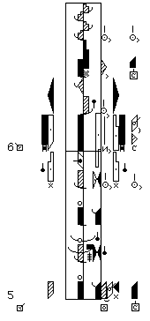 Fig. 1. Labanotation for excerpt from variation of the Dance of the Sugar Plum Fairy. The Nutcracker Site. Courtesy of the Dance Notation Bureau, Inc.
It was not until the late 1970s and early 1980s that video began to be used to document dance. Video had important advantages over film: longer recording time, instant playback, and synchronous sound. It was also easier and less expensive to use. Since video made it easier to capture movement in time and through space, the ephemeral aspect of dance was fast becoming less of an issue. When videocassettes became widely available in the late 1980s, many universities and public libraries set up video viewing areas. Videotapes could be studied by moving forward and backward, selecting sections, and freezing frames, things that could not be easily done with earlier film formats. The advent of home video viewing equipment and its widespread use made viewing the moving image almost as simple as taking a book from the shelf. Videotapes began to compete with books and other forms of the printed word.
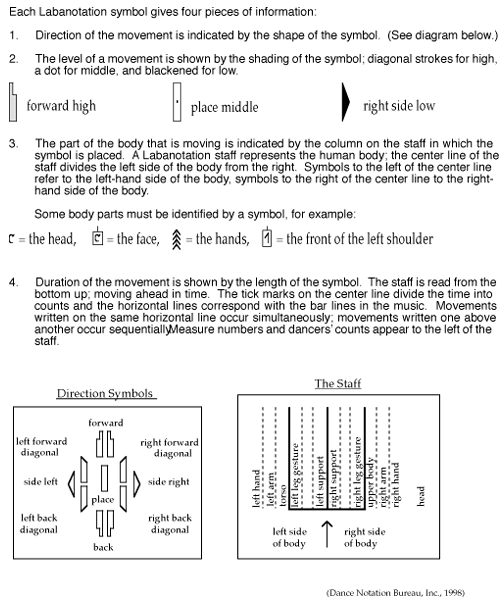
Fig. 2. Reading Labanotation
At this point, the foundations were laid to document, preserve, and access dance as a fully realized time/space experience. In the end, it is a creative combination of various forms of documentation that create the most exciting results. One such example was the recreation of Nijinsky’s The Rite of Spring (Le Sacre du Printemps) by the Robert Joffrey Ballet Company in 1989. In this project, preservation through documentation fed back into reconstruction and performance. The Rite of Spring, with choreography by Vaslav Nijinsky, music by Igor Stravinsky, and decor and costumes by Nicholas Roerich, premiered in 1913. The shocking newness of this work caused an uproar; it was too far ahead of its time. There were seven performances in all, and when Diaghilev wanted to revive it seven years later, no one could remember the choreography. Richard Buckle, in his book Nijinsky, says Le Sacre was not only “a masterpiece, the climax of Nijinsky’s career, but also a seminal work, a turning point in the history of the dance” (1971, 311). Nearly 60 years after its opening, Millicent Hodson, dancer and dance scholar, worked with art historian Kenneth Archer to put the pieces together again. This story is an exemplary demonstration of what is possible when documentation and preservation are pursued to the fullest.
Archer’s goal was to find and reconstruct the Roerich decor and costume designs and Hodson’s task was to recreate the Nijinsky choreography. They searched five countries on three continents. Ultimately, 80 percent of the costumes were found and a good number of the accessories; finding the décor was more difficult. Hodson’s challenge to reconstruct the choreography was even greater. She examined and reexamined visual sources, particularly the drawings by Valentine Gross. She pored over writings about the performance by Stravinsky, the critics, the dancers, and, most importantly, by Marie Rambert (founder of Ballet Rambert), who had been Nijinsky’s assistant and was still alive when Hodson started this project. The most in-depth record of the work was a rehearsal score on which Rambert had written, shortly after the premiere, copious, detailed notes about each measure of choreography. This document could not be found. Nevertheless, Hodson continued, building voluminous notebooks, musical phrase by musical phrase.
Rambert’s lost score emerged in 1984. It was this final discovery that enabled Hodson to complete the reconstruction for the Joffrey Ballet. Décor and costume designs, the costumes and accessories (including shoes), photographs, drawings, newsreel film, written texts, oral histories, and rehearsal scores were all used in the process. The Nijinsky work was reborn in 1989 and filmed by Danmarks Radio and WNET/Thirteen later that year for Dance in America, a PBS television series. History was recast.5
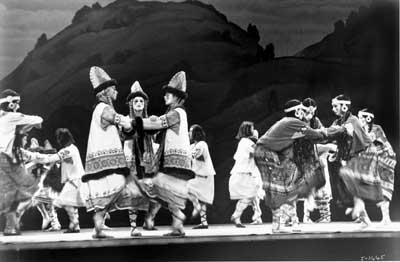
Fig. 3. Members of the Joffrey Ballet perform the Joffrey Ballet’s reconstruction of Vaslav Nijinsky’s legendary “lost” ballet of 1913, Le Sacre du Printemps. Photo by Lawrence/Migdoll.
The growth of electronic media in the 1990s brought new potential for the documentation and preservation of dance, and for access to dance materials. Electronic media embrace the capabilities inherent in the computer itself, and such forms as CD-ROM, DVD, and other emerging tools of telecommunications. The Ohio State University has developed LabanWriter, software that automates Labanotation for the Macintosh, and MacBenesh, a computer software program for writing Benesh notation is also now available. Another area of growing interest relates computer notation to animation: LifeForms is character-movement software used to create choreographic and movement sequences on the computer screen for pre-visualization or presentation in the classroom or on the World Wide Web. Other developing applications and interfacing of programs (such as LabanWriter with LifeForms) will further advance dance documentation methods.
Just as early filmmakers used dance as a subject, the dance field is beginning to take advantage of developments in multimedia technology. While the current work in dance technology emphasizes the creation of virtual dance art, uses for documentation also are being investigated. For instance, the Department of Dance Multimedia Learning Center at the Arizona State University is a facility designed to promote and encourage the use of media and computer technology in dance education. A. William Smith and Vera Maletic of The Ohio State University Dance Department (which is very active in dance technology) created the innovative Dance Comprehensive Documentation Shell (_dance_CODES), a user-friendly multimedia program that dance companies or individual choreographers can use to document and preserve the diverse components of their work.
The digital revolution and the World Wide Web have enabled the merging of time/space documentation: the integration of three-dimensional moving images with two-dimensional text and graphics. For example, An American Ballroom Companion: Dance Instruction Manuals, circa 1490–1920 is a Web-based digital collection of more than 200 social dance manuals. The Web site notes that these materials have been contextualized by “a significant number of anti-dance manuals, histories, treatises on etiquette, and items from other conceptual categories” (Library of Congress 1999). Drawn from materials held in various divisions of the Library of Congress, this virtual collection is the only existing version of this special subject collection. Most of the contents may be viewed in their entirety with full text searching capability. Most significantly, portions of the movement and music come alive through digital video and audio components. With these advances, the foundation is now laid to document, preserve, and access dance as a fully realized time/space experience.
The dance community has grown more interested in and concerned about its own history and the process of documentation. These interests will not only result in more documentation, but will also create incentives to save valuable information from the past. Several organizations and projects are now working toward these ends. The National Initiative to Preserve America’s Dance (NIPAD), sponsored by The Pew Charitable Trusts, supports dance documentation and preservation projects designed to be integral to the creation, transmission, and performance of dance. SAVE AS: DANCE, a national partnership program funded by The Pew Charitable Trusts, includes both NIPAD and the UCLA National Dance/Media Project. By sponsoring fellowships and documentation projects, the program works to develop strategies for using new media to document the diversity of dance in the United States. Preserve, Inc. was established in 1987 “to assure dance a life beyond performance.” It provides services through workshops and publications aimed at influencing the way dance is recorded and saved. In addition to these and other organizations, a number of choreographers, dancers, and companies such as Merce Cunningham, Paul Taylor, Martha Graham, and Eric Hawkins are establishing programs to ensure that their works are documented and preserved in the best ways possible.
Many of the materials that document dance are housed and cared for in libraries and archival repositories. The Dance Heritage Coalition (DHC), an alliance of major repositories and institutions that have dance collections, was founded in 1992 to strengthen the national documentation and preservation network. The coalition’s mission is to make accessible, enhance, augment, and preserve the materials that document the artistic accomplishments of dance of the past, present, and future. It recently collaborated with the George Balanchine Foundation to distribute the Balanchine Archives, a set of videotapes documenting the Balanchine technique and aesthetic, to appropriate libraries and archives worldwide.
A strategy for the presentation of dance materials in a way that spawns new and creative uses is vital to the development of documentation itself. The Library of Congress’s American Ballroom Web site is an example of such presentation of dance for access and use. Libraries should provide comfortable facilities for ready access to all forms of media, ensuring equal access to all forms of documentation. The Dance Collection of The New York Public Library contains more than 30,600 reference books about dance, yet these account for only three percent of its vast holdings. There must be continuing bridge-building between the reading of dance in whatever form it takes, the doing of dance in whatever form it takes, and the use of dance in whatever form it takes. Libraries need to come alive with their awareness of dance. Dance communities need to be excited by new opportunities within the library. All need to make an ongoing effort to establish connections between dance and other facets of culture. The connections are there if one seeks them out, through exhibits, lectures, and other creative interfaces; these are then often further transformed into CDs and Internet sites.
Use is more than taking a book or video off the shelf. It demands a creative combining of textual materials (often retrieved from hidden resources) with drawings, photographs, music, filmed or taped material, and CD-ROM and Internet resources in ways that make both the experience and the understanding of that experience multidimensional. The example of The Rite of Spring, while considerably more ambitious than the tasks suggested here, is nevertheless a useful model. The daily library user should not be afraid, but should be encouraged, to engage in such a creative process. Librarian of Congress James H. Billington suggests that libraries be thought of as knowledge centers rather than information centers (1997, 4), and that librarians “be freed from traditional rote tasks to serve [instead] as ‘knowledge navigators,’ guiding users to the information they are seeking” (1995, 6).
Additionally, library facilities should, as much as possible, supplement the research process with exhibits and demonstrations. By mounting an exhibition on hip-hop, or breakdancing, as it was originally called, the library could use dance to tell the story of a dance form that came out of the ghettos to replace gang warfare with gang dance competition. It has a history parallel to, and interwoven with, rap, and has branched into another form, called stepping, performed by African American fraternities. It has been carried onto the Broadway stage in Savion Glover’s Bring in Da Noise, Bring in Da Funk. It also bears both a physical and psychological relation to such forms as the mgodo, danced in the Chopi villages in southern Mozambique, or capoeira, created by African slaves in Brazil about 400 years ago as a martial art and appreciated today as an aesthetic experience. While aesthetically interesting, such a display would also deepen one’s understanding of the sophisticated and vital role that dance plays in contemporary American life.
With CDs, and increasingly online, there is a new relationship being established between the library, the subject matter, the artist, and the user that will increase the library’s effectiveness in society. According to Billington, “Libraries as places will also be needed in the future to provide local human mediation between the new technologically dispensed information and the old knowledge repositories of books. There can be no real ‘interface’ between the two without a human face on the spot linking remote, electronically-dispensed information with the local printed storehouse of human memory and adding judgment appropriate for the particular community being served” (1977, 7). Through such a process, users inside and outside the field of dance can be made aware of the transformations occurring in the field of dance. An appetite needs to be whetted that can be satisfied through full involvement with current and future demonstrations of dance documentation.
Libraries can be the catalysts in creating a new awareness of dance as a rewarding resource. Libraries can expose new audiences to a full understanding of dance through environments as inspiring as stage performance venues.
Simon Schama, in delivering his New York Council for the Humanities Scholar of the Year address of 1998 entitled “Visualizing History,” stated, “We need to go beyond the book-to the humming bazaar of contemporary culture: to the modern museum; to the rapidly accumulating infinite world of the cyberarchive, of interactive electronic history; to the movies; to the imminent world of digital television; and we need to do so not holding our noses or looking down them, but steadily right into the lens of the camera” (The New York Times, October 10, 1998). Libraries, users, dance scholars, and artists all need to follow this same path to build an enriched future and history for dance.
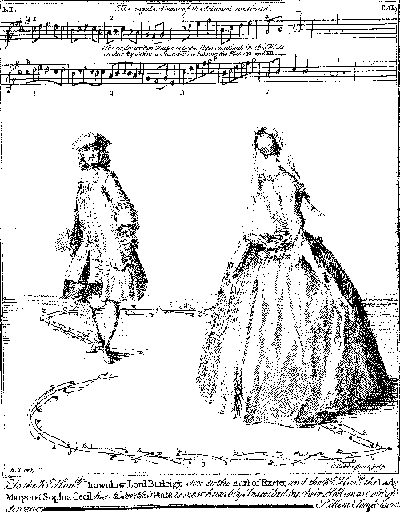
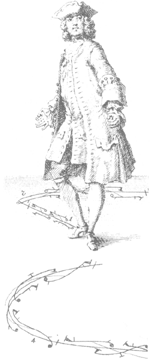
Fig. 4. Illustration from The Art of Dancing by Kellom Tomlinson. Published in London by the author, 1735. Reproduced from the Library of Congress’s Web site, An American Ballroom Companion: Dance Instruction Manuals.
1 Throughout this essay, the term American suggests a mainstream worldview that seems to hold some dominance but is probably more white Anglo-Saxon Protestant in origin and less representative of Native American, African American, Latin American, and Asian American heritage.
2 Other important works included Barbara Morgan’s Martha Graham: Sixteen Dances in Photographs (1941), Cyril Beaumont’s The Complete Book of Ballet (1941), and George Amberg’s Ballet in America: The Emergence of An American Art (1949).
3 The Kojiki also tells the story of the goddess Ame-no-Uzume, who danced in front of the cave where the sun goddess Amaterasu was hiding and lured her out to brighten the world (Gunji 1970, 82).
4 Examples include four Pueblo Indian dances, shot on location in 1898, now in the Library of Congress, labeled Buck Dance, Circle Dance, Eagle Dance, and Wand Dance; and Baldwin Spencer’s footage of an aborigine kangaroo dance and rain ceremony, shot April 4, 1901. Edward Custis filmed the Navajo Yeibechai ceremony, with its central dance component, in 1906, and the Hopi snake dance in 1912.
5 Preservation copies of the film are housed in the Library of Congress and the NYPL Dance Collection. At present, acquisition of the video series is difficult because of unresolved issues relating to distribution arrangements.
by Catherine J. Johnson

Members of the dance community-dance makers, dance educators, dance presenters, dance administrators, and dance scholars-need access to information and materials to help them make new dances, restage dances that have left the repertory, teach dance history and dance practice, and extend the body of research in the history and aesthetics of dance. But, often, dance users cannot easily find the materials they need. When librarians speak of access or making information accessible, they generally mean cataloging an item or collection, preserving it, and making it available either onsite or through photoduplication services, according to the library’s restrictions and schedule. The user has access to the material when he can find information about its existence and location in a catalog or other source and develop a plan for getting either the item itself or a copy of it. While this definition of access is clear to the librarian, users with different perspectives or less familiarity with the systematic storage and retrieval of information may understand the term to mean something altogether different.
To many within the dance community, including scholars and researchers, access connotes having complete and open entrée-in effect, a kind of ownership. Access may also mean that the material is easily available to the user, to be loaned with little or no restriction or on demand. Access may further connote that a particular dance has been documented and a historical record exists. Within the dance community, there is an appreciation for the dedication of particular dance librarians and collections, as well as an understanding that libraries may lack the resources to consistently meet users’ demands (Keens 1991, 23-24). Nevertheless, when libraries fail to meet these demands, they are sometimes seen as unfriendly gatekeepers, withholding information or denying access to it.
The origin of this tension is historical. A quick glance at the history of library cataloging and classification reveals why the subject of dance might appear neglected compared to other disciplines, such as theater, art, or music. Early books in the West focused on how to dance rather than on dance descriptions, history, theory, or analysis. The discipline was viewed more as a recreational activity than as an art form. Dance programs in college and universities were often created as a subdiscipline in the physical education department rather than under the performing arts. The Library of Congress (LC) classification system defined dance within the classification scheme for sports and recreation (the GV class) (Library of Congress 1976). The Library of Congress established most headings for dance subjects under the term dancing, which describes it as a verb or an activity as opposed to a noun or an art form. Those looking for information on dance today are more inclined to search under dance or to browse shelves in the area of the theatrical arts or anthropology, frequently missing a significant amount of literature shelved elsewhere.
To compound the situation, until the 1980s library cataloging systems concentrated on book and print materials, while information about dance is more often found in materials other than books or published records: choreographic notes, anthropological field notes, moving image materials, photographs, and theatrical programs and other ephemeral publications. A research collection that truly served the needs of a dance researcher would need to be multimedia and multidisciplinary in scope. Book-centered cataloging systems designed to provide access to printed items have proven to be unsatisfactory for the field. Resources that document dance are found in many disciplines-including music, anthropology, ethnology, physical education, history, art history, aesthetics, and education-which has made the collection of materials more difficult for researchers. While these access issues are specific to dance, they may also apply to other disciplines where a written record is less central to the activity, such as popular entertainment, ethnographic studies, and folklore. The cooperative approach described below to improve access to dance research materials might also serve as a model for other fields challenged by similar issues.
Research in Dance: A Guide to Resources lists 75 library collections and archives in the United States (Bopp 1994). Of these, six are performing arts companies or organizations that maintained their own archives at the time of publication, two are significant museum collections,1 and six are private collections. An additional 40 entries describe collections of secondary resources or book collections.
Over the past 50 years, dance has become an important focus of collection development efforts at several major American libraries. Most significantly, The New York Public Library (NYPL) established its Dance Collection, now a division of its Performing Arts Library, in 1944. Over time, the NYPL Dance Collection grew to be the largest single collection in the United States (and quite possibly in the world) devoted exclusively to the discipline of dance. The Harvard Theatre Collection has collected dance materials related to the theatrical arts since it was founded in 1891; in the 1950s it also began collecting in the area of theatrical dance and music. The Library of Congress holds materials documenting dance in many of its divisions, from the American Folklife Center to Prints and Photographs. The Library of Congress’s Music Division has collected dance-related titles and has a history of supporting dance creation, having commissioned Martha Graham’s Appalachian Spring in 1944. The curators of these collections maintain close ties with the dance community in an effort to ensure that archival materials are saved and eventually find a home. Through the diligent efforts of these institutions, a great deal of historical material documenting dance has been preserved and is accessible to the public.
Other libraries and institutions have collected dance materials on a more focused or limited scale. The San Francisco Performing Arts Library and Museum (SFPALM), originally founded as a collection documenting the San Francisco Ballet, eventually expanded to include all performing arts activity in the San Francisco Bay area. Ohio State University’s Jerome Lawrence and Robert E. Lee Theatre Research Institute has grown in recent years to include more dance materials and larger dance collections, such as the Twyla Tharp Archive. The institute supports the curriculum of the university’s dance department, one of the largest graduate programs for dance in the country. The Theatre Arts Collection of the Harry Ransom Humanities Research Center at the University of Texas, Austin, has acquired significant materials, especially those related to American musical theater, film, and the Ballets Russes. Historical societies and other organizations, such as the Chicago Historical Society’s Midwest Dance Archive, have developed regionally focused collections.
Since the publication of Research in Dance, and partially in response to a national study on dance documentation and preservation conducted in 1990, additional collections have been established at the libraries of The George Washington University (Department of Special Collections), Wayne State University, and the University of California at Irvine. Two major annual dance festivals-the American Dance Festival in Durham, North Carolina, and Jacob’s Pillow Dance Festival in Beckett, Massachusetts-have created archival programs that document not only their institutional histories but also performances, master classes, and lectures held during the festival period. Moreover, individual dance companies and other dance-related organizations have begun archival projects with the intention of either maintaining an archive for the long term or donating or selling their records to an appropriate repository.2 While public collections are growing, many materials remain in private hands, where access for the general user or researcher is limited or nonexistent. Efforts have been made to encourage those holding dance materials to work with major repositories to care for these materials and eventually to make them accessible on a national scale.
In 1990, a study commissioned by The Andrew W. Mellon Foundation and the Dance Program of the National Endowment for the Arts produced a report, Images of American Dance: Documenting and Preserving a Cultural Heritage (Keens 1991). The study involved extensive interviews on a national scale with a broad range of individuals in the dance and library communities. The study’s purpose was to “ascertain the breadth of dance documentation and preservation needs in the field, to gain a sense of the range of institutions and individuals involved, and to discuss with representatives from the dance archives field how best to achieve effective coordination among them.” The report concluded that while great gaps exist in the national collections, this fact is difficult to substantiate because many significant holdings remain uncataloged. It noted that “major archival institutions have cataloging backlogs of two and three years [or more] . . . irreplaceable material is daily discarded because the general public remains unaware of its historical and artistic significance; and . . . there are no organized channels by which to retrieve information” (Keens 1991, 11).
One of the five principal conclusions of the Keens report was that “‘access’ has become everyone’s byword”-for the artists who create the work and the records of it, for the repositories that house those records, and for scholars and others who want to use those materials (Keens 1991, 23). The report recommended the formation of a coalition of the heads of major dance repositories to address access problems and other concerns.
A Coalition Planning Group was formed and began looking for collaborative solutions. In November 1991, representatives from the Harvard Theatre Collection, the Library of Congress, the NYPL Dance Collection, and the San Francisco Performing Arts Library and Museum, and an advisor from the Research Libraries Group met to discuss access, which seemed to be the most pressing need. Two discussion papers were written describing the status of access to the collections, the use of standard MARC formats, existing cataloging rules and manuals, name authorities and subject headings for dance, and archival arrangement and description for dance materials and suggestions for a future union catalog (Flecker 1991, Johnson 1991).
After further study, the Coalition Planning Group found that the participating institutions were struggling with major cataloging arrearages. While staff shortages were noted as a major contributing factor, a number of other impediments to access were identified. The planning group reviewed these impediments and discussed possible solutions and model approaches for overcoming them. The principal conclusions were as follows:
As a result, the four major institutions in the planning group-The Harvard Theatre Collection, the Library of Congress, the NYPL Dance Collection, and the San Francisco Performing Arts Library and Museum-formed the Dance Heritage Coalition (DHC) and developed a cooperative undertaking called the Access to Resources for the History of Dance in Seven Repositories Project. The project was funded primarily by the National Endowment for the Humanities with additional support from private foundations. It lasted six years and successfully carried out the tasks that the planning group had recommended. Members found the collaboration to be beneficial in many areas and have developed additional cooperative work under the aegis of the DHC.3
To create the foundation for a union catalog of dance materials, 204,518 machine-readable records for the holdings of the NYPL Dance Collection were updated into current MARC format and added to the Research Libraries Information Network (RLIN) database. This addition makes the cataloging work of other institutions easier as more titles, name authorities, and subjects are now available nationally. Moreover, an additional 6,500 catalog records were entered in RLIN describing 2,000 linear feet of archival collections and other materials at SFPALM, the Minnesota Dance Theatre Archives at the University of Minnesota, the Harvard Theatre Collection, the American Dance Festival, LC, and NYPL.
A difficulty frequently cited in cataloging dance materials is the inadequacy of Library of Congress Subject Headings (LCSH) for dance. Over the years, the NYPL Dance Collection adapted and broadened the LCSH, establishing more specific subject terms for in-house purposes. For example, NYPL’s headings provide subject access to the more than 50 named systems of dance notation, whereas LCSH identifies only three. Some of NYPL’s subject headings were submitted to the existing LCSH headings to expand that system and to make headings widely available for all. Most significantly, about 53,000 personal name headings and title headings for choreographic works from the authority file became part of the National Authority File in 1996. The NYPL Dance Collection and others continue to add to this system through LC’s National Cooperative Name Authorities and Subject Heading Program (NACO). The NYPL Dance Collection manages a cooperative dance “funnel” through which other libraries creating dance authority headings can submit them to NACO under the supervision of the DHC. Now, as new choreographic works are created and performed, new title headings are established and contributed. For example, every year the American Dance Festival contributes headings for all works premiering at the festival.
Dance and other performing arts collections include a variety of formats that require a range of expertise to catalog. Certain cataloging decisions common to these materials previously resulted in different solutions at different repositories. Decisions regarding the treatment of particular types of materials, the formation of headings, and the application of MARC tagging rules needed to be agreed upon and documented. By compiling rule references and sample records, the DHC developed coordinated guidelines to increase the efficiency and consistency of cataloging the many formats common to this specific subject area.
The development of the cataloging guidelines raised several intellectual issues. Traditionally, library cataloging has focused on cataloging the item in hand. This necessarily divorces the item from its context. A group of photographs that document a single event or performance, if cataloged as individual items, may result in a catalog record that yields little or no information about the content documented. The cataloging may provide adequate access to the photographs as individual objects but does little to provide access to the context, which was why the photographs were taken. The event or choreographic work may not be represented in any other format (that is, there may be no script, notation, or videotape that represents the dance). This problem struck the staff of the American Folklife Center at LC as they began work on the American Memory Project in the early 1990s. They developed the concept of an event-level record that both provided information about the ethnographic event, whether a powwow, quilting bee, or religious procession, and described all of the types of materials that documented it.
This concept is particularly appealing to performing arts collections, but not always easy or practical to implement. The event-level record has tremendous potential for new archives and has been recommended as a method of organizing and describing portions of the Merce Cunningham Dance Foundation Archives. An authority record for a choreographic work can form the basis for specific event-level records that describe all materials documenting different iterations (performances) of that work. At institutions with established cataloging systems, such as the NYPL Dance Collection, catalogers have been able to apply this concept in some cases, particularly for the cataloging of photographic materials.

Fig.5. Sample record from NYPL’s event cataloging of photographs. The companion authority record for A Mirror for Witches provides complete production information.
It is unlikely that the creation or performance of an individual choreographic work will ever result in a single item that accurately defines it. The closest record of this sort at this time is a videotape that documents a performance of the dance. The catalog record for the videotape often can serve as the base record that mentions or links to other items. Since linking records can be time consuming, catalogers’ thorough and careful assignment of added entries and subject headings becomes important to ensure access.
While describing materials that document an event collectively in an event-level record can be beneficial, for magnetic media materials such as film and videotape, where serious preservation concerns require continual monitoring and reformatting, item-level control is necessary for collection maintenance as well as access. Similarly, item-level cataloging may be recommended for a particular type of object or work of art. For example, an individual drawing by Pablo Picasso for a production of Les Tricornes may be part of a larger collection (the Howard D. Rothschild Collection on Sergei Pavlovitch Diaghilev’s Ballets Russes), but adequate curatorial control over and access to this valuable object warrant a thorough item-level description.
Another difficulty faced by the cataloger and the curator of a dance or performing arts collection is the frequent dispersal of documentation. In many cases, the materials that serve to document a single work do not reside together. When an archive from an individual or a performing company arrives at the repository, the archivist is expected to maintain the original order of the material insofar as possible and generally cannot spend time reorganizing. Providing access to materials documenting the choreographic works becomes a challenge when they are dispersed throughout various sections of a collection or archive. Additionally, materials documenting a single artist, company or group, production, or event might be scattered among collections held by different institutions. Linking and cross-referencing are possible within a single repository but become more difficult across institutions. Cooperative work can ease this problem. For example, NYPL and Ohio State University are currently working on a joint finding aid for a shared collection, the papers of lighting designer Tom Skelton. The two finding aids will be linked and indexed in the same finding aid database, making it easier for users to understand the connections between the two collections.
It is clear that neither one set of cataloging rules nor one perfect cataloging record can generally fit all circumstances and needs. Access to performing arts materials requires flexibility and creativity in applying rules and guidelines, bearing in mind the goals of providing access to the performance work or dance event itself and the need for efficiency in cataloging. Cataloging with great detail or describing the material object at the expense of being unable to describe materials representing many other works defeats the purpose of increasing access. In other words, a little access is better than none.
The rapidly changing technological environment of the library and archival community presents ongoing challenges. The development of the World Wide Web, library catalogs with Web interfaces, and the implementation of search engines that comply with the International Standards Organization’s Z39.50 standard for search and retrieval software have affected the way in which users interact with bibliographic utilities. Individual library catalogs available over the Internet are no longer primarily used by individuals associated with the institution and a few scholarly subject experts. Rather, whole new populations are using the catalogs of individual libraries for bibliographic and related research, regardless of institutional affiliation.
The increased use of and access to library catalogs is only one of the effects of the World Wide Web. Catalogs now refer and link to online versions of full-text documents, images, and finding aids describing archival collections. There has been explosive growth in the amount of information presented by libraries in general and by special collections and archives in particular. On the subject of dance, some 300 representative images from the Paget-Fredericks Collection of roughly 2,000 original drawings, paintings, and photographs owned by the University of California at Berkeley, depicting Isadora Duncan, Loie Fuller, Vaslav Nijinsky, Ruth St. Denis, and other figures of early twentieth-century dance, have been digitized and may be viewed on the UC Berkeley Web site. The Library of Congress has digitized its collection of early dance manuals and created its American Ballroom Web site, which provides the texts and video clips of examples of contemporary reenactments of the dances.
Finding aids describing dance archival collections at DHC member institutions have been encoded in a standard generalized mark-up language (SGML) using the encoding standard for archival description (EAD). These finding aids, capable of full-text searching, are becoming available on the Web via a collaborative DHC site. As with online finding aids in other subject areas and institutions, they offer the user the ability to review the contents of unique holdings located at great distances from one another. An interested researcher or potential user can then request access to specific materials either through microfilming or copying (when possible) or by visiting the repository. Users can discover the depth and breadth of the collection before they request to see the materials, saving time and energy. Because finding aids for dance collections in different repositories are mounted together on one site, the user also has the ability to search across the collections and to view and compare finding aids for related collections. Although the DHC site provides some centralized linking and navigation for dance materials, there is still a need to provide more detailed and appropriate maps of the information landscape, along with navigational tools and links between the online catalogs of repositories, union databases in bibliographic networks, and collection finding aids.
In addition to access through traditional library and archival channels, the World Wide Web has provided a platform on which others can easily present information and documentation to a wide audience. Individuals with a passion for dance have created Web sites of great diversity and varying quality. When the search engine Mosaic was introduced, one of the most popular sites on the Web was a Swiss-based tango site, set up by a tango aficionado, that included numerous video clips. Other dance companies and organizations have established sites providing materials and information that were previously much more difficult to obtain. The José Limón Dance Foundation Web site, for example, includes information about the foundation’s archival holdings. Nowadays, any individual with a collection of dance photographs can easily digitize them and make them available on his or her own Web site. Increasingly, photographers are using this method to publicize their work.
Although the DHC’s work has demonstrated that library and archival descriptive standards can be used for dance materials, alternative ways of representing large volumes of data are still being sought. European theater data collection agencies have discussed developing a standard format for describing information about theatrical performances that would be available in a unified database.4 A project launched recently at Cornell University aims to develop an international standard for performing arts metadata to make sharing and interlinking data easier.5
The beginning of an information retrieval system for dance is now in place through a variety of modes: bibliographic networks, individual library catalogs, informational Web sites and links, finding aid databases, text-retrieval systems, and digital collections. A more seamless web is needed to ease navigation.6 Just before the explosion of the World Wide Web, Lawrence Dowler, then head of Research Services for Harvard College Library, described subject pathfinders that could help users navigate the resources for a particular area of study, from published sources to original manuscripts and visual images (1997). This idea has been carried into the Web environment. A thorough, sophisticated pathfinder for dance has yet to be developed, but the building blocks are in place.
On another front, more work is needed to identify additional dance documentation that is not accounted for or readily accessible. The Images of American Dance report noted that large gaps exist in the documentary record of dance in America that are historical, geographic, cultural, and artistic in nature (Keens 1991, 20). A systematic approach to identifying gaps has yet to be developed, but pieces of the process are now within reach. For example, as a result of the DHC’s Access Project, the major collections’ holdings are recorded in RLIN or OCLC, or both. With the recent publication of the International Encyclopedia of Dance by Oxford University Press (Cohen 1998), a method could be developed to search bibliographic networks and other information sources using the Encyclopedia to determine the scope of repository holdings on all subjects. However, unless other institutions housing dance materials contribute information to national systems, the gaps will be more difficult to identify and analyze. Tools such as the new DHC cataloging guidelines and a processing procedures manual for performing arts collections should standardize this process and make it easier. In particular, the manual is currently being revised to incorporate information on EAD. Furthermore, repositories will soon be able to use a finding aid template on the DHC Web site to add descriptions of their archival holdings. Still under development, the finding aid template allows a person to enter basic information about a collection and list the collection’s contents. As outreach efforts continue, it is hoped that more materials to document the gaps in America’s dance history will be discovered and made accessible.
Assessing the impact of the DHC Access Project on the participating repositories is much easier than assessing the impact on dance research generally or on research in other disciplines. Anecdotal evidence shows that processed collections and the tools and guidelines have been used. For instance, a scholar processing a collection of materials from a native hula artist at the University of Hawaii made use of the DHC processing guidelines. The Agnes DeMille papers processed as part of the project have subsequently been used for a new biography of DeMille. The relationships established with scholarly organizations have led to a greater awareness of the materials available and of the online resources, and have helped improve scholars’ understanding of the parameters of access in the information science environment. However, the true impact on research and scholarship is more difficult to gauge. Whether or not efforts to date have really improved users’ ability to obtain materials for their work will probably not be known until a body of resulting research and writing can be evaluated.
Although the accomplishments of the DHC Access Project and other efforts have solved some of the fundamental problems that contribute to backlogs in cataloging and processing, a major quandary remains. That is, the dance field continues to create and produce materials, and curators continue to acquire these materials at a rate that often exceeds the ability of their institutions to catalog and process them. Conventional wisdom says that a curator should not accept materials that cannot be cataloged and made available within a reasonable amount of time or that cannot be appropriately cared for. However, the urgent need of the dance field to find safe homes for materials at risk raises questions about the wisdom of that approach. Does such a policy result in a loss of documentation in fields that are less financially sound, while the records of more lucrative fields of endeavor are left to represent our cultural heritage? The DHC’s work and other efforts, such as the Dance Notation Bureau’s work to computerize the cataloging of its holdings, have made strides to reduce cataloging backlogs. Other efforts to improve access include the Dance Librarians Discussion Group’s (DLDG) forthcoming publication, A Core Collection in Dance, a bibliography for libraries interested in creating a basic, representative collection of secondary resources, and the Alliance for the Arts’ project to identify the documentation of choreographic works created about or by artists lost to AIDS. The DLDG’s participation in promoting the interlibrary loan of videotape among libraries will also ease access restrictions, at least for published videotapes. But the continued decrease in funding for such organizations means that backlogs will continue or begin to build again.
The concept of access is multidimensional. Librarians, archivists, and curators, with the support of library administrators, must be creative in making the materials in their charge as accessible as possible without causing damage. Providing access to materials without a long-term preservation plan is wasteful at best and futile at worst. Access and preservation must work hand-in-hand; access decisions must reflect the preservation needs of the materials, and the accessioning and processing systems should integrate both goals. Collaboration among repositories in all aspects, from documentation and collection strategies to cooperative access projects and coordinated preservation, will be necessary to ensure that the history of American dance of the past century is known and understood into the twenty-first century. The library and archives communities have the ability and responsibility to help the dance field move out of what critic John Martin once called a “limbo of illiteracy” (Keens 1991, 10). They can do this by defragmenting the scattered documentation of the past, uniting it intellectually through the Internet, caring for it, and encouraging more comprehensive documentation and collection for the future.
REFERENCES
1 The two significant museum collections are the Serge Lifar Collection of Ballet, Set and Costume Designs at the Wadsworth Athenaeum in Hartford, Connecticut, and the Tobin Collection at the Marian Koogler McNay Art Museum in San Antonio, Texas.
2 Well-known companies with active archives include the Paul Taylor Dance Company, the Merce Cunningham Foundation, and the Nikolais Louis Dance Company, whose archive is housed at Ohio University in Athens, Ohio.
3 The Dance Heritage Coalition originally established itself as an informal organization under the fiscal agency of the San Francisco Performing Arts Library and Museum. Its initial activity included the development of the cooperative Access Project. The benefits of working together led to an increase in membership. The coalition, now formed as a tax exempt, not-for-profit organization, currently has seven members.
4 At the 20th International Congress of the Société Internationale des Bibliothèques et de Musées des Arts du Spectacle (SIBMAS) [International Association of Libraries and Museums of the Performing Arts] entitled “Documents et Témoignages des Arts du Spectacle: Pourquoi et Comment?” [“Collecting and Recording the Performing Arts: Why and How?”] held in Antwerp, September 4-7, 1994, several papers presented in the session on “Documentation et Informatique: Miracle ou désastre?” [Electronic Documentation: Breakthrough or Breakdown?] included discussion of shared electronic data collection and distribution of theatrical information. Of particular note were papers by Jürgen Kirschner of Germany, “Coordination and Standardization: Two Assumptions for Communication;” and Margret Schild, also of Germany, “Considerations for Developing an Electronic Theatre Information System.” The presentation of these papers was followed by extensive discussions regarding international cooperation.
5 At Cornell, the digital library staff, under the direction of Peter Hirtle, have created a simple Web-accessible relational database to test what sort of data people might need in such a database. The theater faculty is putting records into that database for Noh and Kabuki theater; Ann Ferguson, of the Manuscripts and Archives Department, is adding records relating to the playwright, G.B. Shaw; and other theater partners are testing it with some documents from Russian theater archives. The Cornell theater staff and faculty are including a wide range of photographic, printed, and manuscript items in the prototype database, and would like eventually to link all items to the text or video of the performance. The database is currently in English; making it multilingual is a long-term goal.
6 Steven Hensen, of the Special Collections Library at Duke University, coined the term seamless web to describe a system in which users can navigate easily from a broad description of a group of materials to a more specific finding aid, thereby giving contextual information to a digital surrogate of the item itself. Hensen referred to this concept in several presentations to the Society of American Archivists (1998).