pub165. Getting Found: SEO Cookbook
Brylawski, Sam; Lerman, Maya; Pike, Robin; Smith, Kathlin (May 2015)
At a time when Internet search engines have become the default discovery layer for most users, libraries need to report that their websites and digital repositories are discoverable through those search engines as well. The Getting Found (GF) Cookbook provides a step-by-step video guide to help libraries measure and monitor the search engine optimization (SEO) performance of their digital repositories. The Cookbook includes everything necessary to implement a preconfigured Google Analytics dashboard that continuously monitors SEO performance metrics relevant to digital repositories.
The Cookbook was supported by a grant from the Institute of Museum and Library Services.
At a time when Internet search engines have become the default discovery layer for most users, libraries need to report that their websites and digital repositories are discoverable through those search engines as well. The Getting Found (GF) Cookbook provides a step-by-step video guide to help libraries measure and monitor the search engine optimization (SEO) performance of their digital repositories. The Cookbook includes everything necessary to implement a preconfigured Google Analytics dashboard that continuously monitors SEO performance metrics relevant to digital repositories.
The Cookbook was supported by a grant from the Institute of Museum and Library Services.

Video: Institutionalizing SEO: Strategic Planning
The Montana State University (MSU) strategic plan is built around six core areas: learning, discovery, engagement, integration, access, and stewardship. Each strategic area has its own set of goals, followed by objectives and metrics. According to the plan each university unit, including the library, is “empowered to envision its future, develop its own paths to these goals, and contribute to the University’s success in diverse and creative ways.”
The MSU Library proactively aligned its SEO program with the goals and objectives of the university, and the effort raised awareness throughout the university of the strategic value of an open access institutional repository (IR). The example shown below focuses on the “discovery” area of the strategic plan and demonstrates how library staff mobilized to contribute to the university and prominently position the IR.
Since finalizing its strategic plan 18 months ago, the library:
A first step in aligning the library’s work with university goals is to locate and review the most recent strategic plan that has been published or is under development. After reviewing the university strategic plan the MSU library staff identified an objective related to discovery:
Montana State University Strategic Plan
The provost and her team of deans developed an academic strategic plan in alignment with the overall university plan. The library dean proposed to support the university’s discovery goal by developing and implementing a unit strategy that committed the library to “Develop an institutional repository of intellectual output of campus.”
MSU Provost Academic Strategic Plan
Based on the unit strategy in the academic strategic plan, the library administration and staff developed a set of objectives and metrics they would use internally to deliver on their commitment to the provost
Montana State University Library 2013 Strategic Plan (see page 3)
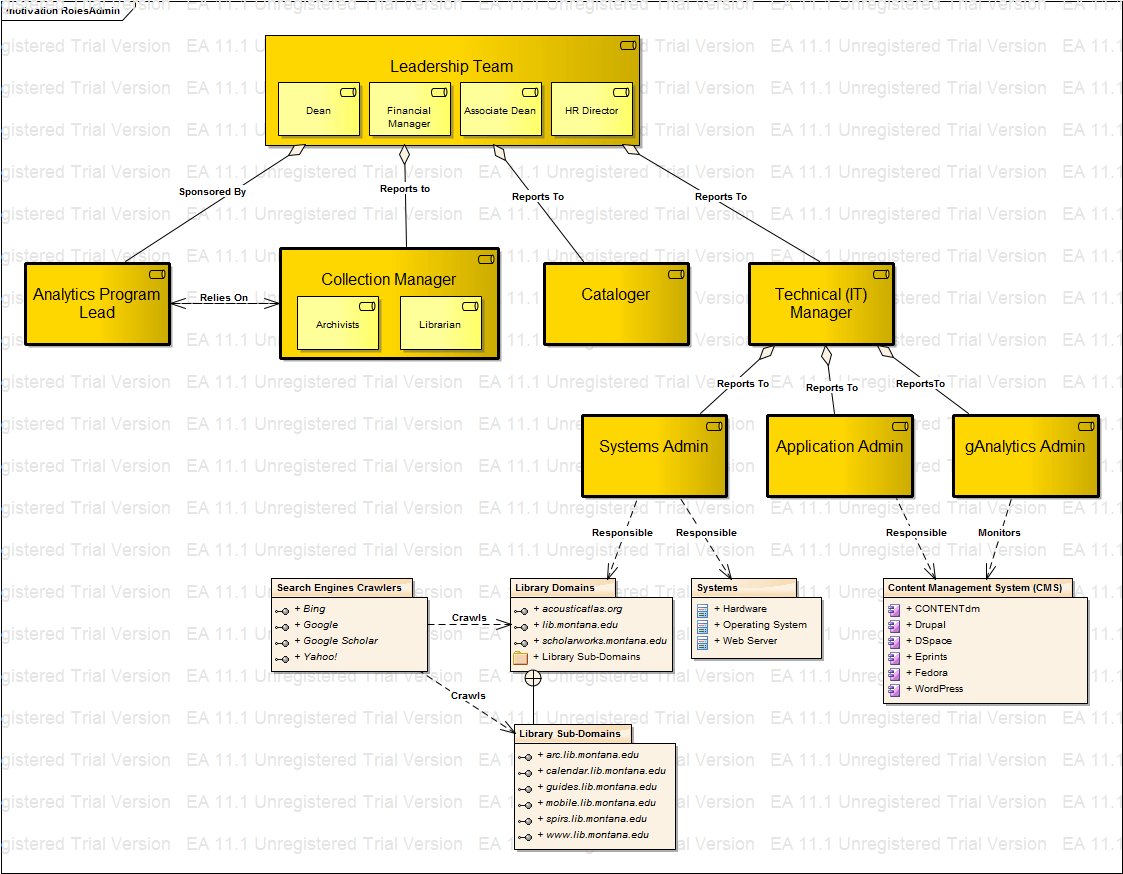
Object Management Group Business Motivation Model Sections
Birol Berkem (2008). “From The Business Motivation Model (BMM) To Service Oriented Architecture (SOA)” Journal of Object Technology, vol. 7, no. 8, November-December, pp. 57-70