
The Center of Excellence Model for Information Services
Feb 2015

In 2013, The Andrew W. Mellon Foundation awarded a group of librarians from ARL’s Research Library Leadership Fellows program a planning grant to examine the center of excellence (CoE) model for information services. Used in a variety of industries, CoEs are designed to attract the most talented researchers in a particular field, enhance collaboration, and improve access to the resources needed for their research. The planning grant was awarded to determine whether the CoE model could serv...

The Changing Landscape of Library and Information Services: What Presidents, Provosts, and Finance Officers Need to Know
Sep 2014

Rapidly evolving digital technologies and services are profoundly influencing the financial model supporting many colleges and universities. Institutions that rely solely on traditional solutions to address the growing challenges to the higher education business model are unlikely to thrive. Colleges and universities must identify and seize new opportunities in light of new financial challenges.
In December 2013, CLIR sponsored a workshop that explored the ways in which library and ...
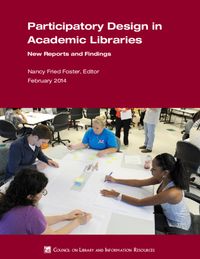
Participatory Design in Academic Libraries: New Reports and Findings
Feb 2014

This report looks at how staff at eight academic institutions gained new insight about how students and faculty use their libraries, and how the staff are using these findings to improve library technologies, space, and services.
Participatory design is a relatively recent approach to understanding library user behavior. It is based on techniques used in anthropological and ethnographic observation. The report’s editor, anthropologist Read
Research Data Management Principles, Practices, and Prospects
Nov 2013

This report examines how research institutions are responding to data management requirements of the National Science Foundation, National Institutes of Health, and other federal agencies. It also considers what role, if any, academic libraries and the library and information science profession should have in supporting researchers’ data management needs.
University of North Texas (UNT) Library Director Martin Halbert opens the report with an overview of the Read
Born Digital: Guidance for Donors, Dealers, and Archival Repositories
Nov 2013

This report offers recommendations to help ensure the physical and intellectual well-being of born-digital materials transferred from donors to archival repositories. The report surveys the primary issues and concerns related to born-digital acquisitions and is intended for a broad audience with varying levels of interest and expertise, including donors, dealers, and repository staff. Read Japanese translation ...
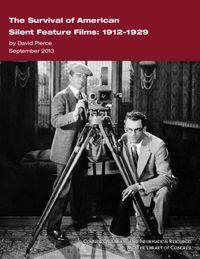
The Survival of American Silent Feature Films: 1912–1929
Sep 2013

Commissioned for and sponsored by the National Film Preservation Board, Library of Congress.
The era of the American silent feature film lasted from 1912 until 1929. During that time, filmmakers established the language of cinema, and the motion pictures they created reached a height of artistic sophistication. These films, with their recognizable stars and high production values, spread American culture around the world. Silent feature films disappeared from sight soon aft...
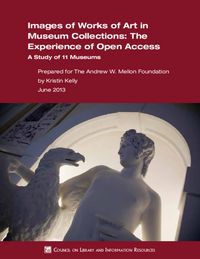
Images of Works of Art in Museum Collections: The Experience of Open Access
Jun 2013

This report describes the current approaches of 11 art museums in the United States and the United Kingdom to the use of images of works of art that are in their collections and are in the public domain. Each approach is slightly different. By presenting the thought processes and methods used in these institutions, this report aims to inform the decision making of other museums that are considering open access to images in their collections.
The following museums are included in thi...
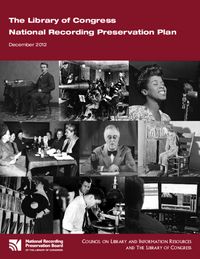
The Library of Congress National Recording Preservation Plan
Dec 2012

Sponsored by the National Recording Preservation Board, Library of Congress. This plan was written by Brenda Nelson-Strauss, Alan Gevinson, and Sam Brylawski, under the direction of Patrick Loughney.
The National Recording Preservation Plan has been devised to provide a blueprint to “implement a comprehensive national sound recording preservation program,” as mandated in the National Recording Preservation Act of 2000. Congress specified that the program established by the ...
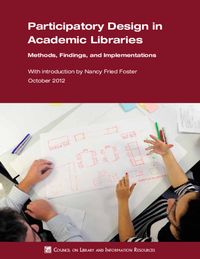
Participatory Design in Academic Libraries: Methods, Findings, and Implementations
Oct 2012

Participatory design is an approach to building spaces, services, and tools where the people who will use them participate centrally in coming up with concepts and then designing the actual products.
The papers in this volume, written by librarians and IT professionals from 12 colleges and universities, report on user research and participatory design projects. All of the authors attended workshops and then dove fearlessly into projects with as little as two days of training.
The Problem of Data
Aug 2012

Jahnke and Asher explore workflows and methodologies at a variety of academic data curation sites, and Keralis delves into the academic milieu of library and information schools that offer instruction in data curation. Their conclusions point to the urgent need for a reliable and increasingly sophisticated professional cohort to support data-intensive research in our colleges, universities, and research centers.
Core Infrastructure Considerations for Large Digital Libraries
Jul 2012

This study examines the core infrastructure elements of systems that manage large quantities of digital materials that one would think of as a digital library. An examination of the infrastructures of a few make it possible to understand the diverse approaches each has taken to manage digital content. This study focuses on large, noncommercial digital libraries. Published in collaboration with CLIR’s Digital Library Federation program.
One Culture. Computationally Intensive Research in the Humanities and Social Sciences
Jun 2012

This report culminates two years of work by CLIR staff involving extensive interviews and site visits with scholars engaged in international research collaborations involving computational analysis of large data corpora. These scholars were the first recipients of grants through the Digging into Data program, led by the NEH, who partnered with JISC in the UK, SSHRC in Canada, and the NSF to fund the first eight initiatives. The report introduces t...
"Rome Wasn’t Digitized in a Day": Building a Cyberinfrastructure for Digital Classicists
Jun 2012

The author provides a summative and recent overview of the use of digital technologies in classical studies, focusing on classical Greece, Rome, and the ancient Middle and Near East, and generally on the period up to about 600 AD. The report explores what projects exist and how they are used, examines the infrastructure that currently exists to support digital classics as a discipline, and investigates larger humanities cyberinfrastructure projects and existing tools or services that might...
Linked Data for Libraries, Museums, and Archives: Survey and Workshop Report
Nov 2011

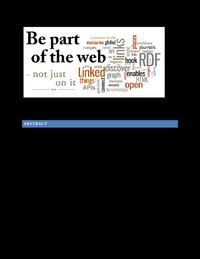
In June 2011, Stanford University hosted a group of librarians and technologists to examine issues and challenges surrounding the use of linked data for library applications. This report summarizes the activities and discussions that took place during the workshop, describes what came out of the workshop, outlines next steps identified by the participants, and provides contextual and background information, including preliminary reports and biographies of workshop participants. The worksho...
Digital Forensics and Born-Digital Content in Cultural Heritage Collections
Dec 2010

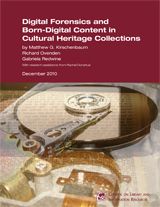
While the purview of digital forensics was once specialized to fields of law enforcement, computer security, and national defense, the increasing ubiquity of computers and electronic devices means that digital forensics is now used in a wide variety of cases and circumstances. Most records today are born digital, and libraries and other collecting institutions increasingly receive computer storage media as part of their acquisition of “papers” from writers, scholars, scientists, musicians,...