
Usage and Usability Assessment: Library Practices and Concerns
Jan 2002

This report offers a survey of the methods that are being deployed at leading digital libraries to assess the use and usability of their online collections and services. Focusing on 24 Digital Library Federation member libraries, the study’s author, Distinguished DLF Fellow Denise Troll Covey, conducted numerous interviews with library professionals who are engaged in assessment.
The report describes the application, strengths, and weaknesses of assessment techniques that include su...
Scholarly Work in the Humanities and the Evolving Information Environment
Dec 2001

As the scholarly information environment changes, so do the needs, expectations, and behaviors of users. Assessing and responding to those changes is essential for the academic library so that it may continue in support of the scholarly mission. The authors of this report have formally examined how humanities scholars conduct and collate their research. The study was based on a small sample of scholars; nonetheless, the results are powerfully suggestive of ways in which academic libraries ...
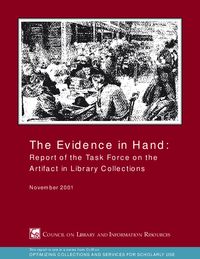
The Evidence in Hand: Report of the Task Force on the Artifact in Library Collections
Nov 2001

Although film and digital technology have made the intellectual content of artifacts far more accessible to researchers, scholars have an abiding interest in consulting the original. Maintaining original artifacts while also providing increased access to surrogates poses new challenges to university and library administrators, who must make difficult choices about how to invest in information resources.
In 1999, CLIR convened a task force of scholars, academic officers, librarians, ...
Proceedings of the 2000 Sino-United States Symposium and Workshop on Library and Information Science Education in the Digital Age. November 5-10, 2000; Wuhan, China.
Sep 2001

This report contains papers presented at the plenary sessions of the 2000 Sino-United States Symposium and Workshop on Library and Information Science Education in the Digital Age held November 5-10, 2000 in Wuhan, China.
The question of how best to train professionals for library and information professions is being debated in many countries. What should these professionals be prepared to do? The very question raises a host of other questions about the future of the information inf...
Strategies for Building Digitized Collections
Sep 2001

In this report, Abby Smith synthesizes the nearly 10 years’ experience that libraries have had digitizing items from their rare, special, and general collections, and making them available online. The learning she uncovers is distilled in and extended by several case studies conducted in leading digital libraries with very different digitization programs. Smith demonstrates that digitization programs work best where their role within a library’s collection development strategy is clearly u...
Building and Sustaining Digital Collections: Models for Libraries and Museums
Aug 2001

In February 2001, the Council on Library and Information Resources (CLIR) and the National Initiative for a Networked Cultural Heritage (NINCH) convened a meeting to discuss how museums and libraries are building digital collections and what business models are available to sustain them. A group of museum and library senior executives met with business and legal experts, technologists, and funders to discuss the challenges that cultural institutions face when putting collections online and...
Selection and Presentation of Commercially Available Electronic Resources: Issues and Practices
Jul 2001

Author Timothy D. Jewell, head of collection management services at the University of Washington, provides an in-depth look at how several research libraries select, license, present, and support the use of commercial online materials. Uncovering a variety of practices, he identifies those that are proving to be most effective integrating commercial online materials into library collections. He includes a decision tool that emphasizes and supports strategic planning, and encourages careful...

Dimension and Use of the Scholarly Information Environment
Jul 2001

The backdrop for this study is that the Digital Library Federation (DLF) has become increasingly concerned by the absence of reliable information with which to document and explain changing patterns of library use in universities and colleges. DLF repeatedly hears from academic library directors that such analyses are vital but missing ingredients of their strategic planning, and of the business case they make to faculty and senior administrators either to win or bolster support for the li...