Capacity Assessment of Latin American and Caribbean Partners: Report of Symposium and Recommendations
Feb 2021

In April 2020, the authors, CLIR fellows in the second cohort of Data Curation for Latin American and Caribbean Studies, virtually convened Capacity Assessment of Latin American and Caribbean Partners: A Symposium about Open Access, Technological Needs, and Institutional Sustainability. The symposium provided a forum for stakeholders from institutions in Latin America and the Caribbean to share strategies for digital archiving and cultural preservation and to identify common areas of need....
The Foundations of Discovery: A Report on the Assessment of the Impacts of the Cataloging Hidden Collections Program, 2008–2019
Sep 2019

From 2008 to 2014, CLIR administered the Cataloging Hidden Special Collections and Archives program, which granted funds to catalog “hidden” collections of high scholarly value. Generously supported by The Andrew W. Mellon Foundation, the program awarded more than $27.4 million to academic, cultural heritage, and other collecting institutions.
To assess the program’s impact, CLIR conducted a comprehensive analysis of final reports from all 128 projects funded through the program. Th...
3D/VR in the Academic Library: Emerging Practices and Trends
Feb 2019

This volume, comprising eight chapters from experts in a variety of fields, examines the use of three-dimensional (3D) and virtual reality (VR) technologies in research and teaching, and the library’s vital role in supporting this work.
3D modeling, 3D capture techniques, and VR enable faculty and students to engage with highly detailed 3D data—from cultural heritage artifacts to scientific simulations—in new ways. As 3D and VR projects scale up and move outside of the specialist di...
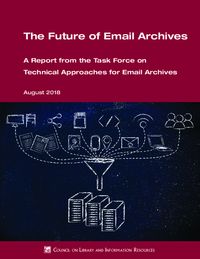
The Future of Email Archives
Aug 2018

Email is an increasingly important part of the historical record, yet it is particularly coverdifficult to preserve, putting future access to this vast resource at risk. The Future of Email Archives looks at what makes email archiving so complex and describes emerging strategies to meet the challenge. The report presents the findings of a yearlong investigation of the Task Force on Technical Approaches for Email Archives, sponsored by The Andrew W. Mellon Foundation and the Digital Preserv...
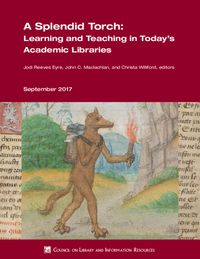
A Splendid Torch: Learning and Teaching in Today’s Academic Libraries
Sep 2017

Six essays, written collaboratively by current and former CLIR postdoctoral fellows, explore the contributions that today’s academic libraries—as providers of resources, professional support, and space—are making to learning and teaching. Topics include the continuing evolution of the learning commons, information literacy instruction, digital humanities teaching in libraries, spatial literacy, collaboration in digital special collections, and 3-D printing and pedagogy.
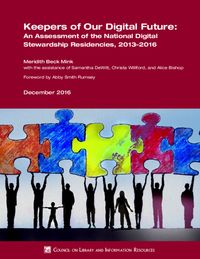
Keepers of Our Digital Future
Dec 2016

In September 2015, IMLS awarded CLIR a grant to investigate the early impacts of the National Digital Stewardship Residency (NDSR) programs, in order to inform subsequent development of similar programs by others with a vested interest in building professional capacity to preserve digital information. Keepers of Our Digital Future provides a formative evaluation of the early residencies, based on surveys and interviews with NDSR participants and supervisors from the Washington, D.C., New Y...
National Institute for Technology in Liberal Education: An Assessment
Aug 2016

The National Institute for Technology in Liberal Education (NITLE) was formed in 2001 to “stimulate collaboration between selected liberal arts colleges and to act as a catalyst for the effective integration of emerging and newer digital technologies into teaching, learning, scholarship, and information management.” In July 2015, NITLE migrated its operations from Southwestern University to CLIR. In conjunction with this migration, CLIR initiated a rigorous analysis of NITLE’s current cond...
The Open Data Imperative: How the Cultural Heritage Community Can Address the Federal Mandate
Jul 2016

New U.S. government requirements for exposing and managing federally funded research data add urgency to the call for curating data that can be used, reused, and exploited by future generations.
The Open Data Imperative: How the Cultural Heritage Community Can Address the Federal Mandate, offers a series of recommendations to improve the open data infrastructure, engage a broad community of stakeholders to support the management of data as an asset, and expand collaboration that is ...
Terra Cognita: Graduate Students in the Archives, A Retrospective on the CLIR Mellon Fellowships for Dissertation Research in Original Sources
May 2016

Terra Cognita surveys the current landscape of archival research and the experiences of emerging scholars seeking to navigate it. Drawing on data from CLIR’s Mellon Fellowships for Dissertation Research in Original Sources, the report takes an in-depth look at how the conditions and practices of original source research have changed in recent decades and what communities invested in cultural heritage research can do to better support new scholarship in this evolving context. Part one of th...
Innovation, Collaboration and Models
Nov 2015

This volume documents the capstone event to the seven-year Cataloging Hidden Special Collections and Archives program, funded by The Andrew W. Mellon Foundation. The two-day symposium and unconference brought together more than 180 participants, including many past and current grant recipients. In the proceedings, more than 20 symposium presenters examine inter-institutional collaboration, student and faculty involvement, cataloging, ar...
Building Expertise to Support Digital Scholarship: A Global Perspective
Oct 2015

This report sheds light on the expertise required to support a robust and sustainable digital scholarship (DS) program. It focuses first on defining and describing the key domain knowledge, skills, competencies, and mindsets at some of the world’s most prominent digital scholarship programs. It then identifies the main strategies used to build this expertise, both formally and informally. The work is set in a global context, examining leading digital scholarship organizations in China, Ind...
The Process of Discovery: The CLIR Postdoctoral Fellowship Program and the Future of the Academy
Jul 2015

This volume celebrates the first decade of CLIR’s Postdoctoral Fellowship Program by bringing together 20 past and present CLIR postdoctoral fellows to share their thoughts on their experiences and, more broadly, on the direction of academia. Each essay is a look into the working conditions associated with creating a new profession of expertise and responsibilities in response to emerging forms of scholarly communication and pedagogy....
The Once and Future Publishing Library
Jul 2015

The report explores the revitalization of library publishing and its possible future, and examines elements that influence the success and sustainability of library publishing initiatives.
The authors trace the history of library publishing and factors that have transformed the publishing landscape, and describe several significant library-press collaborations forged over the past two decades. Authors include results of a survey they conducted to better understand how current librar...
Getting Found: SEO Cookbook
At a time when Internet search engines have become the default discovery layer for most users, libraries need to report that their websites and digital repositories are discoverable through those search engines as well. The Getting Found (GF) Cookbook provides a step-by-step video guide to help libraries measure and monitor the search engine optimization (SEO) performance of their digital repositories. The Cookbook includes everything necessary to implement a preconfigured Google Analytics...
ARSC Guide to Audio Preservation
May 2015

Commissioned for and sponsored by the National Recording Preservation Board of the Library of Congress. Copublished by the Association for Recorded Sound Collections, the Council on Library and Information Resources, and The Library of Congress
The ARSC Guide to Audio Preservation is a practical introduction to caring for and preserving audio collections. It is aimed at individuals and institutions that have recorded sound collections but lack the expertise in one or more areas to p...